REVIEW · BERLIN
Charité Hospital Walking Tour: Exploring Berlin’s Medical History
Book on Viator →Operated by Beyond and Beneath Tours · Bookable on Viator
Berlin’s medical past still shows on the street. This Charité Hospital walking tour turns monuments into a clear story about how medicine changed, for better and worse. You get small-group context as you move between major names tied to breakthroughs, experiments, and public health debates.
I especially like how the guide connects what you see to the real world of patients, outbreaks, and ethics. Second, the route is tight and doable: about two hours with six outdoor stops, so you can fit it even when your Berlin schedule is packed.
One thing to note: this tour focuses on exterior sites and doesn’t include visits to buildings where clinical or university operations are happening, so it is not a behind-the-scenes hospital walkthrough.
In This Review
- Key things that make this Charité tour worth your time
- A 2-hour Charité Hospital walking tour that reads like a case study
- Getting there: Robert-Koch-Platz start and a canal-side end point
- Stop 1: Robert-Koch Denkmal and the shadow side of breakthroughs
- Stop 2: Tieranatomisches Theater and animal disease study before modern science
- Stop 3: Rudolf Virchow’s Denkmal and why pathology changed everything
- Stop 4: Albrecht von Graefe and the shift toward focused medical specialties
- Stop 5: Charité Campus Mitte and the ethics you can’t ignore
- Stop 6: Design Offices Berlin Humboldthafen and the canal escape story
- Why this tour feels like good value for $30.12
- Who should book this Charité Hospital walking tour
- Should you book Charité Hospital Walking Tour?
- FAQ
- How long is the Charité Hospital walking tour?
- What does the tour cost?
- Is the tour offered in English?
- How large is the group?
- Where does the tour start and end?
- Does the tour include visits to active hospital or university clinical areas?
- Do you need to buy admission tickets for the stops?
- What if weather is bad or you need to cancel?
Key things that make this Charité tour worth your time
- Small group (max 15) keeps questions easy while you walk
- English guide + mobile ticket makes it simple to show up and go
- Monuments to major medical figures with straight talk about what they did
- Charité Campus Mitte history includes both scientific progress and medical abuse
- Canal-side escape stories add a human layer from the socialist and post–Wall era
- About 2 hours makes it a good choice for travelers short on time
A 2-hour Charité Hospital walking tour that reads like a case study
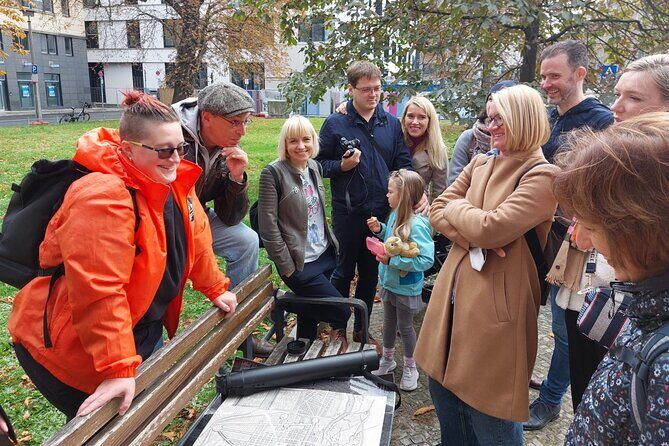
If you think Berlin’s history lives only in palaces and memorials, this walk proves otherwise. The focus is medicine, but not in a dusty way. You’re looking at statues and academic buildings while your guide explains why certain breakthroughs happened, why they were controversial, and what the costs were for real people.
At $30.12 per person for roughly two hours, the value comes from the guide’s storytelling more than from any one building. Every stop is free to view, and the tour structure keeps you moving. That matters because you’re not paying for entry fees into active hospital spaces that you still wouldn’t be able to tour fully.
The best part is how it links science to society. You end up understanding medicine as something shaped by politics, funding, and fear—plus the courage of public health thinking when it works.
You can also read our reviews of more walking tours in Berlin



Getting there: Robert-Koch-Platz start and a canal-side end point
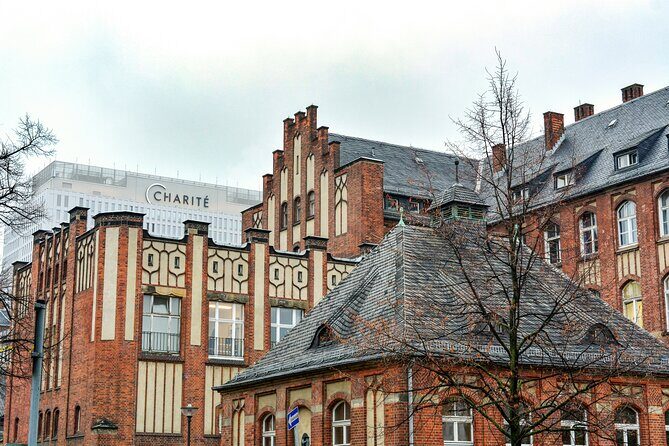
You’ll start at Robert-Koch-Platz, 10115 Berlin, and finish at Alexanderufer, 10117 Berlin. The end point is by the Humboldthafen canal, a helpful detail because it’s close to the Berlin Central Station area. In practical terms, you can build this into a day around transit instead of treating it like a separate mission.
This is also a “show up and walk” style tour. You’ll use a mobile ticket, and it’s offered in English. Service animals are allowed, and it’s near public transportation, so you’re not stuck figuring out a complicated last-mile route.
Finally, the tour runs best with good weather. It’s not a weatherproof indoor series, so if Berlin is doing Berlin (wind, rain, weird skies), plan to keep an eye on conditions so you don’t get caught unprepared.
Stop 1: Robert-Koch Denkmal and the shadow side of breakthroughs
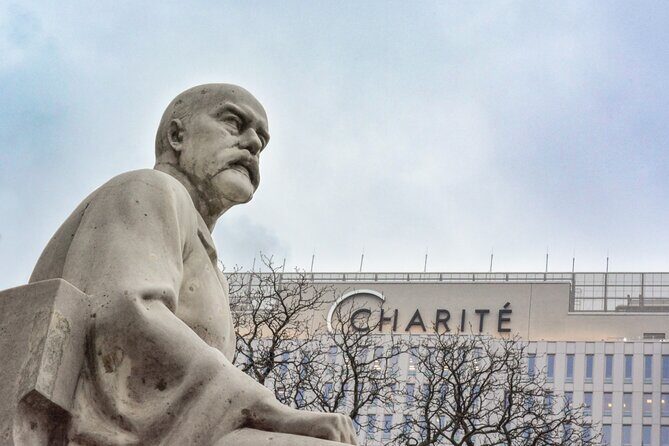
The walk begins at the Robert-Koch Denkmal, where the story stretches back to why Charité (Berlin’s oldest hospital) was established in the 18th century. This is your first clue that medicine here isn’t just modern hospitals and MRI scans. It’s institutions built to respond to outbreaks, plus a history of experiments and scandals that shaped public trust.
Robert Koch is the headline name. Your guide ties him to the Nobel Prize-winning work that helped identify the causes of tuberculosis, anthrax, and cholera. That’s the scientific headline—and then the tour turns to the messy part of medical history. You also hear about an early pharmaceutical scandal tied to his era, which helps you understand that wrongdoing in healthcare is not a new problem.
What I like about this first stop is pacing. It sets the theme without getting lost in facts. You get a sense of the medical “why” before the tour starts moving through other monuments.
Possible drawback: if you’re expecting museum-style deep interior interpretation at every step, this part may feel more statue-and-story than hands-on. Still, it’s a strong foundation.
Stop 2: Tieranatomisches Theater and animal disease study before modern science
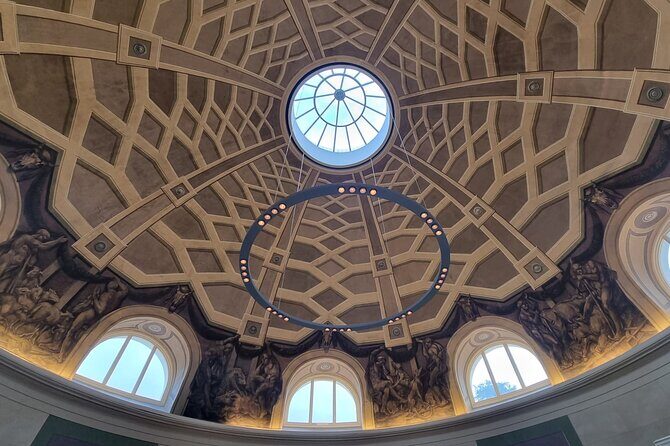
Next is the Tieranatomisches Theater, described as the oldest surviving academic building in Berlin. It’s an 18th-century neoclassical structure, and the guide uses it to show what veterinary medicine looked like before the tools and methods we now take for granted.
The key idea here is that animal disease study mattered long before it had today’s labels. Your guide talks about how veterinarians studied animal illnesses and what “treatment” meant in a world where science wasn’t yet organized the way we expect now.
Even if you’re not a science person, this stop helps you see how research ecosystems form. People build institutions. They train specialists. They preserve buildings. And those academic spaces become the infrastructure for later discoveries.
A practical tip: because this stop is outdoors and time is limited (about 20 minutes), watch for the guide’s cues about what to look at on the building itself. It helps you connect the architecture to the story instead of just admiring the façade.
Stop 3: Rudolf Virchow’s Denkmal and why pathology changed everything

The Denkmal Rudolf Virchow is short in time but big in meaning. You’ll hear why Virchow is often linked to modern pathology—thinking that disease isn’t just a vague problem, but something you can study through the body’s changes.
Your guide also brings in Virchow’s role in social medicine. That’s important, because it turns the tour from “medical heroes” into a more realistic view of public health. Medicine doesn’t happen only in laboratories. It happens in housing, nutrition, sanitation, and access—things that governments can influence.
This stop is where the tour feels most relevant to today. Once you understand the link between pathology and society, you start noticing how current public health debates echo older concerns: who gets care, how outbreaks spread, and what policies protect people.
If you’re the type who likes big ideas explained plainly, this is a great moment to pay close attention.
You can also read our reviews of more historical tours in Berlin






Stop 4: Albrecht von Graefe and the shift toward focused medical specialties
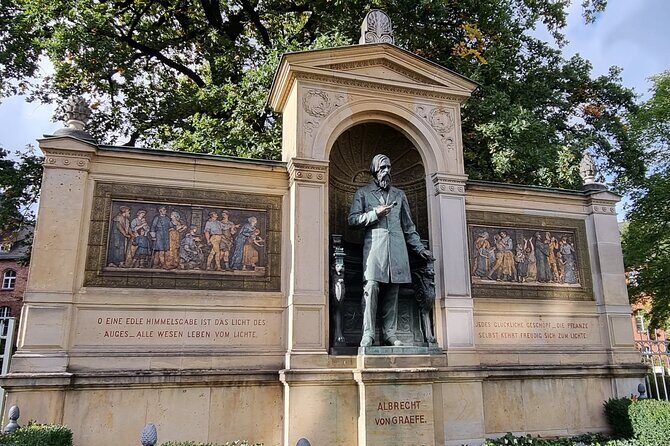
At the Denkmal Albrecht von Graefe, the tour moves into ophthalmology. Graefe was a groundbreaking ophthalmologist, and the guide uses the monument to show how medical specialties grew into organized disciplines.
This stop works well after Virchow because it changes the angle. Instead of focusing on how disease is understood, you also learn how knowledge becomes targeted treatment. Eye medicine, for example, requires precision and repeatable methods—so it helped push medical thinking toward more systematic approaches.
You’ll probably leave this part noticing a pattern: the tour keeps connecting individual scientists to larger structures. Charité wasn’t just a building. It was a place where training, research, and care evolved together.
Drawback to consider: the tour doesn’t linger. It’s designed to stay short, so if you love one specific field (like eyes, pathology, or outbreaks), you may wish you had extra time afterward to follow up on your favorite topic independently.
Stop 5: Charité Campus Mitte and the ethics you can’t ignore

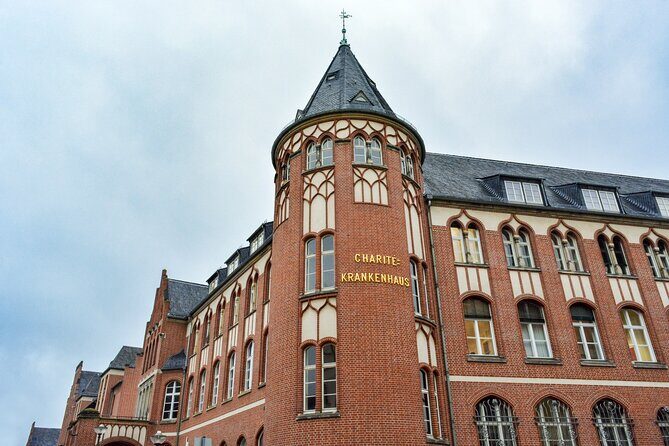
Now you get to Charité Campus Mitte, a striking neogothic red-brick campus. The architecture alone gives you a sense of permanence—these buildings were meant to last and to keep doing important work.
But the story here turns heavier. Your guide explains how some doctors abused medicine during the Third Reich, while others helped people more indiscriminately until the last days of WWII. That contrast is not a small detail. It’s the point.
This stop forces you to confront a hard truth: the “science” part of medicine and the “ethics” part of medicine can break apart. Institutions can produce discoveries and still be used for harm. And the same systems that support healing can be bent toward control.
I like that the tour doesn’t sanitize the story. It gives you a lens for evaluating medical institutions today: who benefits, who is protected, and what safeguards exist when power meets medicine.
If you’re sensitive to dark history, expect this to be the emotional weight of the tour. It’s still presented in a guided, structured way within a short time window.
Stop 6: Design Offices Berlin Humboldthafen and the canal escape story
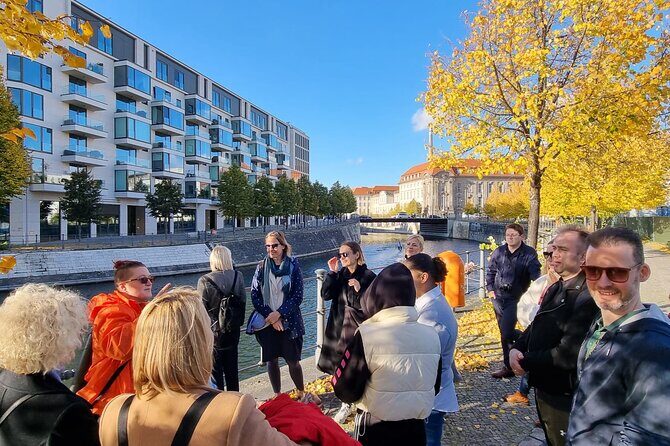
The final stop is by Design Offices Berlin Humboldthafen, outside the Charité campus area near the city canal. Here, the guide shifts from scientific names to human stakes in a divided city.
You’ll hear about escape attempts by East Berliners who tried to reach the West by swimming across the city canal near the Charité area. That story adds immediate tension and stakes to what might otherwise feel like a calm architectural setting.
Then the guide connects it to hospital life during the socialist era and after the fall of the Berlin Wall. The theme is continuity and change: medicine in a political system is shaped by the system’s rules, shortages, permissions, and priorities.
This last section is also a nice way to close the loop. The tour began with outbreaks and scientific breakthroughs; it ends by reminding you that medicine always sits inside a society with rules and pressures.
Practical note: since this is the end point, it’s a good moment to check your onward transit while the guide’s route is still fresh in your mind.
Why this tour feels like good value for $30.12
Let’s talk value without hype. You’re paying for:
- a guided walk with context rather than a self-guided stroll
- a compact route that covers multiple key sites in about two hours
- free access to the outdoor stops you’re viewing
- English language interpretation
- a maximum group size of 15, which tends to make the experience feel less rushed
At $30.12, you’re not trying to “buy” expensive entrances. You’re buying meaning—someone to connect Robert Koch, Rudolf Virchow, and Albrecht von Graefe into a coherent story about how medical thinking and medical ethics evolve.
And the time factor matters. If you’re sightseeing in Berlin for only a few days, this kind of short focused tour can be a smart anchor. It gives you a theme you can carry into other stops, like memorials, science institutions, or neighborhoods tied to modern German history.
Also, the tour’s structure is friendly if your day already includes museums. You’re not signing up for a half-day commitment, and you’re not waiting around in lines for indoor tickets.
Who should book this Charité Hospital walking tour
This tour is a good fit if you:
- want a medical history tour that stays understandable
- enjoy stories that connect science to society and ethics
- prefer a short walking format over long museum days
- like learning from a guide who tells stories clearly while you move between locations
It’s less ideal if you:
- specifically want to enter active hospital wards or university clinical spaces (those building visits are not included)
- need a fully indoor experience regardless of weather
- plan to use the tour as a deep scientific lecture series (it’s guided, but it stays compact)
In short: it’s built for travelers who want context fast, without sacrificing substance.
Should you book Charité Hospital Walking Tour?
I’d book it if you want a focused, well-priced walk that uses real Berlin landmarks to explain how medicine developed—and how it sometimes failed people. The small group size and short duration make it easy to slot into a busy itinerary. And the mix of major scientific names with the darker ethical chapters makes the tour feel honest, not just celebratory.
Skip it only if you’re mainly interested in going inside hospital operations or if you can’t handle history that includes medical abuse. Otherwise, this is a strong way to see Charité’s legacy in a way that sticks.
FAQ
How long is the Charité Hospital walking tour?
It runs for about 2 hours.
What does the tour cost?
The price is $30.12 per person.
Is the tour offered in English?
Yes, it is offered in English.
How large is the group?
The tour has a maximum of 15 travelers.
Where does the tour start and end?
It starts at Robert-Koch-Platz, 10115 Berlin and ends at Alexanderufer, 10117 Berlin. It’s near the Humboldthafen canal and about a 10-minute walk from Berlin Central Station.
Does the tour include visits to active hospital or university clinical areas?
No. Visiting buildings where clinical or university operations take place is not included.
Do you need to buy admission tickets for the stops?
The stops highlighted on the tour are admission ticket free.
What if weather is bad or you need to cancel?
The tour requires good weather. If it’s canceled due to poor weather, you’ll be offered a different date or a full refund. You can also cancel for free up to 24 hours in advance for a full refund.