REVIEW · BERLIN
Berlin & The Third Reich Private Guided Tour
Book on Viator →Operated by Private Tours Berlin · Bookable on Viator
Berlin has scars you can still see. What makes this tour stand out is how it connects them into a clear story, starting with the streets of Hitler’s rise and ending with the final collapse in 1945. I liked the private pacing and the way my guide turned recognizable landmarks into specific moments in the timeline. I also liked that you hit major sites without constant museum-hunting. One thing to consider: this route covers brutally heavy topics, including the Holocaust and Hitler’s end, so you may want to mentally slow down.
In my experience, the best part is the straight talk from guides like Walid, Campbell, and Gregor—names you might see depending on your group. They don’t just point out buildings; they explain why those spots mattered, then help you see the city differently the moment you walk away. The tour runs about 4 hours, and it’s built for a small group with pickup offered and a mobile ticket for ease.
In This Review
- Key highlights at a glance
- A 4-hour private walk through Hitler’s rise and fall
- Pariser Platz, Unter den Linden, and why the Reichstag feels different after the story
- Brandenburg Gate: from royal entrance to a reunified Germany symbol
- The Holocaust Memorial: where you slow down and let the space do the work
- The Führerbunker sign and Potsdamer Platz’s ruin-and-rebuild contrast
- Checkpoint Charlie: seeing Cold War boundaries in plain view
- Price and group size: is $329.92 good value?
- Pickup, mobile tickets, and the practical stuff that makes it smoother
- Who should book this Berlin Third Reich tour, and who might want a different plan
- Should you book this Berlin & The Third Reich Private Guided Tour?
- FAQ
- How long is the Berlin & The Third Reich private guided tour?
- What does the tour cost?
- Where does the tour start and end?
- Is this a private tour?
- Are there admission fees for the stops?
- Is pickup and a mobile ticket included?
Key highlights at a glance
- A clear Nazi-era storyline across real locations, not a generic lecture
- Stops chosen for cause-and-effect, from propaganda power to wartime damage
- Reichstag context tied to the fire and the later glass dome by Sir Norman Foster
- The Holocaust Memorial handled as a moment to pause and absorb
- Führerbunker at its current site, now marked simply and quietly
- Cold War boundary reminders at Checkpoint Charlie’s role between Americans and Soviets
A 4-hour private walk through Hitler’s rise and fall
This is not the kind of Berlin tour where you hop from one famous photo spot to the next. It’s a connected route built around a timeline: how the Nazi movement gained power, how it operated, and how it finally fell in 1945. That structure helps your brain file the city away in order, instead of collecting facts like postcards.
You’ll be walking Berlin in a focused window of about four hours. That matters because you’re not dragging the story across the whole city all day. Instead, you get enough time to ask questions, and enough space between stops to let the meaning land.
The private format is also a big deal. With up to 15 people per group, you’re more likely to get a conversation than a one-way performance. And if you’re traveling with a partner or small group, this setup is a strong way to cover a serious theme without feeling rushed or crowded.
You can also read our reviews of more guided tours in Berlin



Pariser Platz, Unter den Linden, and why the Reichstag feels different after the story
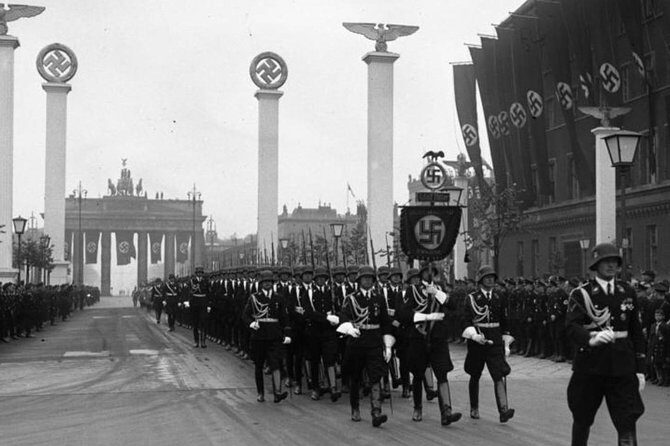
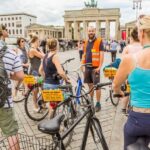
The tour starts at Pariser Platz, right by Berlin’s most prestigious square and at the end of Unter den Linden. This is your first “you are here” moment. You also get positioned for what comes next: the Brandenburg Gate area and the German Parliament zone.
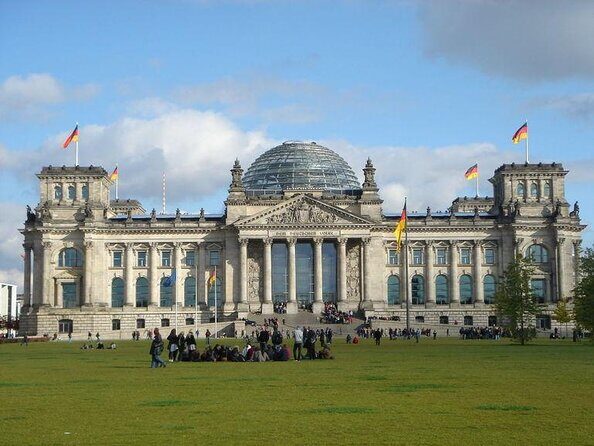
From there, you move to the Reichstag Building. It’s famous on paper, but the tour’s framing changes how you read it. You learn why the Reichstag fire became a turning point that enabled Hitler to take total control. In other words, it’s not just a dramatic headline; it becomes part of how power was consolidated.
Then there’s the architectural layer. The Reichstag is topped with a glass copula designed by British architect Sir Norman Foster. So you’re standing at a site that went through fire, politics, and war damage—and then later transformation. It’s the kind of contrast Berlin does well: layers on layers. You can appreciate the design more when you understand what the building represented before it was “beautiful again.”
A practical note: this part of the route is concentrated, so wear comfortable shoes. You’ll likely be standing still often—your guide will point, explain, and ask you to look again.
Brandenburg Gate: from royal entrance to a reunified Germany symbol
Next up is the Brandenburg Gate, the royal entrance associated with the Hohenzollern family and one of 18 former city gates. Even if you’ve seen photos, it hits harder when you understand what it survived.
Here, the tour brings in three big eras:
- It survived Napoleon.
- It survived World War II.
- Then it was trapped in the middle of the Berlin Wall for almost 30 years.
That “stuck in the middle” detail matters. The gate wasn’t only architecture; it became geography. It turned into a marker for division, then later—once Berlin reunited—something like a shared symbol of a country that moved on.
In a good guided walk, you stop looking for the perfect angle for a photo and start looking for the meaning of the angle. You’ll likely notice how the gate sits in the city’s lines and corridors, and how those lines connect to the broader story you’ve been hearing since Pariser Platz.
The Holocaust Memorial: where you slow down and let the space do the work
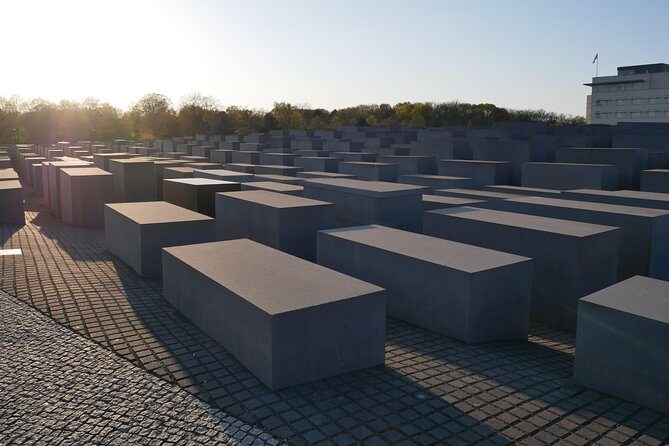
After the major political landmarks, the tour turns toward the Holocaust Memorial, formally the Memorial to the Murdered Jews of Europe. It’s a massive field covered with stone stelae, and it serves as a central Germany memorial to Jewish victims of the Holocaust.
This is one stop where the guide’s job isn’t to entertain you. It’s to help you absorb. The layout encourages you to move carefully, but also to stop thinking like a sightseeing machine. The stelae create a sense of enclosure and disorientation. You don’t need extra theatrics. The environment already communicates gravity.
If you tend to rush, this is a place to resist that habit. Plan to spend a real chunk of attention here—about 20 minutes on this tour. In a route full of political power and wartime sites, this stop gives the story its moral center.
Also: this memorial can feel emotionally heavy in a way that’s different from hearing about battles. If you’re traveling with kids or with anyone who gets overwhelmed easily, consider whether this stop will feel appropriate for their comfort level.
The Führerbunker sign and Potsdamer Platz’s ruin-and-rebuild contrast
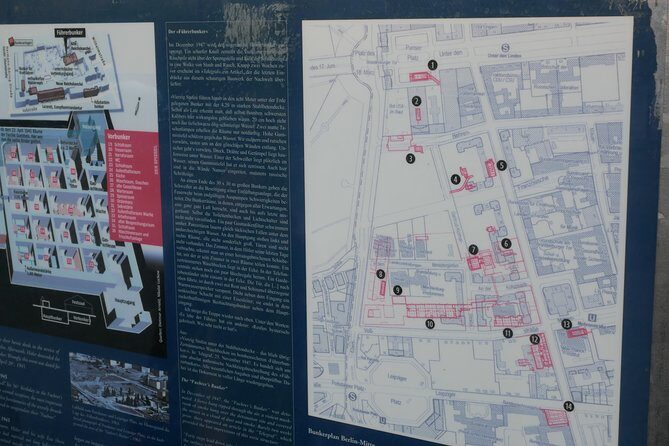
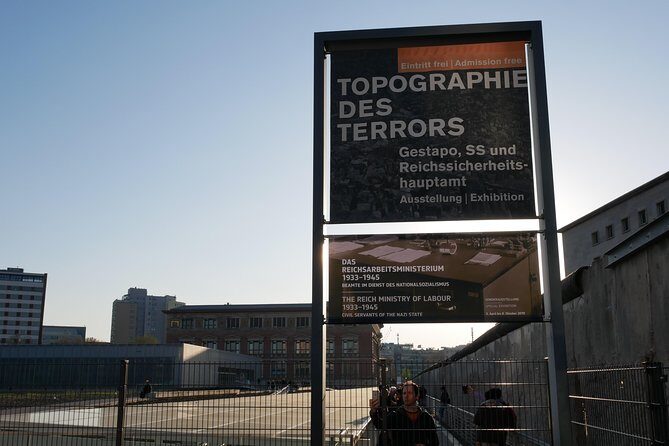
The tour then goes to the Fuhrerbunker site. Today it’s essentially a parking lot with a simple sign. That detail is powerful. The place where Hitler spent his final days—where he married and later committed suicide during the final days of WWII in Europe—is no longer marked like a grand museum.
Because of that, the guide’s context becomes everything. You’re standing on ordinary ground while discussing extraordinary events. It can feel unsettling, and that’s part of the point: history doesn’t always preserve itself in dramatic forms. Sometimes it hides in plain sight.
From there, you head to Potsdamer Platz. In the 1920s, it was one of the busiest traffic intersections in Europe. Then WWII destroyed it almost completely. Later, in the 1990s and early 2000s, it was rebuilt as Berlin’s most modern precinct.
That creates a sharp emotional contrast. You go from a site associated with the end of a tyrant’s life, to a place that illustrates what rebuilding looks like—how a city can re-form itself once the damage is done. It doesn’t erase what happened. It just shows how cities keep moving.
This stop is short on the schedule (around 10 minutes), so don’t expect a deep architecture lesson. Instead, expect a quick read of transformation: what was lost, what returned, and what modern Berlin chooses to emphasize.
You can also read our reviews of more private tours in Berlin


Checkpoint Charlie: seeing Cold War boundaries in plain view
The last major stop is Checkpoint Charlie. This is one of Berlin’s most famous Cold War symbols, and the tour explains why: it was a frontline checkpoint manned by the Americans and Soviets.
What I like about including this stop at the end is that it expands the timeframe. You’re not only ending with 1945. You’re also stepping into what came after, when Berlin became a stage for a new kind of division.
Even if the area is crowded or touristy on your own time, a guide helps you read it differently. The key lesson here is that checkpoints weren’t just plot points. They were practical boundaries—real rules about who could cross, and real power in controlling movement.
The tour keeps it concise (about 10 minutes), which works. You’ll leave with the basic meaning, then you can decide if you want to wander the surrounding streets on your own.
Price and group size: is $329.92 good value?
The price is $329.92 per group, up to 15 people, for an approximately 4-hour private guided tour. So the value depends on your group size.
If you’re traveling as a couple or small family, you’re paying as one group, not per person. That can make it more affordable than you might expect, especially compared to doing separate paid tours or paying multiple entry fees. Also, the tour schedule is tight and focused, with admission listed as free for all the featured stops. That keeps your total costs under control.
If you’re a bigger group up to 15, you’re likely getting a strong per-person deal because the guide is handling the entire route while you share the cost.
One more value point: this tour is designed around walking time in a compact area. You’re not paying for long transit breaks across Berlin, which is how many themed tours quietly inflate their cost in practice.
Pickup, mobile tickets, and the practical stuff that makes it smoother
This tour includes pickup offered and a mobile ticket. Pickup matters if you want to start quickly without spending time figuring out exact meeting logistics on your own. A mobile ticket is also just easier on the day.
Your starting and ending point is Brandenburg Gate, specifically Pariser Platz (10117 Berlin). That’s convenient because it’s a well-known location and easy to align with other Berlin plans.
Also, all stops are listed with admission as free. That means you’re not stacking paid entries into the day. You do want to stay aware that even with free access, you may still face crowds or normal street-level constraints.
The tour is private, meaning only your group participates. And it’s near public transportation, which helps if you don’t use pickup or if you want to catch a tram or train after.
Who should book this Berlin Third Reich tour, and who might want a different plan
This is a great fit if:
- You want a guided timeline of Nazi power across major real-world sites.
- You like history that connects politics, architecture, and city geography.
- You prefer private conversation over crowded group tours.
It may not be ideal if:
- You strongly dislike heavy subjects. The Holocaust Memorial and Führerbunker stop are essential parts of the story here.
- You’re looking for a lighter sightseeing day with minimal emotional weight.
Because it covers major national history points in a short walking window, it works best as a cornerstone experience. If you’re spending several days in Berlin, this is the kind of tour that makes later independent walking make more sense.
Should you book this Berlin & The Third Reich Private Guided Tour?
If you’re ready to trade random sightseeing for a structured, serious walk, I’d book it. This tour gives you a clear narrative arc and uses the city itself—Pariser Platz, the Reichstag context, the Brandenburg Gate through division and reunification, the Holocaust Memorial, the quiet sign at the Fuhrerbunker site, Potsdamer Platz’s rise-from-ruins story, and Checkpoint Charlie’s Cold War boundary—to help you see how Berlin changed across decades.
My only caution is emotional pacing. You’ll want a mindset of respectful attention, not quick photo stops at every corner.
And if you care about value: at $329.92 per group with free admission at the featured stops, it can be a smart way to spend money on guidance rather than fees. Just make sure your travel schedule has room for a reflective day.
FAQ
How long is the Berlin & The Third Reich private guided tour?
It lasts about 4 hours.
What does the tour cost?
It costs $329.92 per group (up to 15 people).
Where does the tour start and end?
It starts at Pariser Platz near the Brandenburg Gate and ends back at the same meeting point.
Is this a private tour?
Yes. It is private, and only your group will participate.
Are there admission fees for the stops?
The listed stops are marked as admission ticket free.
Is pickup and a mobile ticket included?
Pickup is offered, and you’ll receive a mobile ticket. Confirmation is received at the time of booking.