REVIEW · BERLIN
Berlin Highlights in 2 Hours: Express Walking Tour
Book on Viator →Operated by Original Berlin Walks · Bookable on Viator
Two hours. One brutally honest Berlin. This express walking tour strings together central landmarks that explain how Germany remembers its worst chapters while showing the power of the city’s Cold War era.
I love the time-saving 2-hour format, and I love that the route is built around meaning, not just landmarks.
One drawback to consider: the pace is quick, so if you like to read every plaque or stop for lots of photos, you may feel rushed.
In This Review
- Key highlights you’ll feel right away
- How the 2-hour walking pace keeps Berlin from feeling like homework
- Brandenburg Gate to Pariser Platz: where Berlin looks calm and carries weight
- The Reichstag and the shift from government to consequences
- Remembering the Sinti and Roma victims: a memorial you’re meant to slow down for
- The Holocaust Memorial: how to walk the space without turning it into sightseeing
- Fuhrerbunker: facing the last days of WWII without sensationalism
- Aviation ministry site: Nazi-era architecture, East German use, and today’s Federal Ministry of Finance
- The Berlin Wall section at Niederkirchnerstraße: escape attempts with real stakes
- Topography of Terror and Checkpoint Charlie: the Cold War finale in two steps
- Price and value: why $21.77 can be a smart move
- Who should book this express walk, and who might skip it
- Should you book Berlin Highlights in 2 Hours: Express Walking Tour?
- FAQ
- FAQ
- Is this tour offered in English?
- How long is the Berlin Highlights in 2 Hours walking tour?
- Where does the tour start and end?
- How much does it cost?
- Are the stops included in the tour free to enter?
- Do I need a physical ticket?
- What group size should I expect?
- Is confirmation provided after booking?
- Is the tour near public transportation?
- Is there free cancellation?
- Are service animals allowed?
Key highlights you’ll feel right away
- Free, major stops: Every featured stop is listed as free to enter.
- Tight route, lots of context: You connect Cold War, WWII, and remembrance themes in one walk.
- Small-group cap: The tour limits group size to 25, which usually keeps things conversational.
- Guide-led storytelling: People highlighted guides like Ryan, Gregor, Dylan, and Giles for clear explanations and good pacing.
- Works well for first-time Berlin days: You finish near Checkpoint Charlie, so you can keep exploring right after.
- Accessible by transit: The start and end points are in central areas with nearby public transportation.
How the 2-hour walking pace keeps Berlin from feeling like homework
This is designed for a short window. The promise is simple: hit the key sights, get the context, and still leave you enough energy to roam afterward on your own.
In practice, you’re walking between landmark clusters in central Berlin, spending about 10 minutes at each stop. That means you won’t get long museum-style pacing. Instead, you get guide narration plus quick orientation: what you’re seeing, why it matters, and what to notice next.
The biggest win for me is that you can use this as a starter course. If you’re the type who wants a guided backbone before you start wandering, the timing works well. If you already know Berlin deeply and want long time at memorials, you might prefer a slower, more focused tour.
Also, the fact it’s offered in English and uses a mobile ticket keeps friction low. And it’s capped at 25 people, which helps the guide keep questions moving.
You can also read our reviews of more walking tours in Berlin



Brandenburg Gate to Pariser Platz: where Berlin looks calm and carries weight

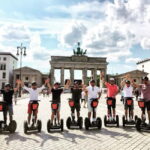
You begin at Brandenburger Tor, the big symbol most visitors can spot right away. The tour then moves along Pariser Platz, where the architecture creates that grand, official feel that Berlin does so well.
Here’s what’s useful about this opening: it gives you a “stage.” You’re not just looking at a postcard monument. Your guide frames it as a place tied to ideas of unity and peace, which makes the later stops hit harder. It’s a smart way to start, because Berlin’s meaning shifts fast as you move through space.
Potential drawback: if it’s crowded (common around this area), your 10-minute window can feel shorter than you expect. If you want photos without people in the frame, pick a slightly off-peak time if you can.
The Reichstag and the shift from government to consequences
Next up is the Reichstag building. Even from the outside, it’s hard not to think about what power looks like when politics goes wrong. The tour connects what the building represents over time, from Germany’s early democratic era through later developments up to the present day.
Why this stop matters on an express tour: it bridges the gap between “place” and “systems.” You don’t only learn dates. You start understanding how institutions shape outcomes, and how the same physical spaces can hold radically different meanings across decades.
If you’re a history fan, you’ll likely like the way your guide can turn architecture into explanation. Guides like Ryan and Giles were specifically praised for being engaging and responsive to questions, which helps if you want extra clarity while you stand in front of the building.
Remembering the Sinti and Roma victims: a memorial you’re meant to slow down for
Then you move to the Memorial to the Sinti and Roma Victims of National Socialism. This is one of those stops that can feel emotionally heavy even when you’re only there briefly.
On a 2-hour tour, the challenge is obvious: you don’t get long. But the value is also obvious: you don’t skip it. A well-run guide helps you understand what the memorial represents and why remembering these victims is essential, not optional.
One practical tip: even if the stop is short, take a moment to look. Don’t treat it like another photo stop. The guide’s job here is to give context quickly, but your job is to let it land.
The Holocaust Memorial: how to walk the space without turning it into sightseeing
From there, you go to the Memorial to the Murdered Jews of Europe. The setting is haunting in a way that’s hard to explain until you’re standing among the concrete slabs.
Your guide’s role matters a lot at this stop. Without context, it’s easy to reduce the experience to atmosphere. With context, it becomes a guided reminder of scale, system, and loss. This is the kind of place where the difference between a good and a great guide shows fast.
People have highlighted that guides like Gregor bring meaning to what you see, and that fits this stop perfectly. The best tours here don’t rush you. They frame what you’re walking through so you understand why it was designed this way.
Still, consider your own comfort level. If you prefer very slow time in memorial spaces, an express tour might feel too quick. But if you want to make sure you hit it at all, this route is strong.
A few more Berlin tours and experiences worth a look


Fuhrerbunker: facing the last days of WWII without sensationalism
Next is the Fuhrerbunker area, where the tour explains the final days of World War II, including Hitler’s suicide on April 30, 1945, and how Germany today confronts and reflects on that past.
This stop is powerful because it keeps things grounded. The aim isn’t shock. It’s understanding how collapse looked from inside a regime that had already made catastrophic decisions.
The practical side: the tour’s short timing means you get the key story beats, not a long interpretive lecture. That can be a plus if you’re pairing this with another plan later. It can also be a minus if you wanted deeper detail about the bunker’s history.
If you like asking questions, this is a good moment to do it. A few guides in the feedback you provided were praised for answering questions clearly, which helps when topics are complex.
Aviation ministry site: Nazi-era architecture, East German use, and today’s Federal Ministry of Finance
The walk continues to the former Reich Air Ministry and Luftwaffe headquarters area. The tour connects what it represented during the Nazi era, how it was later used by East Germany’s government, and its current function in Berlin’s government landscape, now home to the Federal Ministry of Finance.
This is one of the most interesting “architecture with layers” stops on the route. You’re seeing how buildings outlive the regimes they were built for. The same stone and shape can become a different message depending on who’s using it and how the public understands it.
What to watch for: look at how grand government space can be repurposed. Even when the exterior looks formal and calm, the tour points out the historical weight behind it.
The Berlin Wall section at Niederkirchnerstraße: escape attempts with real stakes
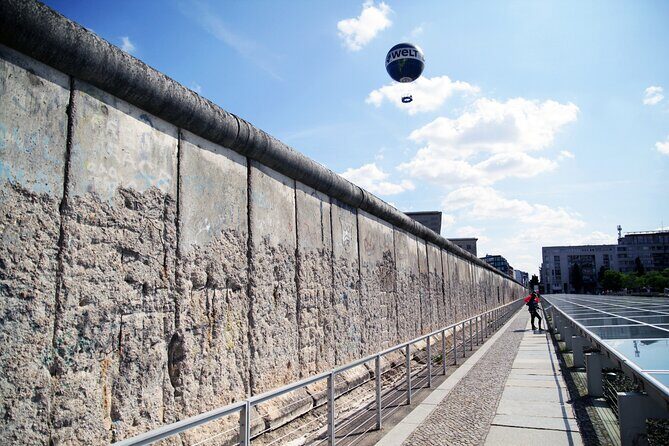
After that, you reach Niederkirchnerstraße, where you can see a preserved section of the Berlin Wall. Your guide describes daring escape attempts, including both successes and tragic failures, and you get a sense of day-to-day life in divided Berlin on both sides.
This is the stop that turns history into human scale fast. The Wall isn’t just a barrier you can photograph. It’s a lens into risk, fear, hope, and control.
The drawback is also part of the deal: you only get a short window. If you want names, stories, and deeper background, plan to continue reading on your own afterward or pair the tour with another Berlin Cold War-focused visit.
If you’re the type who loves “what it must have felt like,” this is a strong match. Guides like Dylan were praised for answering questions and keeping the pace appropriate for mixed ages, which tends to work well when the material is emotionally intense.
Topography of Terror and Checkpoint Charlie: the Cold War finale in two steps
Your final stretches bring you to two iconic Cold War-era places.
First, Topography of Terror, the site of Nazi Germany’s SS, Gestapo, and SD headquarters. Today it’s the location of the Topography of Terror exhibition. Even if you don’t spend long inside during an express tour, the guide helps you connect the location to the crimes committed there.
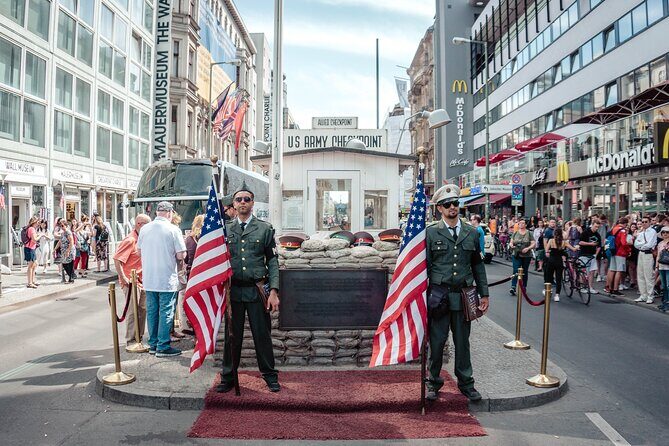
Then you end at Checkpoint Charlie, the famous border crossing during the Cold War. The tour closes with stories about espionage and escape attempts, bringing the “divided Berlin” theme to a clear finish line.
This pairing works because it gives you contrast. Topography of Terror is about the machinery of terror during WWII. Checkpoint Charlie is about the chessboard of the Cold War. Together, you leave with a sense of how control can take different forms across time.
If you like structure to your day, the ending location helps. You’re placed in a busy, central spot where it’s easy to keep walking, grab food, or head to another attraction on your own.
Price and value: why $21.77 can be a smart move
At $21.77 per person for about 2 hours, this is priced like a budget-friendly “starter guide.” What makes it feel like real value is the combination of:
- a short duration that fits into a tight itinerary,
- central stops that don’t require paid admission (listed as free),
- and a guide-led narrative that helps you connect the dots.
The cost makes more sense if you’re using it for orientation. Instead of spending hours on your own trying to guess what matters at each site, you get the interpretation quickly.
Where value might not fit: if your schedule is ultra-flexible and you already planned to spend lots of time at memorials, you might prefer paying for longer, slower visits. But for most first-time or time-limited Berlin days, this hits a sweet spot.
Who should book this express walk, and who might skip it
You’ll likely love this tour if:
- you want a guided route that covers major Berlin sites fast,
- you like history but don’t want to spend half a day commuting or researching on the fly,
- you’re starting your trip and want your bearings straightened out early.
It’s also a good fit if you appreciate good pacing. In the feedback you provided, guides like Giles and Ryan were praised for being good communicators with appropriate walking pace, and that matters when you’re mixing ages and energy levels.
You might skip or upgrade your plan if:
- you prefer long stops for reflection and reading,
- you’re sensitive to dark subject matter and want more time to process,
- you already know Berlin well and want a more specialized theme (for example, only WWII sites, or only Cold War escape routes).
Should you book Berlin Highlights in 2 Hours: Express Walking Tour?
If you’re in central Berlin with limited time, I’d book it. This is one of those tours that helps you spend your energy on the meaning, not on figuring out what to look at first. The route is packed, yes, but the pacing is built for people who want a fast orientation and then freedom to explore.
Choose it especially if you want to make sure you cover the remembrance stops and the Cold War landmarks in one go. The guide quality seems to be the thing people remember most, with named guides such as Ryan, Gregor, Dylan, and Giles getting strong praise for clarity and good communication.
If you’re the kind of person who needs long quiet time at memorials, consider pairing this with another visit later where you can linger. Think of this as the map and context, not the whole experience by itself.
FAQ
FAQ
Is this tour offered in English?
Yes. The tour is offered in English.
How long is the Berlin Highlights in 2 Hours walking tour?
It runs for about 2 hours.
Where does the tour start and end?
It starts at Pariser Platz 1, 10117 Berlin and ends at Checkpoint Charlie, Friedrichstraße 43-45, 10117 Berlin.
How much does it cost?
The price is $21.77 per person.
Are the stops included in the tour free to enter?
All listed stops are marked as free.
Do I need a physical ticket?
No. The tour uses a mobile ticket.
What group size should I expect?
The tour has a maximum of 25 travelers.
Is confirmation provided after booking?
Yes. You receive confirmation at the time of booking.
Is the tour near public transportation?
Yes, it’s near public transportation.
Is there free cancellation?
Yes. You can cancel for a full refund up to 24 hours in advance. Canceling less than 24 hours before start time is not refunded.
Are service animals allowed?
Yes, service animals are allowed.