REVIEW · MUNICH
Munich WWII and Dachau Concentration Camp Private Tour with Licensed Guide
Book on Viator →Operated by Sightseeing Bavaria Exclusive · Bookable on Viator
Hitler’s trail, then the truth at Dachau. This private day links Munich WWII sites with a guided visit to the Dachau Concentration Camp Memorial, keeping the story clear from grand buildings to ordinary streets. I especially like the logistics: hotel/address pickup in a new, A/C VW or Mercedes and all-you-group-only transport (minivan or small coach). I also like the way the tour uses a licensed guide to connect what you see—like bomb damage and reconstruction—with what happened during the Nazi era. The main drawback is the pace and emotional weight: it’s a long day with lunch not included, and Dachau is not recommended for kids under 12.
You’ll spend most of the day on the move through Munich, with short, focused stops, then shift gears for the memorial where time tends to run longer. One small detail that makes this tour feel thoughtfully planned: Dachau includes a pre-memorial overview of former SS grounds with some villa context before you walk the site. And yes, one guide name you’ll hear in positive feedback is Max, praised for making sure everything gets covered—and then some.
In This Review
- Key things you’ll notice on this tour
- Price and what you really get for $804.18 per person
- How the day starts: Munich pickup and your first WWII context
- Marienplatz and Munich’s WWII-era city core (Stop 1)
- Frauenkirche: bomb damage and reconstruction shown through photos (Stop 2)
- St. Michael: a second major church lesson in destruction and change (Stop 3)
- Residenz München and the story of power inside palace walls (Stop 4)
- Viscardigasse: how even street names carry meaning (Stop 5)
- Feldherrnhalle and the aborted putsch: the regime’s violence in public space (Stop 6)
- Platz der Opfer des Nationalsozialismus: a memorial that uses symbol and silence (Stop 7)
- Ludwig Maximilian University and the White Rose memorial visit (Stop 8)
- Schwabing: where the Nazi elite mixed with everyday Munich (Stop 9)
- Hofbräuhaus area: history at lunch time (Stop 10)
- The dark-era architecture in Altstadt-Lehel (Stop 11)
- Haus der Kunst: Nazi-approved art in a former showcase (Stop 12)
- Eisbachwelle: the city’s normal joy right next to trauma (Stop 13)
- Bogenhausen: places tied to Hitler and Eva Braun, viewed from the outside (Stop 14)
- Prinzregentenstraße and the strange logic of protection (Stop 15)
- Ramersdorf model settlement: ideology built into housing (Stop 16)
- Stadelheimer Straße: White Rose executions in the real prison context (Stop 17)
- Königsplatz and the NS Documentation Center: where power gatherings met modern memory (Stop 18)
- Karolinenplatz: the obelisk and changing meanings (Stop 19)
- Maxvorstadt: a shabby room, then a planned mausoleum (Stop 20)
- Dachau Concentration Camp Memorial: what you’ll actually experience (Stop 21)
- Transport, tickets, and timing: how to make the day feel manageable
- What the tour gets right (and where it can frustrate you)
- Should you book this private Munich WWII and Dachau tour?
- FAQ
- How long is the Munich WWII and Dachau private tour?
- Where does pickup happen and what time?
- Is this a private tour or a shared group?
- What language is the tour offered in?
- Is lunch included in the price?
- Is the Dachau memorial visit suitable for children?
Key things you’ll notice on this tour
- Hotel pickup and A/C comfort: new VW or Mercedes transport, only for your group, with a chauffeur/driver.
- Licensed English guiding throughout: narration ties buildings to events instead of just pointing and reading.
- Short Munich stops that still feel meaningful: quick looks at key locations, often with historical photos on topic.
- Dachau visit with footwear advice: some paths are coarse pebbles, so you’ll want solid shoes.
- No ticket headaches: the itinerary lists free admission for the included sights.
- A guide who manages time well: strong customer feedback highlights guides like Max for coverage and flow.
Price and what you really get for $804.18 per person
At $804.18 per person for about 9 hours 30 minutes, this is firmly a premium, private-day experience. The good news is that the price isn’t just for a driver. You’re paying for (1) a licensed guide for both Munich WWII context and the Dachau Concentration Camp Memorial, (2) private transportation in a new A/C VW or Mercedes (minivan or small coach depending on group size), and (3) an itinerary packed with many stops that each need explanation, not just sightseeing time.
You’re also spared some usual cost traps. The tour lists mineral water and says there are no hidden costs. Lunch isn’t included, and tips aren’t included—so you’ll want to plan for a real meal around the Hofbräuhaus area if that’s your style.
Here’s the practical way to judge value: if you’re the type who wants a guide to connect dots—why certain buildings look the way they do, what was rebuilt after bombing, and how propaganda sites link to real victims—then private guiding pays off fast. If you just want photos and a self-guided walk, you could lower costs elsewhere. But you’d lose the framing that makes these places hit harder and make more sense.
You can also read our reviews of more guided tours in Munich
How the day starts: Munich pickup and your first WWII context
The day begins with pickup from any hotel or address in Munich at 8:00 a.m., 9:00 a.m., or 9:30 a.m. (and pickup can be arranged for other times if you ask). If you’re outside central Munich—even the airport MUC—pickup and return can be arranged on request, with possible additional costs.
This matters because it removes friction. You don’t have to line up transit, find parking, or worry about timing between distant sites. The tour uses a chauffeur-driven vehicle, and your group goes together only—no mixing with strangers.
Once you’re in position, the first sights set the tone: Munich isn’t presented as one memorial moment. It’s shown as a lived city—civic squares, churches, royal residences, and propaganda locations—then later, the story travels outward to Dachau.
Marienplatz and Munich’s WWII-era city core (Stop 1)
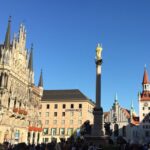
You start at Marienplatz, the city’s longtime civic center. The tour includes an approximately 1-hour old-town walk, with Marienplatz described as the bourgeois center since the city’s founding in the 12th century. Here’s why it works early in the day: you get your bearings before the Nazi-era details arrive.
This stop also points out how quickly the regime made itself visible in everyday space. During National Socialism, the neo-Gothic town hall was fitted with swastika flags, and the old town hall from the 15th century got an extra-wide passage to handle increasing traffic. That’s a useful lens: ideology wasn’t only “big speeches”—it was branding and infrastructure.
What to watch for: pay attention to how civic architecture gets repurposed in symbolism. If you’re prone to “just taking pictures,” this is the moment to slow down.
Frauenkirche: bomb damage and reconstruction shown through photos (Stop 2)
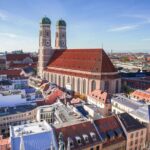
Next is Frauenkirche, the late Gothic Munich cathedral built at the end of the 15th century in about 20 years. On paper, it’s a landmark. On this tour, it becomes evidence. You’ll see how Allied bombings destroyed parts of the city and how reconstruction changed details afterward, supported by historical images.
Small time, big payoff: this is listed as a short stop, so you’ll want to listen carefully and not spend the whole time wandering.
St. Michael: a second major church lesson in destruction and change (Stop 3)
Then comes St. Michael, with a major architectural point: it houses the second largest barrel vault in the world, and it was built about 100 years later in Mannerist style. Again, the guide uses historical images to connect the church’s look today to wartime destruction and later alterations.
This is one of those moments where a guide earns their fee. Churches are beautiful. But understanding what changed and why makes the buildings feel like witnesses, not just monuments.
You can also read our reviews of more private tours in Munich

Residenz München and the story of power inside palace walls (Stop 4)
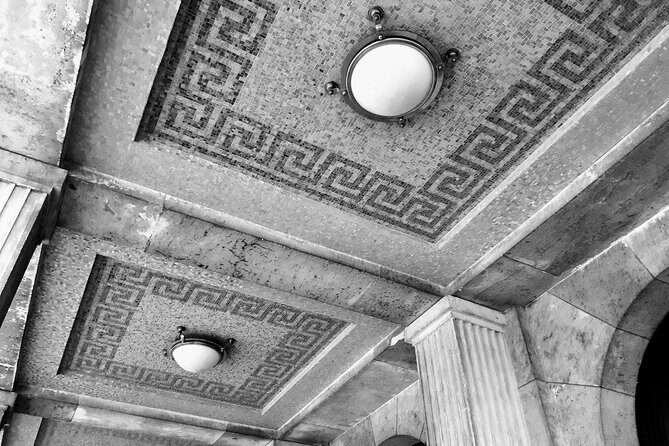
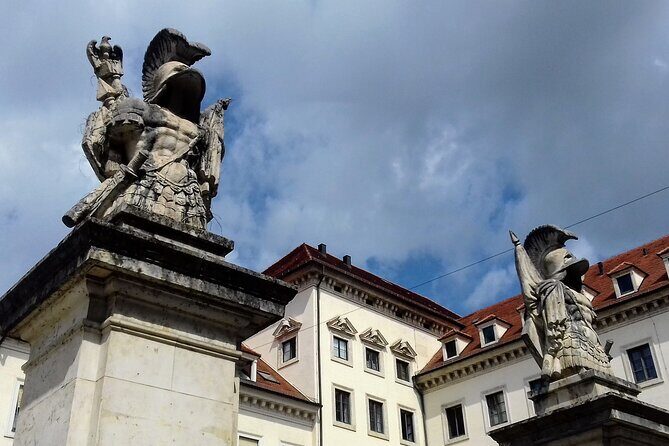
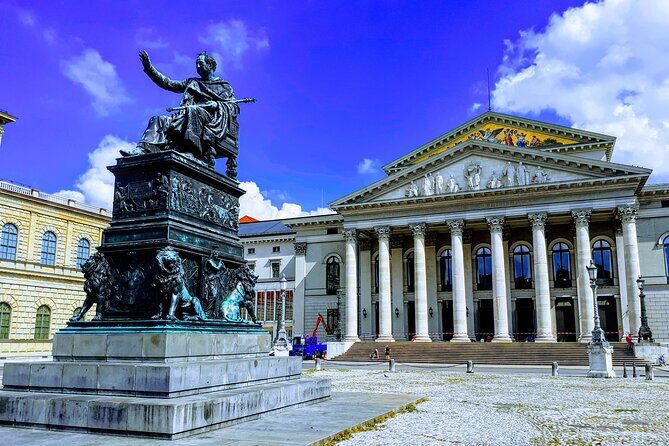
At Residenz München, you’re shown the vast palace complex from outside, including seven large inner courtyards. The tour links the setting to Nazi-era occupancy, explaining that in 1933, SS Brigade Leader Christian Weber set up residence there.
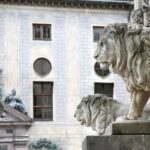
A fun (in a careful, historical context) detail: your guide will explain the importance of petting one—or all—of the lions at side entrances. It’s a local tradition tied to the building’s features, and it gives you a human-scale pause inside a story that can feel heavy all day.
Consideration: you’re likely to be tempted to treat this like a photo stop only. Try to focus on the guide’s explanation about how different stylistic epochs and uses show up through time.
Viscardigasse: how even street names carry meaning (Stop 5)
Then you get Viscardigasse, described as the little street with a name connected to a specific local wordplay: why it was called Drückebergergäßchen. This stop is brief, but it’s a reminder that culture and language survive regime changes—sometimes as a wink, sometimes as a record.
Short stop energy is real here: quick, listen, move.
Feldherrnhalle and the aborted putsch: the regime’s violence in public space (Stop 6)
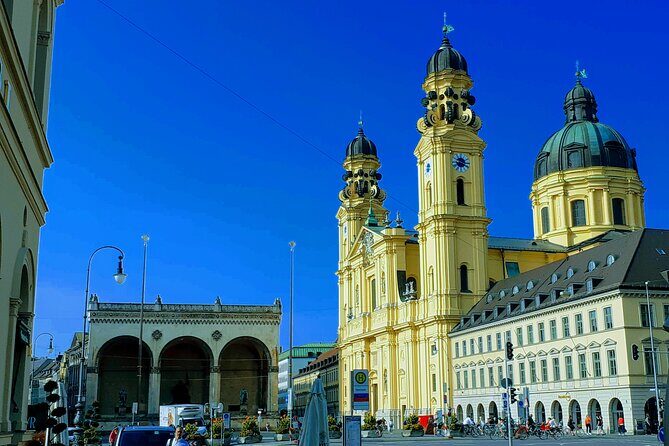
Feldherrnhalle is one of the more direct “history hits the sidewalk” moments. This viewpoint on the historic Ludwigstraße is tied to the 1923 attempted Hitler putsch that ended in bloodshed.
The tour also mentions a northern city gate—Schwabinger Tor—that stood until about 200 years ago, and your chauffeur waits for you here while other sights are driven to by minivan/coach.
What to expect: a clear narrative connection between propaganda-era theater and real violence. If you like your history linear and explained, this is the kind of stop where it clicks.
Platz der Opfer des Nationalsozialismus: a memorial that uses symbol and silence (Stop 7)
At Platz der Opfer des Nationalsozialismus, you’ll see an eternal flame that burns as a symbol of freedom. The tour notes this site was erected in 1985 on the destroyed Schiller memorial’s location, and it includes a symbolic “dungeon” element in the design.
This is a good breather stop between heavier topics. It’s only minutes, but it helps reset your emotional footing before universities and resistance come into view.
Ludwig Maximilian University and the White Rose memorial visit (Stop 8)
At Ludwig Maximilians University, you get the story of White Rose, resistance formed in 1943 after members like Hans and Sophie Scholl, Christoph Probst, Alexander Schmorell, and Willi Graf (plus Professor Kurt Huber) were murdered. Your guide takes you to visit the memorial with context.
Why this is valuable in a Munich WWII tour: the regime is often shown as monolithic—buildings, flags, power. White Rose adds something essential. It shows individual courage, and it makes the story about moral choice, not only destruction.
Listen closely here: the university setting makes names and events feel less abstract. This is where you start connecting people to paper records and then to places.
Schwabing: where the Nazi elite mixed with everyday Munich (Stop 9)
Next is Schwabing, the artists’ quarter where Hitler was said to have liked to stop at the Osteria Italiana (still existing today). The tour also places Nazi media and image-making around the area, including the editorial house Völkischer Beobachter and Heinrich Hoffmann Verlag National Socialist Pictures. And it notes that in 1929, Hitler met Eva Braun at the later Photohaus Hoffmann.
This stop is short, but it helps you understand something most tours skip: propaganda depended on networks. Photos, publishing houses, and social meeting spots mattered.
Hofbräuhaus area: history at lunch time (Stop 10)
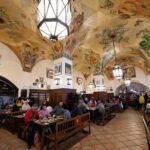
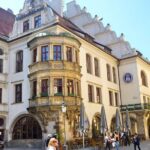
At Staatliches Hofbräuhaus, your guide points out a specific meeting spot: in a niche on the first floor of the Hofbräuhaus, Hitler and his entourage enjoyed meeting.
If you want food, the tour suggests a hearty lunch in the “Schwemme” ground floor or the inner courtyard if weather works. Lunch isn’t included, but the guidance helps you time it without losing the tour’s momentum.
Even if you skip eating, you should at least look around. It’s one of those places where the building’s fame can distract you—unless your guide anchors you to the historical point.
The dark-era architecture in Altstadt-Lehel (Stop 11)
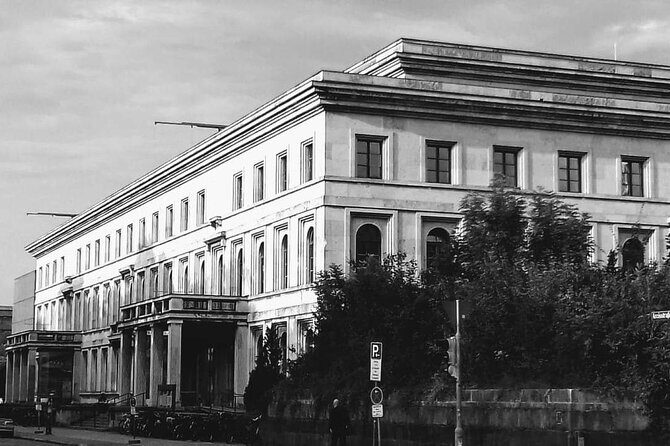
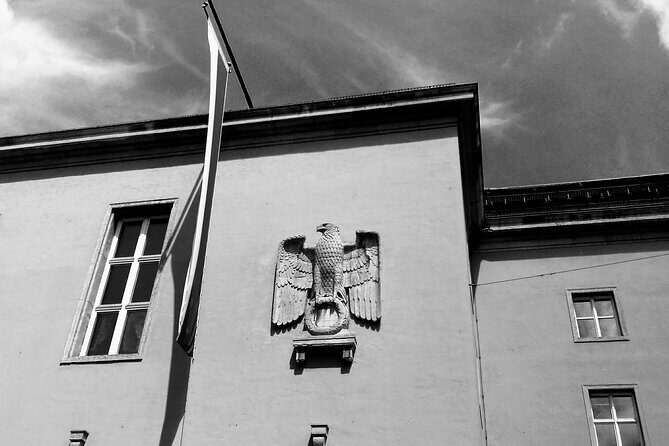
In Altstadt-Lehel, you’ll see a monument from 1937: a monumental building erected by Hermann Göring’s Reich Aviation Ministry for a new Luftgaukommando V building. The tour notes the main front is 225 meters long and that Nazi symbols like swastikas on window grilles and steel helmets on house walls remain visible.
This stop is only minutes, but it’s useful because it makes the propaganda feel industrial—an entire system built into office blocks.
Practical note: if you’re sensitive to hate symbols, you may want to mentally prepare. This tour doesn’t avoid them; it frames them with history.
Haus der Kunst: Nazi-approved art in a former showcase (Stop 12)
Then it’s Haus der Kunst, described as the first representative Nazi building in Munich. It’s jokingly associated with bright granite columns, and during Hitler’s time it was called the House of German Art. The tour points out how the building showed works of artists conforming to the Nazi regime—and you’ll see swastika decor in the present.
Again, this is one of those “short stop, strong meaning” moments. Art institutions weren’t neutral. They were tools.
Eisbachwelle: the city’s normal joy right next to trauma (Stop 13)
Not far from the heavy Nazi sites, you get Eisbachwelle, the famous city surfers’ wave. The tour frames it as a chance to forget the horrors for a moment and watch surfers try to conquer an artificially generated wave.
You can see how this works as a tour technique. You’re not being asked to ignore suffering; you’re given a human counterbalance. Sometimes your brain needs a small release valve.
Bogenhausen: places tied to Hitler and Eva Braun, viewed from the outside (Stop 14)
In Bogenhausen, the tour focuses on private residence stories. It mentions Hitler’s house in Munich’s noblest district: a luxurious 317 sqm apartment with nine rooms in 1929, which today is the police station and can only be viewed from the outside. It also notes a nearby villa district where Eva Braun lived in a villa since 1936, though that house was demolished a few years ago.
This is where you may feel the limits of what’s possible. You’re looking at external views and location context, not interior details. That said, it still matters: these are real places where power lived, and the tour keeps you from turning them into vague myths.
Prinzregentenstraße and the strange logic of protection (Stop 15)
Along Prinzregentenstraße, the tour points out a curious Nazi building: an apartment building with flanking air raid shelters built for the National Socialist upper class. The tour says it was meant as a model for others, but World War II meant this is the only one completed.
This is the practical lesson: ideology and class shaped even survival planning. It’s not only hate; it’s planning, money, and hierarchy.
Ramersdorf model settlement: ideology built into housing (Stop 16)
In Ramersdorf, you’ll see a Nazi model settlement. In 1934, around 200 settlement houses with gardens were built for “German national comrades.” The tour notes it’s now a listed building.
If you like “show me how it worked” history, this stop helps. Housing is everyday. Even the most brutal regimes needed ordinary routines for the people it supported.
Stadelheimer Straße: White Rose executions in the real prison context (Stop 17)
At Stadelheimer Straße, the tour explains that in 1943, White Rose members Hans and Sophie Scholl, Christoph Probst, Alexander Schmorell, Willi Graf, and Professor Kurt Huber were guillotined at the penal institution in Stadelheim. Their graves are described as being in the nearby cemetery in the Perlacher Forest.
This is one of the hardest parts of the day, even though it’s brief. The guide’s context matters here. Names should be spoken with care, and you should give yourself a moment to absorb it before rushing ahead.
Königsplatz and the NS Documentation Center: where power gatherings met modern memory (Stop 18)
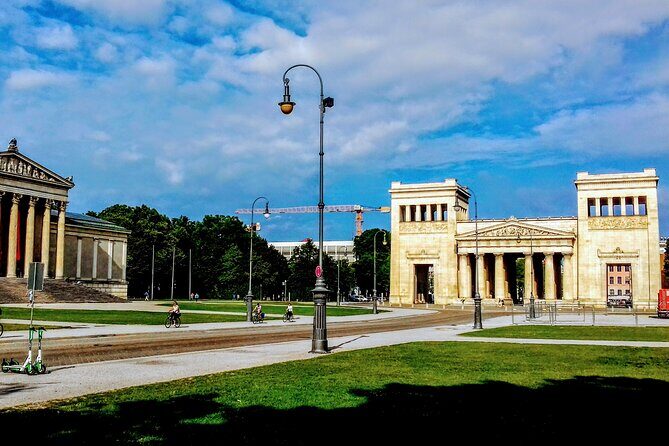
At Königsplatz, the tour explains how the area between Karolinenplatz and Königsplatz became the NSDAP party center, with administrative buildings and the Führerbau. The tour notes that almost all Nazi buildings survived bombing attacks unscathed.
Today, the NS Documentation Center, opened in 2015, sits on the site of the destroyed Brown House. That detail is key: it shows how memory institutions use actual sites of administration, not just generic memorial grounds.
What to do: slow down. Even in a short stop, let the shift from “party center” to “documentation center” land.
Karolinenplatz: the obelisk and changing meanings (Stop 19)
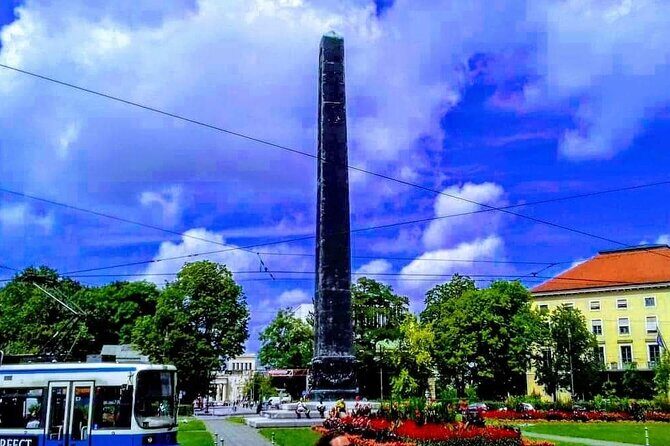
At Karolinenplatz, the tour explains that 100 years later, the NSDAP center of power was built around an obelisk ordered by King Ludwig I in 1833.
This is a great example of how layers of history sit in one place. Symbols change hands over time. The guide helps you notice that, instead of treating it as one fixed “Nazi location.”
Maxvorstadt: a shabby room, then a planned mausoleum (Stop 20)
In Maxvorstadt, the tour highlights an apartment house now renovated where Hitler shared a shabby room with Austrian Rudolf Häusler after moving from Vienna to Munich in May 1913 as an unsuccessful postcard painter.
The guide also shows the location where Hitler planned a mausoleum with an adjoining “Hall of the Party.” The tour notes Hitler was stimulated during a 1940 visit to Paris when he revered Napoleon’s sarcophagus in the Invalides.
This is a chilling contrast stop: small beginnings vs. grand self-mythology. If you like that kind of cause-and-effect framing, this will stick.
Dachau Concentration Camp Memorial: what you’ll actually experience (Stop 21)
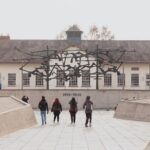
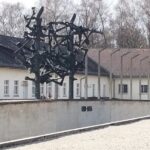
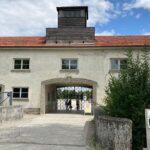
Then you move to Dachau Concentration Camp Memorial Site. The tour description doesn’t sugarcoat the subject. It says that in the camp’s 12 years, over 200,000 people were imprisoned, and 41,500 were murdered. It also notes the site opened about six weeks after Hitler was appointed Chancellor.
Before you begin touring the memorial proper, the tour includes a look at some luxurious villas on the former SS grounds. That contrast is part of how the guide explains the system.
Time-wise, the tour notes the average length of stay at the memorial is 1.5 to 2.5 hours, and the itinerary lists the memorial portion as about 2 hours. This is where you’ll want real patience. You’re not on fast “see-and-go” mode.
Footwear matters: some footpaths are coarse pebbles. Bring comfortable, supportive shoes and expect uneven surfaces.
Who should reconsider: the tour explicitly says Dachau is not recommended for people under 12. If your group has kids, check carefully against their ability to handle intense history in a concentrated format.
Transport, tickets, and timing: how to make the day feel manageable
This is a long, packed day, but the structure is designed to keep you moving without chaos. The tour is private, driven in an A/C VW or Mercedes vehicle, and it lists free admission for the included stops in Munich and for Dachau. You also receive a mobile ticket.
To make it work in real life:
- Wear layers. Munich mornings can feel cooler than you expect.
- Use a daypack, not pockets. You’ll likely be shifting between outdoor and indoor-feeling viewpoints.
- Plan your food decision early. The Hofbräuhaus area is your natural lunch anchor, but lunch is not included.
- If you’re prone to fatigue, accept that you won’t “wander.” This tour is explanation-heavy with short stops.
What the tour gets right (and where it can frustrate you)
The tour gets right:
- It ties Nazi-era presence to actual Munich streets and architecture, not just one museum room.
- You get both sides: propaganda locations in Munich and the victim-centered reality at Dachau.
- The guide’s licensing and focus make short stops worth it. You don’t waste time.
Where it can frustrate you:
- The day is long, and some stops are only 2–25 minutes each. If you want slow, unguided lingering, this itinerary may feel tight.
- Lunch isn’t included. You’ll need to plan, or you’ll end up spending time searching for food.
Should you book this private Munich WWII and Dachau tour?
Book it if you want a guided, private day that connects Munich’s visible WWII-era traces to a serious memorial visit at Dachau, with clear storytelling and comfortable transport. It’s also a strong pick if you dislike the stress of self-guiding: pickup, vehicle, and a licensed guide handling the “why this matters” part are doing the heavy lifting.
Don’t book it if your priority is leisurely pacing or if your group includes anyone under 12 who may not be ready for Dachau’s emotional weight. Also, be honest about your schedule: this is a 9.5-hour day, so plan for an early start and a slower evening afterward.
If you do book it, consider keeping your expectations simple: you’re not here to collect stamps. You’re here to understand how power showed up in buildings, streets, and institutions—and what that system did to human beings.
FAQ
How long is the Munich WWII and Dachau private tour?
It runs for about 9 hours 30 minutes (approximately). The Dachau visit is typically the longest section of the day at about 1.5 to 2.5 hours on average.
Where does pickup happen and what time?
Pickup is offered at any hotel/address in Munich starting at 8:00 a.m., 9:00 a.m., or 9:30 a.m., and you can request another pickup time. Pickup and return outside Munich (like MUC airport) may be possible on request.
Is this a private tour or a shared group?
This is a private tour/activity. Only your group participates.
What language is the tour offered in?
The tour is offered in English.
Is lunch included in the price?
No. Having lunch is not included, though the tour suggests you can stop for a hearty lunch at the Hofbräuhaus area.
Is the Dachau memorial visit suitable for children?
Visiting the Dachau Concentration Camp Memorial is not recommended for people under 12 years of age.