REVIEW · KOBLENZ
Koblenz: Old Town Tour with the Ehrenbreitstein Fortress
Book on GetYourGuide →Operated by Blackbuck Travels · Bookable on GetYourGuide
Rhine Valley views in just three hours. That’s the draw here, built around Ehrenbreitstein Fortress and its big panoramas over the Rhine Valley. I especially like how the tour pairs that UNESCO-scale viewpoint with straight-on old-town stops, so you’re not spending your time only staring from one spot, or only reading plaques.
I also love the feel of a private guided tour: your guide is exclusively with you, and the pace is meant to match your group. You’ll hit Koblenz landmarks that most people miss when they rush through on their own, including the old-town core and the churches that shape the city’s skyline. One thing to consider: fortress entrance fees aren’t included, so budget a little extra if you want full access on the day.
In This Review
- Key moments worth marking on your Koblenz map
- Why Ehrenbreitstein Fortress is the centerpiece of Koblenz
- Towering above the Rhine: start at the cable car station
- Münzplatz: where coins, Romans, and Koblenz’s name meet
- Liebfrauenkirche and the romantic street between two churches
- Basilica of St. Castor: the oldest church in Koblenz
- Schängel and the city hall fountain: a Koblenz nickname you’ll remember
- Deutsches Eck and Kaiser Wilhelm: the headland viewpoint finish
- What makes this feel private in real life
- Fortress entrance fees: the one cost you should plan for
- Price and value: $430 per group up to 20
- Who this Koblenz tour suits best
- Practical tips for a smooth 3-hour visit
- Should you book this Koblenz tour?
- FAQ
- How long is the Koblenz old town tour with Ehrenbreitstein Fortress?
- Where does the tour start and where does it end?
- Is the tour private?
- Is pickup available?
- What language options are available for the live guide?
- Is Ehrenbreitstein Fortress included in the tour price?
- Is the Ehrenbreitstein Fortress a UNESCO site?
- How much is the tour?
- Is the tour wheelchair accessible?
- What is the cancellation policy?
Key moments worth marking on your Koblenz map
- Ehrenbreitstein Fortress: a UNESCO World Heritage site on a hill 118 meters above the Rhine
- The cable car start: you begin right at the Koblenz-side cable car station, near where the fortress overlooks the city
- Münzplatz origins: learn how the square’s coin history and Roman roots helped shape the city’s name
- Liebfrauenkirche details: onion domes, a 17th-century story, destruction in 1944, and rebuilding in 1955
- Schängel fountain at city hall: the local nickname explained through Koblenz’s 1794–1813 French allegiance
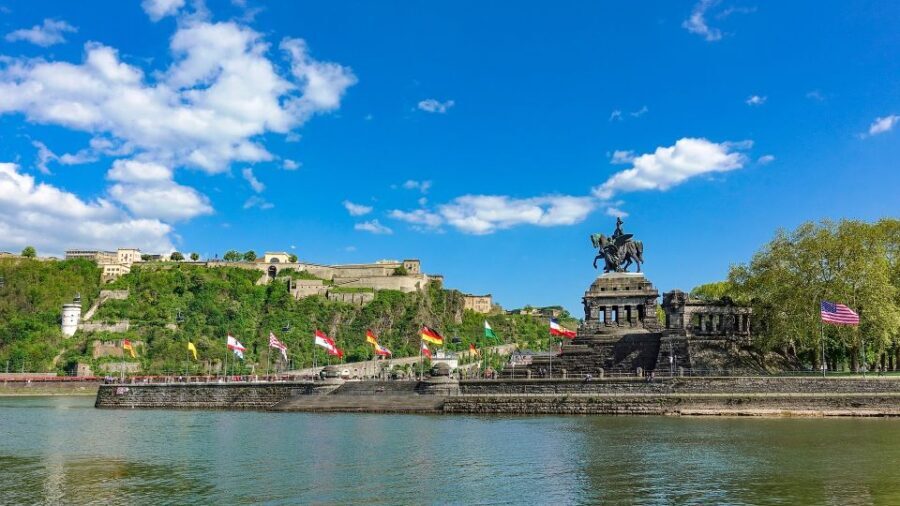
- Deutsches Eck + Kaiser Wilhelm memorial: a classic rivers-meet viewpoint at the headland
Why Ehrenbreitstein Fortress is the centerpiece of Koblenz
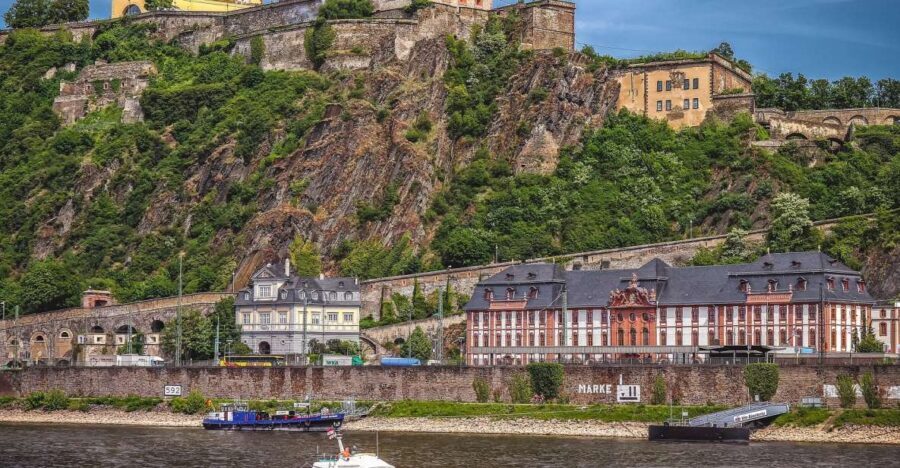
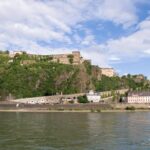
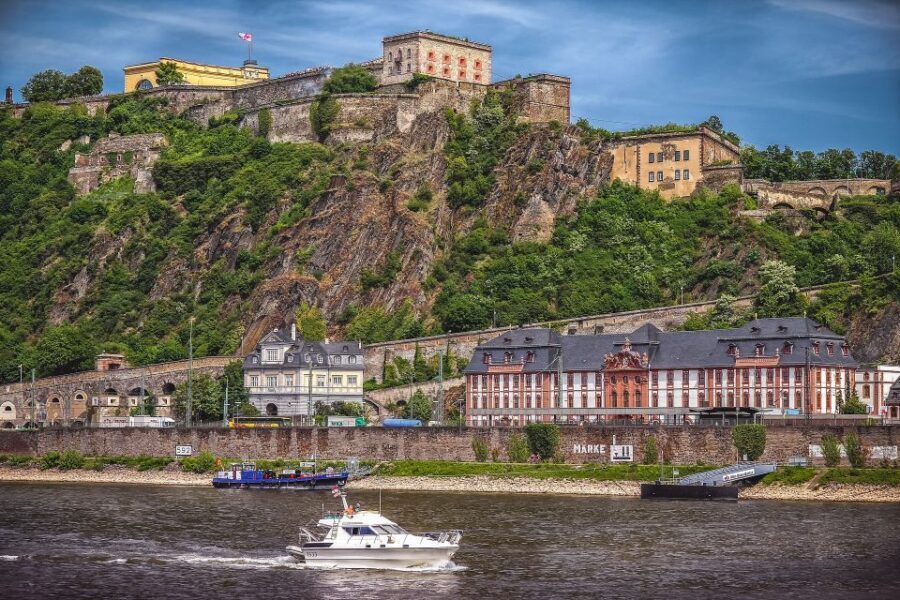
Ehrenbreitstein Fortress is the kind of sight that instantly changes how you understand a place. From up there—118 meters above the Rhine—you’re looking out over the Rhine Valley with a sense of why this area mattered so much for so long. The fortress is also a UNESCO World Heritage site, which is a label that usually comes with paperwork. Here, it matches what you can actually see and walk through.
The scale is impressive for a reason: it’s described as the second largest fortress in Europe. Even if you don’t care about military architecture, you’ll likely appreciate how the position was chosen. High above the river, the fortress guarded the middle Rhine region, and it sits in that sweet spot between “history lesson” and “real view.”
Then there’s the human story tied to the fortress. In 1672, during the war between France and Germany, the Archbishop refused requests from both sides to let troops cross the Rhine. That kind of refusal tells you this wasn’t just a passive building. It was part of high-stakes decisions about power and movement.
You can also read our reviews of more tours and experiences in Koblenz.
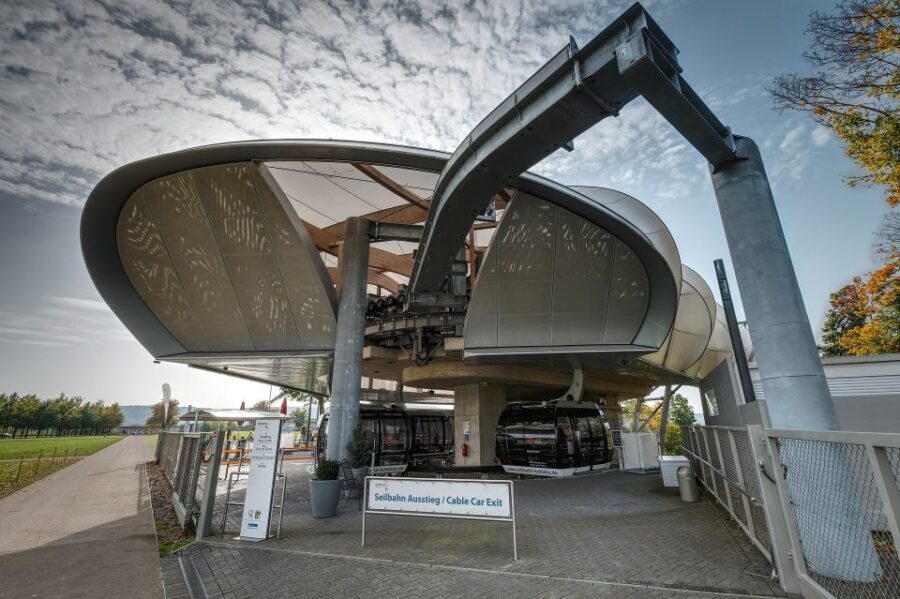
Towering above the Rhine: start at the cable car station
The tour begins at the cable car station on the Koblenz side, and that matters more than it sounds. Starting there helps you get oriented quickly. You see the connection between city and fortress right away, instead of arriving later and trying to reverse-engineer how everything fits together.
Because the fortress is adjacent to the city and connected by cable car, your tour route naturally ties the viewpoints together. You’re not doing a long transport shuffle across town and hoping your timing holds. You’re moving through the same geography Koblenz grew around: river, headland, old town, and the hilltop.
Practical tip: plan for some walking within the old town portion. This tour is only about three hours, so the route is designed to be efficient—good for first-timers, but you’ll still want comfortable shoes.
Münzplatz: where coins, Romans, and Koblenz’s name meet
After the fortress portion, you head into Koblenz’s old town and the tour lands at Münzplatz, a square that sounds simple until you hear how it got its name. “Münz” connects to an electoral coin called Münz, minted back in the 11th century. So the square isn’t just a pretty pause—it’s a clue about older trade and authority.
The square also ties into a major anniversary moment. In 1992, for the 2000-year anniversary, a fountain was constructed by Wili Heinzen as a gift to the city and its citizens from Sparkasse Koblenz. That’s the kind of local detail you’d likely miss if you only skim guidebooks.
And then you get the Roman layer. This is where the Romans first founded a fort called castellum apud confluentes—essentially a fort near the confluence. That’s also where Koblenz’s identity starts to make sense. The name of the city is tied to that meeting of waterways, and Münzplatz is where your guide helps you put the pieces together.
If you like city geography, you’ll enjoy this stop. It gives you the “why” behind the “what,” and it’s a smoother start than jumping straight into churches.
Liebfrauenkirche and the romantic street between two churches
From Münzplatz, the tour moves along the romantic street between two churches, with the Liebfrauenkirche taking a starring role. This church sits at the highest point of the city, which explains why it’s such a natural landmark. The onion domes are the visual signature, and your guide helps you connect the shape to how the city reads from different angles.
The church’s timeline has drama. During the French Revolution it served as one of the main parish churches. Then it was destroyed in 1944 and rebuilt again in 1955. That sequence is a strong reminder: the city’s look you see today is often the result of rebuilding after upheaval, not just “old and intact.”
The walking path here is also part of the experience. The route between the churches is short, but it gives you a pleasant rhythm—move, look up, then get your bearings again.
Basilica of St. Castor: the oldest church in Koblenz
Next comes the Basilica of St. Castor, and this stop is ideal if you want something older than the onion-domed skyline. It’s described as the oldest church in Koblenz, and it dates back to the early medieval period.
The building was constructed by the Archbishop of Trier between 817 and 836, with support from Emperor Louis the Pious. That detail matters because it anchors the church within the political-religious power network of the time, not just local devotion.
You’ll also hear it described as a Carolingian proprietary church. Even if that term isn’t familiar, your guide’s job is to make it click: a proprietary church connects to who had authority over land and institutions. In plain terms, it helps explain why architecture in this area feels like governance as much as faith.
This is a great counterpoint to the fortress viewpoint. From Ehrenbreitstein, you understand defense and control from above. From St. Castor, you understand control and order from the ground, built into long-lasting institutions.

Schängel and the city hall fountain: a Koblenz nickname you’ll remember
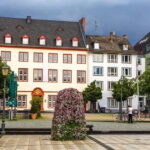
If the churches are the “big” landmarks, the squares are where the tour feels personal. A standout here is the fountain at the city hall, tied to the word Schängel.
You’ll learn where the nickname comes from: Koblenz’s 20-year allegiance to France from 1794 to 1813. That’s not a random trivia fact. It explains why local identity can be shaped by political periods that lasted “only” two decades, yet left visible cultural traces.
The city hall fountain is designed by Carl Burger in 1940 and dedicated to the poet Josef Cornelius. These names are the kind you don’t usually memorize unless someone gives you a reason to. In this tour, the reason is local identity—how Koblenz sees itself and what it chooses to honor in public spaces.
This stop also gives you time to slow down for photos without turning the entire tour into a stop-and-go marathon. You get a meaning behind the scenery, not scenery without context.
Deutsches Eck and Kaiser Wilhelm: the headland viewpoint finish
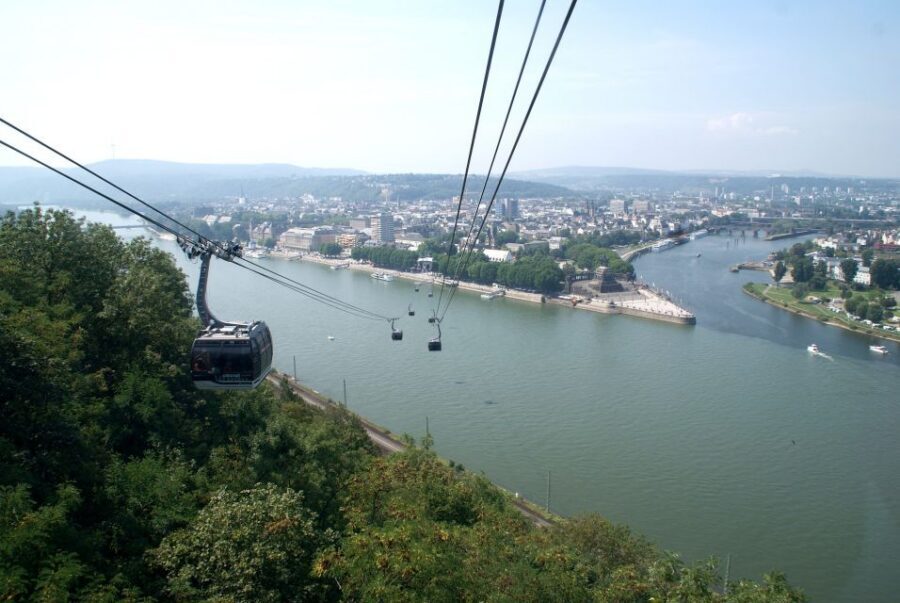
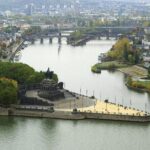
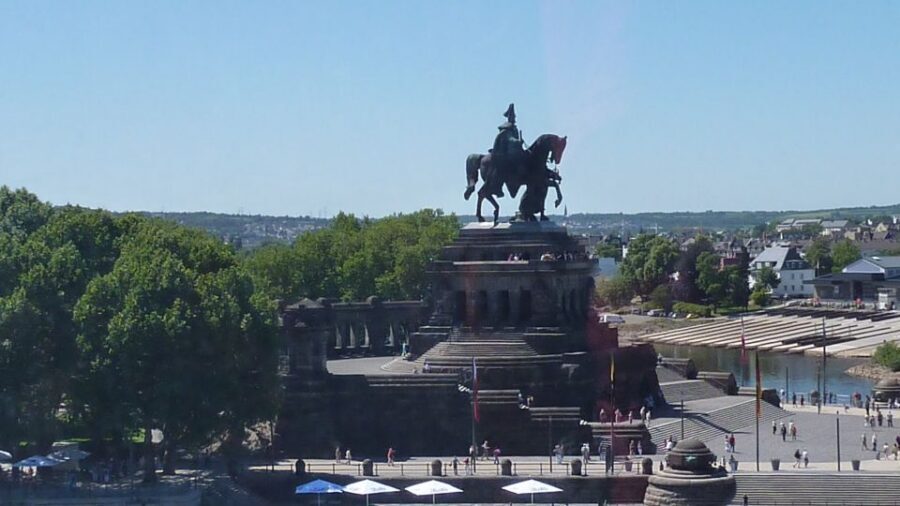
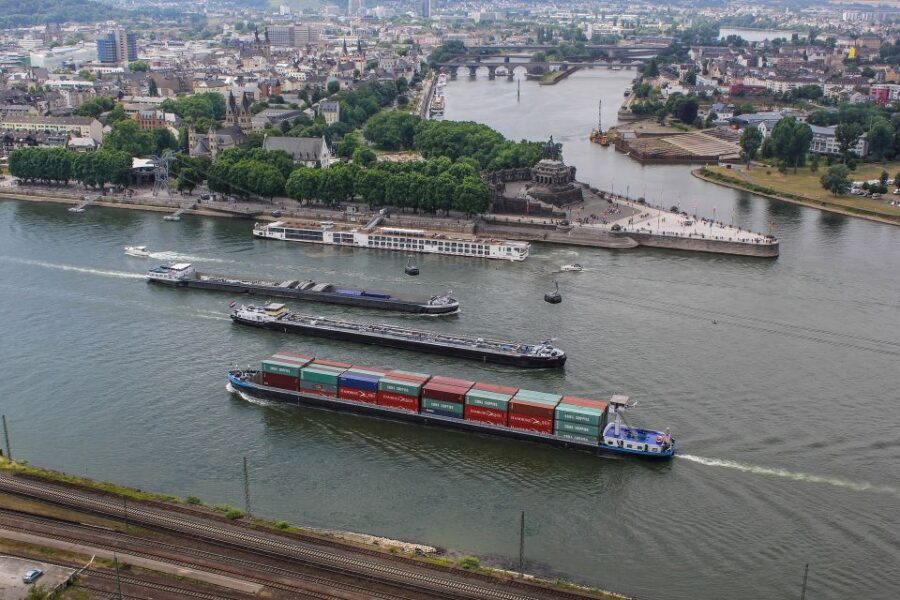
The last major anchor is Kaiser Wilhelm memorial at Deutsches Eck, the headland in Koblenz. This is where the Rhine’s story becomes visible at a glance. Your guide leads you to the spot that locals and visitors recognize because it’s the classic “rivers meet” moment.
Kaiser Wilhelm was the first German Emperor, and the memorial was erected in 1897. If you’ve visited other German monuments from the same era, you’ll notice the style: it’s meant to signal national identity. Here, it also makes more sense because you’ve already learned how power and geography shaped Koblenz in earlier centuries.
The tour also mentions that you’ll view more of the famous sights along the end of the route in the oldest city area. That’s useful because it stops you from ending on a dead-end. You finish with a “see it one last time” sweep that helps tie together fortress, old town, and waterways.
What makes this feel private in real life
A lot of tours claim they’re private. This one is explicitly set up so the guide is exclusively with you, and that changes how the time feels.
In three hours, that exclusivity matters in two ways. First, you can ask follow-up questions without negotiating for attention. Second, your guide can shape the sequence to what your group finds interesting—historic details, quirky side stories, or the kind of architecture explanations that help you stop guessing.
The fortress portion also gets treated as more than a quick photo stop. The guide’s role is to make the fortress story make sense: why it was built when it was built, what it was designed to do, and how earlier events forced change, rebuild, and reinterpretation over time.
The best part for value is that you’re getting expert narration on multiple distinct settings—hilltop military defense, old-town squares, and churches tied to long timelines—without paying for separate day trips.
Fortress entrance fees: the one cost you should plan for
Here’s the honest money point: the tour price does not include entrance fees to Ehrenbreitstein Fortress. Everything else is handled as a guided experience, but you should still budget for admission if you want to go inside the fortress during your visit.
Why this matters for value: if you only pay for the guide and skip the paid parts, you’ll feel like the tour covered less than you expected. If you do pay the entrance fee, you’ll likely feel you got your money’s worth because the fortress is the “anchor view” that makes the old-town walking stops more meaningful.
Also remember: the tour lasts about 3 hours, so admission timing is part of the day’s flow. If you arrive late or linger too long elsewhere, you’ll feel it more than on a half-day tour.
Price and value: $430 per group up to 20
The price is listed as $430 per group for up to 20 people, and that’s a key way to judge value. With group tours, the per-person cost changes dramatically depending on whether you’re traveling as a small group or filling the available spots.
If you’re just a couple or a family, your cost per person is higher because you’re sharing one group rate. If you’re a larger group—friends, a club, or a group traveling together—the math can look much better fast.
Either way, you’re paying for three things that can be hard to recreate alone:
- A structured route that fits the geography of Koblenz (fortress → old town → headland).
- Interpretation that connects names, dates, and landmarks so they stop being random facts.
- A private guide who stays with your group rather than blending you into a bigger crowd.
And since the tour is wheelchair accessible, it’s designed to be usable for a wider range of visitors than many “walk and hope” city tours.
Who this Koblenz tour suits best
This is a strong fit if you’re:
- In Koblenz for the first time and you want the city’s major landmarks stitched into one route
- Traveling with limited time, but you don’t want a “drive-by” experience
- Visiting by cruise ship or staying in a central hotel area (because pickup is offered from cruise docking or centrally located hotels)
- Interested in how the same place can make different kinds of history visible—fortress, churches, and civic identity all in one afternoon
It’s also a good choice if you like your historical context explained in a way that feels practical. Ehrenbreitstein gives you the power-and-defense story. The old-town churches and squares give you the civic-and-religious story. Kaiser Wilhelm and Deutsches Eck bring it into a more modern national frame.
Practical tips for a smooth 3-hour visit
Keep these small points in mind so the timing feels easy:
- Start point matters: you begin at the cable car station on the Koblenz side, so plan to be there early enough to check in calmly.
- Plan for the fortress cost: entrance fees are separate, so don’t be surprised when you get there.
- Wear walking shoes: even with a tight route, you’ll be on your feet through old streets and viewpoints.
- Bring layers: you’ll be 118 meters above the Rhine at the fortress, and open-air areas can feel different than the streets below.
- Use your guide’s languages: English, German, and Italian are available, so pick the one you’ll enjoy most for asking questions.
If you’re visiting on a day with strong wind or rain, the fortress viewpoint can still be worth it, but you’ll want to take it slow while standing near viewpoints.
Should you book this Koblenz tour?
I think this is a yes for most first-time visitors to Koblenz who want more than a list of sights. The reason is simple: the tour connects Koblenz’s geography (Rhine confluence and headland) to the big landmarks that explain how the city grew and rebuilt itself over time.
If you want a quick, personalized overview with Ehrenbreitstein Fortress views plus old-town landmarks like Münzplatz, Liebfrauenkirche, St. Castor, and the Schängel fountain, this route is built for you. Just go in knowing the fortress entrance fee is extra, and you’ll feel in control instead of surprised.
FAQ
How long is the Koblenz old town tour with Ehrenbreitstein Fortress?
The tour lasts about 3 hours.
Where does the tour start and where does it end?
It starts at the Cable Car station on the Koblenz side, and it ends back at the meeting point.
Is the tour private?
Yes. It’s a private group tour where your guide is exclusively with you.
Is pickup available?
Pickup is available from your cruise docking location or from a centrally located hotel.
What language options are available for the live guide?
The live guide is available in English, German, and Italian.
Is Ehrenbreitstein Fortress included in the tour price?
Entrance fees for Ehrenbreitstein Fortress are not included.
Is the Ehrenbreitstein Fortress a UNESCO site?
Yes. Ehrenbreitstein Fortress is a UNESCO World Heritage site.
How much is the tour?
The price is $430 per group, up to 20 people.
Is the tour wheelchair accessible?
Yes, the tour is wheelchair accessible.
What is the cancellation policy?
You can cancel up to 24 hours in advance for a full refund.