REVIEW · KOBLENZ
Koblenz – Old Town including the Deutsches Eck
Book on Viator →Operated by BlackBuck Travels · Bookable on Viator
Koblenz makes sense fast. This private, 2-hour introduction walks you through the Old Town highlights and explains how this river city grew into the place it is today. I love that it pairs famous sights with the kinds of details you’d miss on your own, from coin history at Münzplatz to the story behind Koblenz’s “German Corner” viewpoint.
I also like the way the tour keeps things clear and easy to follow. You hit major churches (from Carolingian-era St. Castor to the rebuilt Liebfrauenkirche) without turning the visit into a long, overwhelming history lecture. One thing to consider: this is an introductory walk, so if you want deep architectural study or long interior time in every church, you may feel a bit time-compressed.
In This Review
- Key Points You’ll Care About
- Why This 2-Hour Koblenz Intro Walk Works
- Starting at Münzplatz: Coins, Romans, and the City’s Name
- Liebfrauenkirche and the Romantic Church Street
- Basilica of St. Castor: A Carolingian Starting Point
- Schangelbrunnen by City Hall: Koblenz’s French Connection
- Deutsches Eck: Kaiser Wilhelm and the Confluence View
- Value and Price: What $420.53 Per Group Really Buys You
- Who This Tour Suits Best
- How to Make the Most of Your 2 Hours
- Should You Book This Koblenz Old Town and Deutsches Eck Tour?
- FAQ
- How long is the Koblenz Old Town tour including Deutsches Eck?
- Where does the tour start and end?
- Is the tour private?
- What language is the tour offered in?
- Are there admission fees at the stops?
- Can I cancel for a full refund?
Key Points You’ll Care About
- Private group up to 15: small enough to feel personal, large enough for friends or families
- Free-to-enter major stops: the core sights listed along the route are ticket-free
- English mobile ticket: you travel light and skip paper
- Short walking pace for orientation: you’ll leave with a practical map of Koblenz in your head
- Deutsches Eck finale: the Kaiser Wilhelm memorial sets up great confluence views and photo angles
Why This 2-Hour Koblenz Intro Walk Works
If you’re visiting Koblenz for the first time, your biggest challenge is figuring out where the story starts. This tour solves that quickly. You begin in the Old Town center and end at the Deutsches Eck area, so you naturally connect town life, church landmarks, and the dramatic river junction.
The pacing is built for orientation. You spend short, focused moments at each stop and then move on. That approach is perfect when you want a first pass that you can build on later—rather than trying to do everything on day one and getting decision-fatigued.
And yes, it’s private. That matters more than you might think. You’re not stuck listening to a one-size-fits-all script while you scan your phone. You can tailor attention to what you care about most, whether that’s religious architecture, civic symbolism, or the deeper meaning behind city monuments.
You can also read our reviews of more tours and experiences in Koblenz.

Starting at Münzplatz: Coins, Romans, and the City’s Name
The tour begins at Münzplatz, a square that feels like Koblenz’s “front porch.” The name links to historic “Münz” coins minted back in the 11th century, which gives you an immediate sense that this place has long been about trade and power.
What I like most here is that the tour doesn’t treat facts like trivia. The square also ties into the Romans’ presence in the region. The Roman “Castellum apud confluentes” (fort at the confluence) is where Koblenz’s name draws its roots. That’s the key idea: Koblenz wasn’t just built because someone liked rivers. It existed because rivers created strategic meeting points.
There’s also a modern layer to the square. In 1992, a fountain was constructed by Wili Heinzen as a gift to the city and its citizens, presented by Sparkasse Koblenz. It’s a nice reminder that “old town” doesn’t mean frozen in time. Koblenz keeps adding to its story.
Practical tip: Spend a minute scanning the area before you move on. Münzplatz is where you’ll orient yourself for the rest of the walk, and it helps you connect later streets and landmarks to this first reference point.
Liebfrauenkirche and the Romantic Church Street
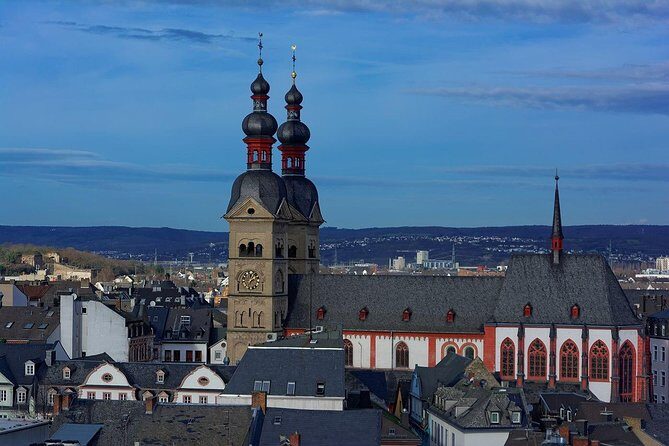
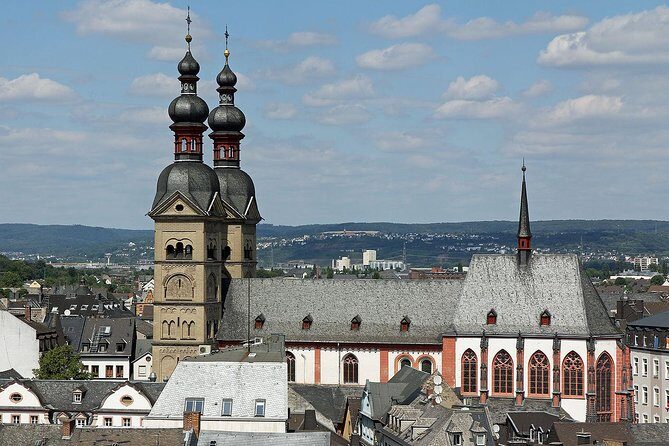
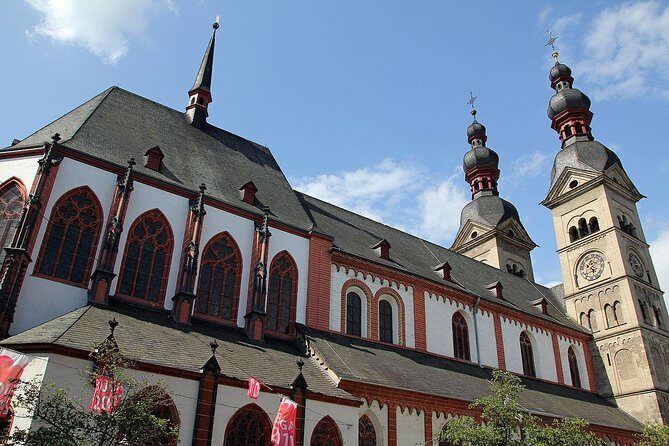
Next comes Liebfrauenkirche, known for its onion domes and for sitting at the highest point in the city. Even if you don’t memorize architectural terms, it’s the kind of landmark that makes you understand why people built churches visibly and deliberately.
The tour frames the location with an interesting urban detail: it’s where the romantic street between two churches begins. That matters because you’re not just seeing a building—you’re stepping into a small corridor of city planning. Streets like this are often where a town’s identity shows up most clearly, because they’re designed for movement and viewpoints, not for museum-style stopping.
Here’s the historical backbone you’ll hear: during the French Revolution, Liebfrauenkirche served as one of the main parish churches. It was constructed in the 17th century, destroyed in 1944, and rebuilt in 1955. That sequence adds texture to the building. It isn’t a “timeless” object. It’s a structure shaped by conflict and rebuilding.
Possible consideration: Since the church’s full story spans centuries and war damage, the short stop can feel like a teaser if you’re hoping for a long interior visit. Still, it’s an excellent way to set context before you choose what to revisit later on your own.
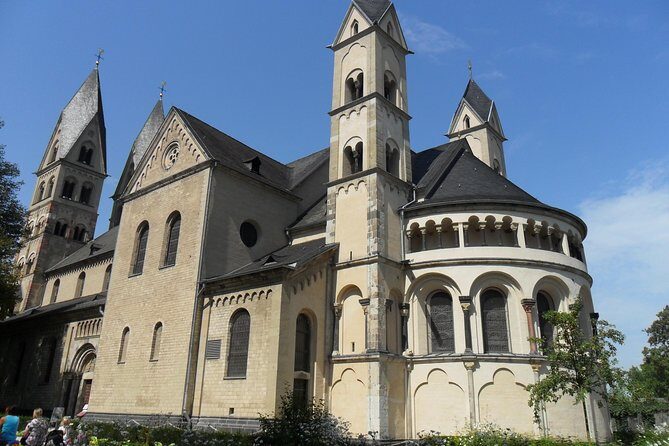
Basilica of St. Castor: A Carolingian Starting Point
From there you move to Basilica of St. Castor, which is the oldest church in Koblenz. This is one of those moments where the tour feels like it’s giving you the city’s “timeline anchor.”
The core detail is strong and specific: the church was constructed by the Archbishop of Trier between 817 and 836, with support from Emperor Louis the Pious. The tour explains it as a Carolingian proprietary church, which is a helpful phrase because it signals this wasn’t just a local project. This was part of larger power and religious organization in the early medieval world.
I like how this stop balances scale and clarity. You’re not asked to be a scholar to appreciate it. The details simply help you realize that St. Castor isn’t just old—it’s tied to who had authority at the time and how religious institutions were used and supported.
Practical tip: Look up and around as you pass. Even when you’re not going deep inside, the setting of a landmark church tells you a lot about the town around it—street alignment, sightlines, and how the building dominates its space.
Schangelbrunnen by City Hall: Koblenz’s French Connection
Then you reach Schangelbrunnen, a fountain near the city hall area that the tour treats as a symbol of Koblenz. This stop works well if you like civic identity—those moments where a town’s history becomes visible in public art.
The story behind the name is especially memorable. “Schängel” comes from Koblenz’s 20-year allegiance to France from 1794 to 1813. That’s the kind of historical connection that usually stays buried unless a guide brings it forward.
The fountain itself has a strong local authorship story. In 1940, it was designed by Carl Burger and dedicated to the famous poet Josef Cornelius. So this isn’t just a pretty photo spot. It’s a civic memorial with cultural roots.
If you’re trying to understand Koblenz as more than a stop on the way to something else, this is where it clicks. You see how political shifts and cultural pride end up as everyday landmarks.
Possible consideration: Because this is a fountain and public-square moment, it’s best treated as a pause and a viewpoint—great for photos and a quick mental reset—rather than a long “learn everything” stop.



Deutsches Eck: Kaiser Wilhelm and the Confluence View
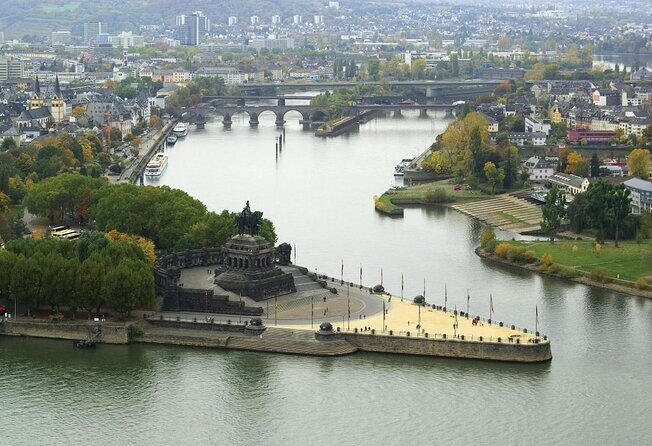
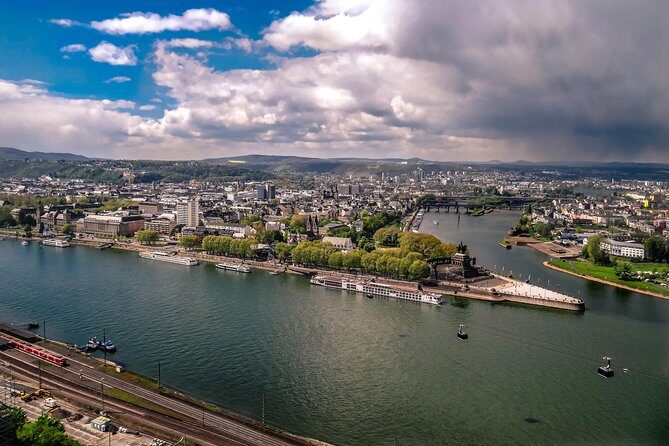
The walk ends at Deutsches Eck (German Corner), at the Konrad-Adenauer-Ufer. The tour describes it as the headland in Koblenz, and it’s also home to the Kaiser Wilhelm memorial. This is where the city’s geography becomes the main character.
Kaiser Wilhelm is the first German Emperor, and the memorial was erected in 1897. The name Deutsches Eck ties the place directly to national identity, but the real value for you is how the location frames the confluence: river meeting points create natural drama, and this area is designed for people to look out and take it in.
The tour also points out more famous sights along the end of the walk. Even if you don’t stop for every photo along the way, you’ll know what you’re seeing and why it matters.
Practical tip: Bring a phone strap or small steady-hands routine if you’re taking water/river photos. End-of-walk lighting can change fast, and this is usually when people start rushing for the best shot.
Value and Price: What $420.53 Per Group Really Buys You
The price is $420.53 per group, up to 15 people, for about 2 hours. At first glance, it can sound steep. But in practice, it’s often good value when you compare what private orientation is worth in a place like Koblenz—small enough that you can walk easily, but compact enough that a guide’s context saves you from wandering in circles.
Also, you’re not paying for expensive museum admissions. The listed stops are ticket-free, so your money goes toward guidance and storytelling rather than venue costs. You get an English-speaking experience, plus a mobile ticket, so the friction is low.
Another hidden value point: timing. The experience has multiple daily tour times, and it’s typically booked about 27 days in advance on average. That suggests it’s a popular “first day in town” option. If you’re traveling high-demand weeks, booking sooner is a smart move.
Who This Tour Suits Best
This is tailor-made for you if:
- it’s your first time in Koblenz and you want a quick, accurate mental map
- you like church landmarks but don’t want a long, exhausting itinerary
- you’re traveling with a small group and want the flexibility of a private setup
- you want a guide to connect monuments to how the city developed
It’s less ideal if you’re a repeat Koblenz visitor who already knows the basics and wants a deeper, longer format focused on interiors, museums, or architecture heavy details. For most first-timers, though, it’s a solid starting point.
How to Make the Most of Your 2 Hours
You’ll get the best results if you do two small things:
- Wear shoes you’re comfortable walking in. The total time is short, but it’s a true stroll.
- After you finish at Deutsches Eck, take a moment to decide what you want to revisit. This tour gives you names, eras, and themes; now you can pick the one stop you want to linger at more.
If you’re the type who likes to photograph, plan to use your last quarter-hour for images. End points often become your photo payoff, and Deutsches Eck is that moment here.
Should You Book This Koblenz Old Town and Deutsches Eck Tour?
Yes, you should book it if you want an efficient, English-friendly way to understand Koblenz without doing homework first. The best part is the balance: you get the big recognizable sights—Liebfrauenkirche, St. Castor, Schangelbrunnen, and Deutsches Eck—and you also get the why behind them, from the Romans at the confluence to the French-era name thread of Schängel.
Book if you’re traveling with friends or family and want it to feel personal. It’s a private group format, short enough to fit almost any schedule, and free-entry stops keep it from turning into a budget-buster.
Skip it only if you already know Koblenz well and you’re looking for a longer, more specialized deep study. For first-time orientation, it’s a strong choice.
FAQ
How long is the Koblenz Old Town tour including Deutsches Eck?
It runs for about 2 hours.
Where does the tour start and end?
The tour starts at Münzplatz and ends at Deutsches Eck (Konrad-Adenauer-Ufer).
Is the tour private?
Yes. It’s a private tour/activity where only your group participates.
What language is the tour offered in?
The tour is offered in English.
Are there admission fees at the stops?
The main stops listed are ticket-free, and the tour includes admission marked as free.
Can I cancel for a full refund?
Yes. You can cancel up to 24 hours in advance for a full refund.