REVIEW · KOBLENZ
e-Scavenger hunt Koblenz: Explore the city at your own pace
Book on Viator →Operated by Qula · Bookable on Viator
Solve Koblenz like a mystery trail.
This e-Scavenger hunt turns a self-guided walk into a game, using a mobile ticket and app prompts to nudge you from one landmark to the next at your own pace. I like that it covers big historic hits without locking you into a strict guided-tour timetable.
My favorite part is the built-in rhythm: you answer questions, find objects, and can use the pause feature when you want an extra look. One drawback to plan for: if the app navigation or translations act up, you may need to fall back on your own sense of direction and patience.
In This Review
- Quick take: what makes this Koblenz hunt worth your time
- How a phone game makes Koblenz feel navigable
- Price and value: $37.33 for up to 6 people
- Starting at Münzplatz: set your tempo and your expectations
- Münzplatz and Church of Our Lady: the old-city silhouette
- The Four Towers area and a cozy square break
- Deutsches Eck: where the Moselle meets the Rhine
- St. Kastor and the 2000-year Koblenz fountain marker
- Electoral Palace and Prussian government: the power layer cake
- Town hall in a former Jesuit college
- Statues and poetry: the bronze boy fountain
- Level house, cranes, and the Old Castle’s archive feel
- St. Florin’s Church and the Romanesque World Heritage note
- The 14th-century stone bridge to Lützel
- Practical tips: phones, GPS trouble, and finding the spots fast
- Who should book this e-Scavenger hunt in Koblenz?
- Should you book e-Scavenger hunt Koblenz?
- FAQ
- How long is the e-Scavenger hunt in Koblenz?
- What is the price for the tour?
- Is it a private activity?
- Is the hunt available in English?
- Where does the scavenger hunt start and end?
- Do I need to use a smartphone?
- What ticket format do I get?
- What time can I do it?
- Can I cancel and get a full refund?
- Are service animals allowed?
Quick take: what makes this Koblenz hunt worth your time

- Self-paced city walk that works well for groups with mixed energy levels
- Landmark-focused challenges tied to real Koblenz sights, not random trivia
- Built-in pause moments so you can stop for photos or a coffee break
- Easy question style that tends to suit families and casual explorers
- A route that mixes eras from early medieval churches to Prussian administration
- Mobile ticket experience designed for straightforward phone use in English
How a phone game makes Koblenz feel navigable
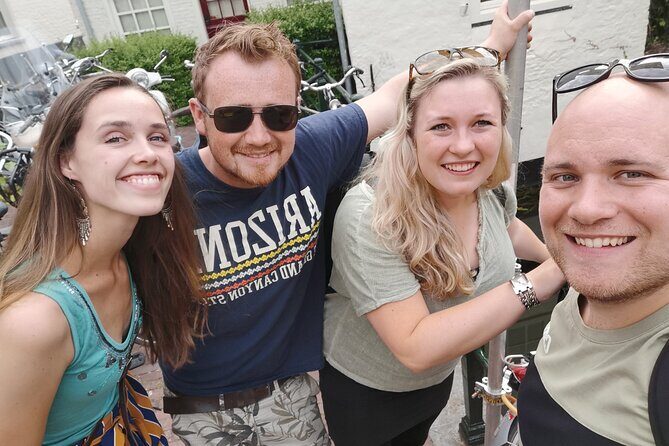
Koblenz is perfect for this kind of outing because it’s compact, scenic, and full of layers. This hunt gives you a sequence of stops and keeps you moving with prompts, challenges, and short facts. Instead of wandering aimlessly, you always have a next target.
You’re not stuck with a live guide’s voice or a fixed pace. You can walk slower if the rivers are calling or faster if you’re in museum-skip mode. The app experience is also designed to be useful for different needs, and it’s offered in English.
One practical note: the experience relies on your smartphone, and data is not included. So you’ll want a plan before you start—either ensure you have mobile data or some offline mapping ready—so the hunt doesn’t turn into a signal-hunting contest.
You can also read our reviews of more city tours in Koblenz

Price and value: $37.33 for up to 6 people
At $37.33 per group (up to 6), this can be a very cost-friendly way to do Koblenz compared with per-person paid activities. The math works best when you have a small gang—friends, a couple plus kids, or a family unit—because the cost stays flat as your group size grows.
You’re also buying more than just “go see these spots.” You’re getting a structured walk that tells you what to look for at each stop: what the place is, why it matters, and how it connects to Koblenz’s story. Even if you already know a bit, you’ll still get a few facts you probably missed on your own.
That said, not every version of the app experience feels equally smooth. Some people found that certain parts of the app felt complicated or that location finding could be tricky. If you’re the type who gets irritated by tech hiccups, come with backup patience.
Starting at Münzplatz: set your tempo and your expectations
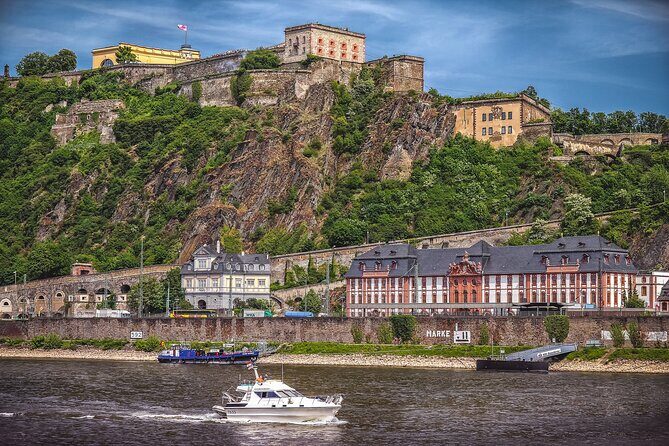
The hunt starts at Münzpl. 15, 56068 Koblenz and ends back near the same meeting point. The total time runs about 2 to 4 hours, which is a comfortable window for a city walk: long enough to see a lot, short enough that you won’t feel wrecked afterward.
The route is built for flexible pacing, and the questions aren’t designed to be ultra-hard. That’s a plus for families and for travelers who just want an enjoyable way to get oriented. If you’re looking for deep, academic-level history, you’ll probably still want to read a bit more on your own after the walk.
Also, the schedule is wide open: it’s available essentially any time of day during the listed operating window. So you can slot it into your itinerary based on weather and energy.
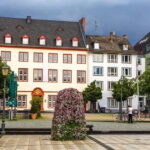
Münzplatz and Church of Our Lady: the old-city silhouette
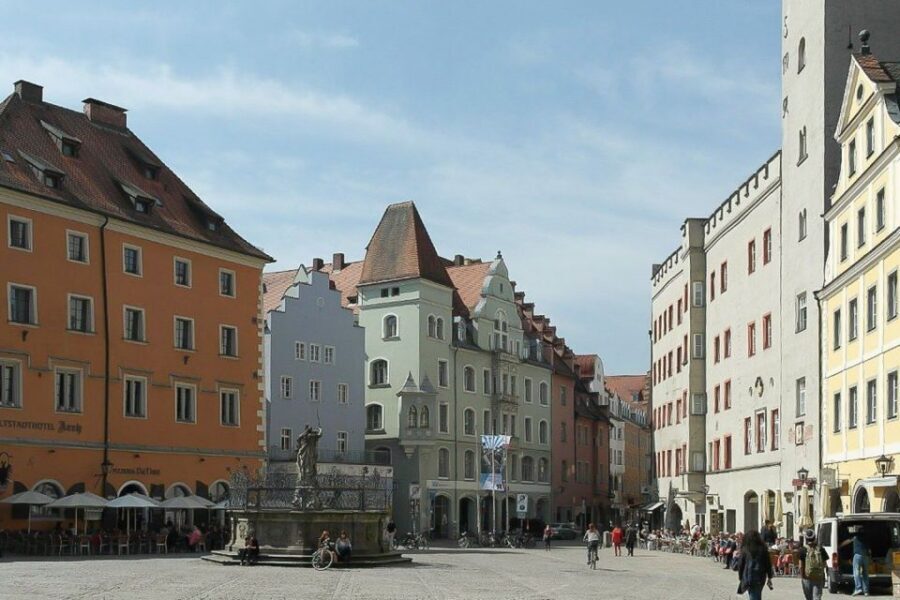
You’ll begin in the old-town zone near Münzplatz, a square whose name points to the area’s former electoral coin. It’s a small detail, but it sets the tone: Koblenz wasn’t just a pretty stop—it was a power center with money and influence.
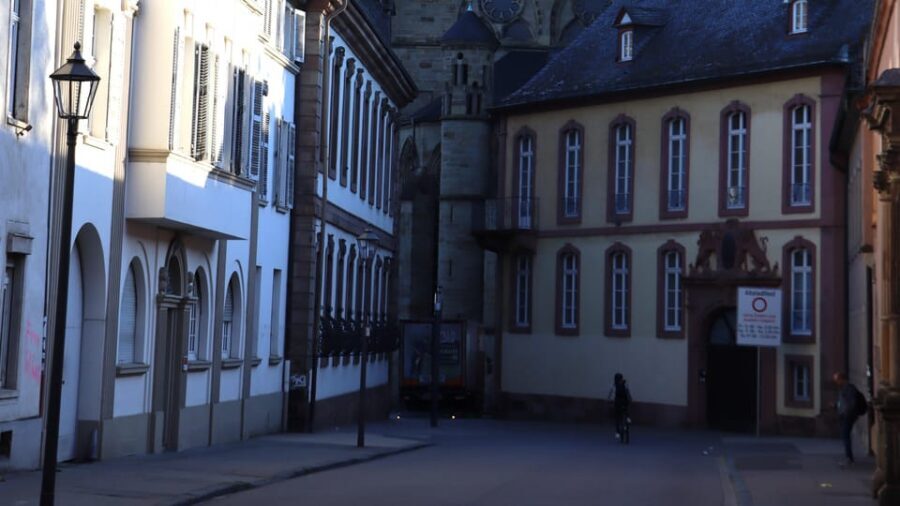
From there, you’re led toward the Church of Our Lady, which sits near the highest point of the city center. The key idea here is visibility. This church, along with nearby churches including St. Kastor and St. Florinus, helps define the skyline shape you’ll notice as you move around the old town.
For me, this is one of the nicest “orientation” moments in the whole experience. Even if you’re not a church person, being told why a building is visible and meaningful makes you look at the city differently.
The Four Towers area and a cozy square break
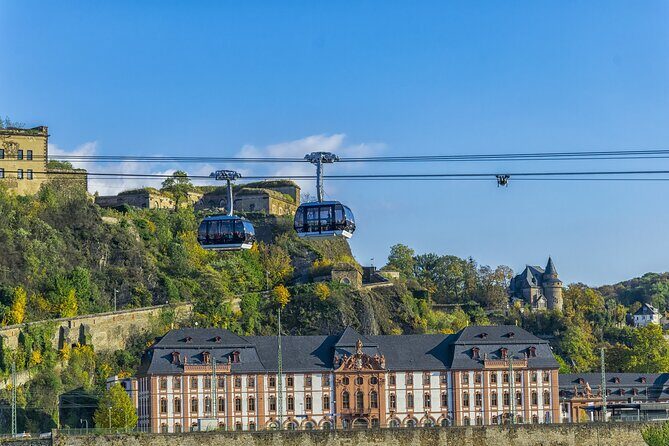
Next comes a cluster in the old town: the Vier Türme—an ensemble of four historic buildings right at the crossing of Am Plan, Löhrstraße, and Altengraben. This stop is worth it because it gives you a visual puzzle: multiple historic facades in one tight space. You’ll likely find yourself slowing down just to compare the buildings.
The route also includes a “wander and then arrive” kind of stop: you walk through Koblenz and then land at a photogenic square with a cozy feel, attractive facades, and terrace life. Even without a grand landmark here, this is a smart design choice. It breaks up the longer historical stretches with a place that feels like you can breathe, snack, or take photos without rushing.
If you’re traveling with kids, this kind of pause point matters. It turns the hunt from pure walking into something more playful and social.




Deutsches Eck: where the Moselle meets the Rhine
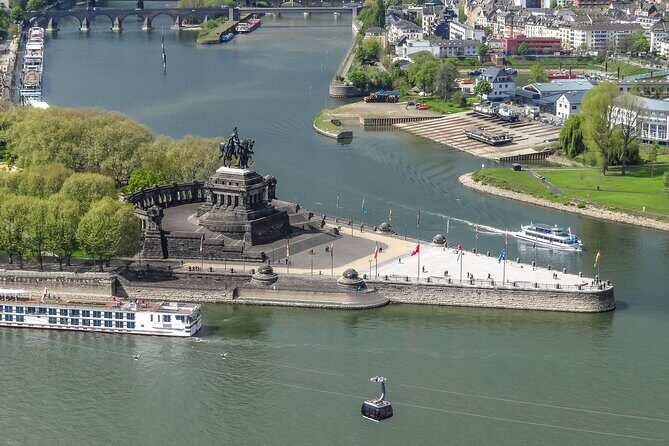
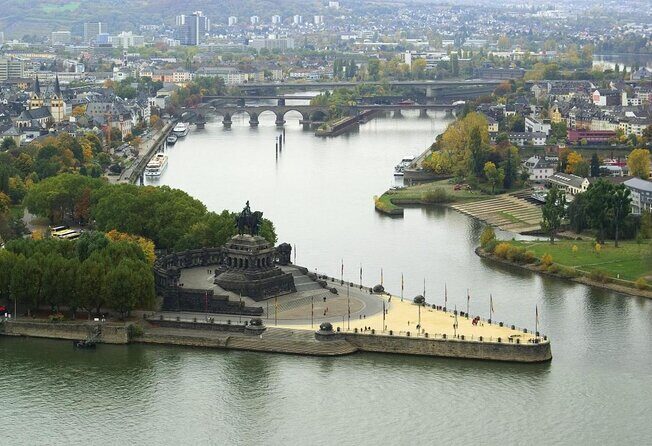
This is the Koblenz headline. The route takes you to Deutsches Eck, the artificial headland marking where the Moselle flows into the Rhine. On that spit of land stands a national monument tied to German unity—so you’re not just looking at a pretty river junction. You’re standing at a meaningful civic moment.
Expect crowds here, especially around the classic viewpoint. Many visitors also arrive from the big tourist boats, so the area can feel busy. That’s not a deal-break, but it’s helpful to plan your mood: if you want quiet, aim for off-peak timing or be ready for the lively atmosphere.
This stop works especially well for the game format. A landmark like this is easy to spot and easy to understand once the app prompts you with the right context.
St. Kastor and the 2000-year Koblenz fountain marker
From Deutsches Eck, the hunt heads to the Basilica of St. Kastor, a Roman Catholic church in the old town. It was built in the years 817–836 and sits right in the Deutsches Eck area. Even if you glance quickly, the age alone helps you feel the scale of time here.
Then you’ll reach a fountain with a large column that tells the past of 2000 years of Koblenz. A lot of tourists stop at it, including visitors coming from boat tours. It’s a useful “reset” moment: you get a condensed time-line feeling before continuing deeper into the city’s specific institutions and buildings.
If you’re the type who hates staring at plaques, don’t worry. The hunt’s job is to make that information feel like part of the walk, not like an assignment.
Electoral Palace and Prussian government: the power layer cake
Koblenz has always been strategically placed, and the hunt shows that through civic and governmental sites.
The Electoral Palace is one of the stops: it was the residence of the last Archbishop and Elector of Trier. That title tells you this wasn’t a minor role in the region. The stop nudges you to see the building as a seat of authority, not just a pretty structure.
You’ll also encounter the Prussian government building in the Rhine Park. It served as the seat of the Prussian government for the Koblenz administrative district of the Rhine Province. Put together, these stops help you understand why Koblenz keeps showing up in big political stories: it sits where rulers needed to be.
A useful mindset here: try to spot what changes between eras. Even without a lecture, you can often feel the differences in style and function when the app frames the building for you.
Town hall in a former Jesuit college
Another historic thread: the route includes the town hall of Koblenz, which is now located in a former Jesuit college in the old town. This is the kind of adaptive reuse that makes travel cities feel alive. Old spaces find new purposes, and you get a sense of continuity without freezing the past in place.
In a scavenger-hunt format, this kind of stop can be surprisingly rewarding. Instead of simply walking past an official-looking building, you’re encouraged to treat it as a story milestone.
Statues and poetry: the bronze boy fountain
The hunt also includes a fountain with a bronze statue of a boy, made by Carl Burger and dedicated to the poet Josef Cornelius. This is one of those details that’s easy to miss if you’re walking fast. It’s also a good example of the hunt doing what it’s supposed to do: turning an ordinary street corner into a small cultural find.
If you like noticing craft—sculptors, plaques, street art style details—this stop is a nice payoff.
Level house, cranes, and the Old Castle’s archive feel
Next up is the level house, built around 1609. It originally served as a Rhine crane. Then in 1839, it became a gauge house station. That combination of purpose is a big clue to Koblenz’s working relationship with its rivers: transport, measurement, and control mattered.
The building’s roof crane was removed around 1900, and it was later expanded by another floor for the 2011 Federal Horticultural Show. In other words, it’s not just ancient or historic—it’s layered and still evolving.
After that, you reach the Old Castle, founded in the 13th century and owned by the Elector. Today, it’s reduced to the later Burghaus, where the city archive is located. Even if you don’t go inside, the point is clear: this is a former power site that still shapes the city’s footprint.
This cluster is one of the most “Koblenz-specific” parts of the walk. The game format keeps it from becoming a blur of dates.
St. Florin’s Church and the Romanesque World Heritage note
The route includes St. Florin’s Church, an Evangelical church in the center of Koblenz. It was built around the year 1100 and belonged to the Florinusstift.
One of the app’s framing points here is the Romanesque weight: it’s described as one of the most important Romanesque church buildings in Germany, and the church is on the World Heritage listing since 2002. Even if you’re not a history nerd, that’s a strong indicator you’re in a place that sits within a wider protected cultural landscape.
For photos, the church area is typically a good pause spot. For walking, it’s a solid anchor: the old town’s silhouette and architectural style come together here in a way that feels more coherent than just hopping between random sites.
The 14th-century stone bridge to Lützel
The final major outward-looking stop is a 14th-century stone bridge over the Moselle, described as the oldest surviving bridge in Koblenz. It connects the old town with the Lützel district.
This is a great ending because it shifts you from buildings back to movement. After you’ve absorbed churches, palaces, government sites, and monuments, the bridge gives you that last wide-angle feeling: water, crossing, and the sense of how Koblenz’s geography made its history inevitable.
If your phone battery is low, this is the point where you’ll appreciate the app’s structure. You’ll know where you are in the route and what’s left to finish.
Practical tips: phones, GPS trouble, and finding the spots fast
This hunt is meant to be easy. Still, I’d plan for real-world travel conditions.
Bring a fully charged phone. The experience is app-led, and smartphone + data aren’t included, so you want fewer surprises. If your signal is spotty near rivers, keep offline maps handy.
Also, be prepared for navigation quirks. If the app’s GPS isn’t locking in smoothly, you may need to use your own navigation to locate stops. To reduce stress, I like the strategy of saving the start point in your map app, then following the walk cues step by step even when the hunt’s directions feel vague.
Finally, watch for translation oddities. Some clue text and question phrasing can feel off in English, so if something seems confusing, don’t panic. Move to the listed spot, look around, and use the surroundings to guide your answer.
Who should book this e-Scavenger hunt in Koblenz?
This is a smart fit if you want a self-guided game that still covers major sites. It works well for:
- families who want a more playful way to walk the old town
- friends who don’t all want the same pace
- visitors who like practical facts tied to real places
- anyone who prefers flexibility over a strict guided schedule
If you want deep lectures or a museum-style experience, you might find the hunt’s information brief. In that case, pair it with a bit of reading afterward, or use it as your orientation walk so you know what to research on day two.
Should you book e-Scavenger hunt Koblenz?
I’d book it if you’re comfortable using your phone for navigation and you like the idea of learning as you go. The price per group is reasonable, the route hits iconic spots like Deutsches Eck, and the walking flow makes Koblenz feel organized without feeling scripted.
Skip it—or go in with extra patience—if you strongly dislike app-based activities, or if you know you’ll struggle with smartphone tech while outdoors. A scavenger hunt lives and dies by your willingness to troubleshoot for a few minutes and keep moving.
FAQ
How long is the e-Scavenger hunt in Koblenz?
It takes about 2 to 4 hours to complete, depending on how often you pause and explore.
What is the price for the tour?
The price is $37.33 per group, for groups of up to 6 people.
Is it a private activity?
Yes. It’s listed as a private tour/activity, so only your group participates.
Is the hunt available in English?
Yes. It’s offered in English.
Where does the scavenger hunt start and end?
It starts at Münzpl. 15, 56068 Koblenz, Germany and ends back at the same meeting point.
Do I need to use a smartphone?
Yes. The experience involves an online game and city walk on your phone, and use of smartphone and data are not included.
What ticket format do I get?
You’ll receive a mobile ticket.
What time can I do it?
The listed opening hours run Monday–Sunday, 12:00 AM to 11:59 PM (within the overall availability dates shown).
Can I cancel and get a full refund?
Yes. You can cancel up to 24 hours in advance for a full refund.
Are service animals allowed?
Yes, service animals are allowed.