REVIEW · HAMBURG
Hamburg 3-Hour Bike Tour
Book on GetYourGuide →Operated by Hamburg City Cycles · Bookable on GetYourGuide
Hamburg shows its best face from a bike, and I love the Alster Lakes glide plus the photo-and-story moments in the Speicherstadt. The ride is mostly easy, but the tour does put you in real urban traffic sometimes, so don’t book it if you hate cycling near cars.
In about 3 to 3.5 hours, you’ll bounce between old port wonders and modern Hamburg: St. Michael’s Church, the Town Hall area, HafenCity, and then down toward the piers and the Reeperbahn, with stops at each attraction and a coffee break built in.
In This Review
- Key things to know before you pedal off
- Starting at St. Pauli: where the tour really begins
- The easy ride that still feels like you earned it
- From St. Pauli to the Alster Lakes: the neighborhood warm-up
- Town Hall and the grand civic feel
- Speicherstadt: old warehouses, big stories
- HafenCity and modern Hamburg in the same breath
- St. Michael’s Church and the best use of a church stop
- Piers and Reeperbahn: where Hamburg gets loud
- Stops, coffee, and guide time: why this route feels worth the hours
- Where the route can feel tricky: traffic and pace
- Price and value: why $46 can make sense
- Who should book this, and who should pause
- Should you book the Hamburg 3-Hour Bike Tour?
- FAQ
- Where does the tour meet?
- How long is the Hamburg bike tour?
- What sights do you see?
- What’s included in the price?
- Are food and drinks included?
- What languages is the guide available in?
- Is the ride difficult?
- Should I reserve for children?
Key things to know before you pedal off
- Flat, easy city riding means you can focus on sights, not survival.
- Spotlight stops at major landmarks give you context and time for photos.
- Old-meets-new Hamburg: Speicherstadt and HafenCity in one smooth route.
- St. Pauli to the Alster is a great flow of neighborhoods, not a random scatter of sights.
- Rain plan available (raincoats have been provided on wet days for some groups).
Starting at St. Pauli: where the tour really begins
This tour starts at Hamburg City Cycles, right on Gebrüder-Wolf-Platz (Hopfenstr. 15b). It’s a simple find: the shop sits on the square with an Aldi and a bakery, and you’ll be about 150 meters from Taubenstraße’s southern end, near the Reeperbahn area.
I like this meeting point because it puts you in the right neighborhood from the start. St. Pauli has that lived-in, port-city feeling, and you’re not stuck in a museum-only part of Hamburg. Also, the tour begins with bike selection—arrive about 10 minutes early so you can get a comfortable fit and avoid that first-minute stress.
You get a bicycle as part of the price, plus a basket and a helmet if required. That basket is small but useful if you’re carrying a camera, a bottle, or a layer you’ll ditch once you warm up.
You can also read our reviews of more cycling tours in Hamburg

The easy ride that still feels like you earned it
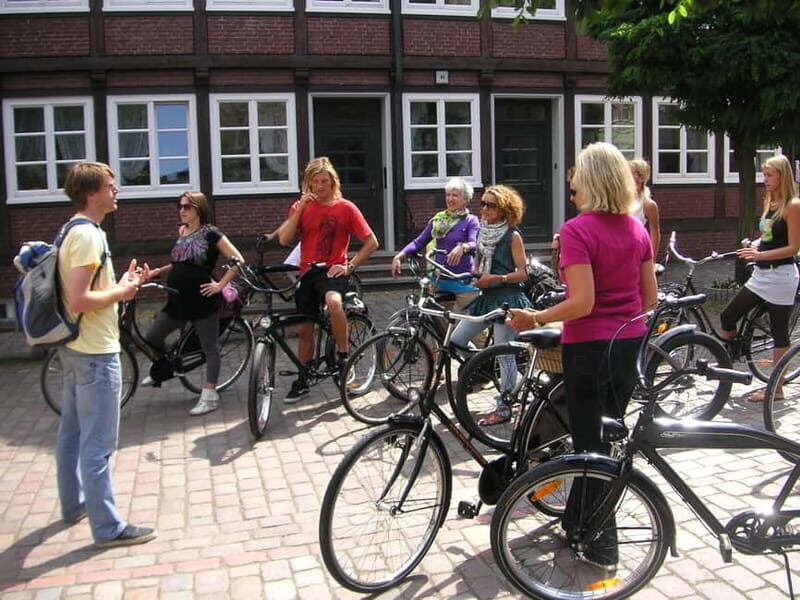
Hamburg is famously flat, and this matters more than you might think. Flat terrain lets you keep a steady pace without constantly working against hills, wind, or awkward gear changes. The result is that you actually enjoy the city instead of just trying to survive the ride.
The tour is designed for a wide range of ages and riding abilities. That said, the main caution is not your legs—it’s your comfort with biking in a real city. Hamburg has traffic and bike lanes that can vary block to block, so if you’re tense around cars or you’re brand-new to city cycling, you’ll want to mentally prepare for a few moments that feel busier than the “pretty promenade” parts.
One more practical point: plan for the full experience timing. The duration is listed as 3 hours, but the tour experience runs about 3 to 3.5 hours in practice. That extra half hour is usually where the magic happens: more stops, more questions, more time to look.
From St. Pauli to the Alster Lakes: the neighborhood warm-up
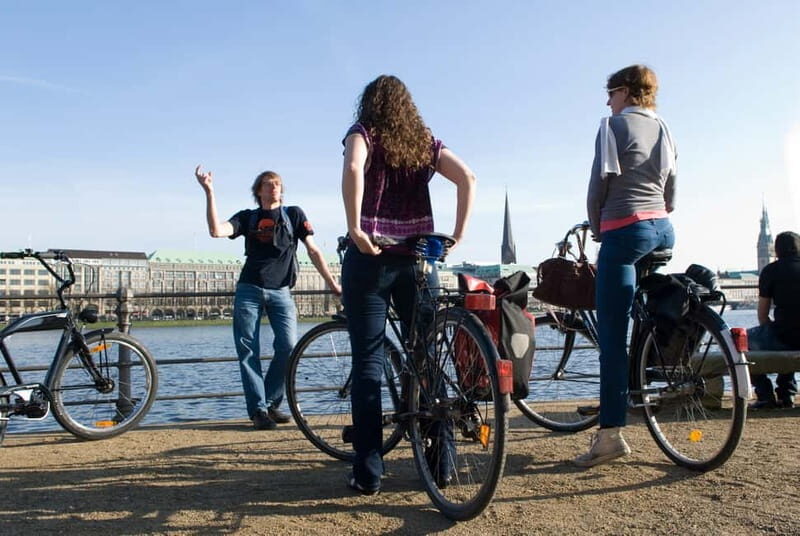
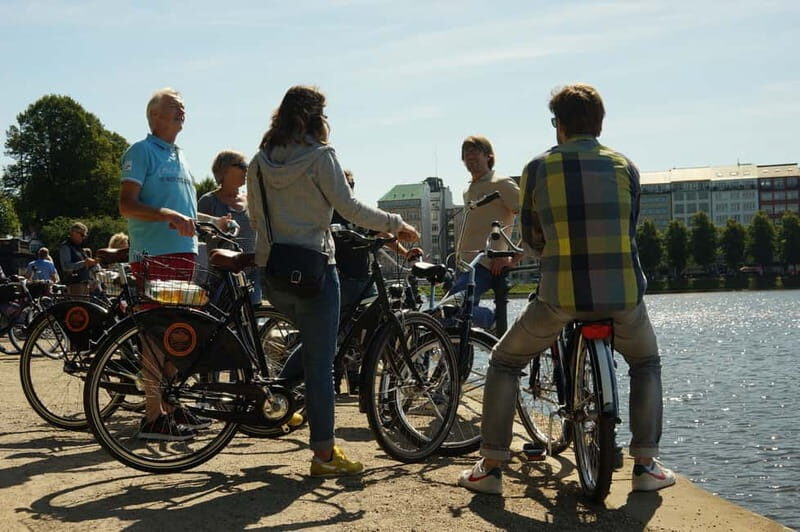
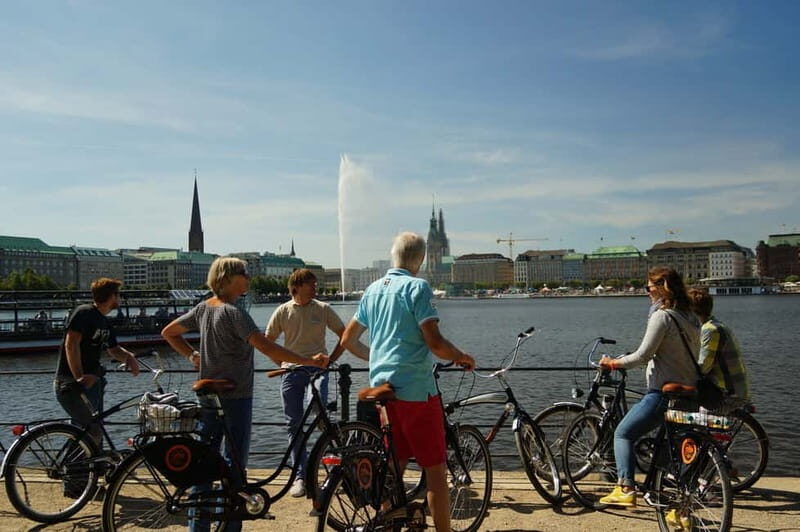
After the start in St. Pauli, you ride through Heiligengeistfeld and then head toward the Outer Alster Lake and Inner Alster Lake. This is a smart sequence because it gets you out of the densest area early, then eases you into open views.
Heiligengeistfeld acts like a launchpad—big, open, and easier to find your rhythm. Then the Alster lakes take over with that calm, reflective water that Hamburg does well. If you’ve ever visited a city and felt like everything blended together, this section helps you set a visual baseline: water, promenades, and classic city geometry.
Your guide also uses stops to slow you down at the right moments. You’re not just passing scenery; you’re getting small packets of information at each attraction, with time to take photos and ask questions. That turns “I saw a lake” into “I understand why this lake matters to how Hamburg grew.”
Town Hall and the grand civic feel
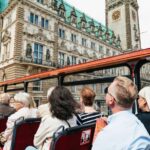
From the lakes, the route moves you into the more civic, central side of the city, including the Town Hall area. Even if you’re not into government architecture, a stop here helps you connect Hamburg’s identity with its shipping-driven prosperity.
Cycling past major civic buildings gives you a different angle than the usual sidewalk approach. You also get a pace that feels efficient but not rushed. The guide’s commentary is typically woven into what you’re seeing right now, so it lands better than reading a placard while you’re standing still.
One thing I appreciate about this style is that you’re learning while you move. It keeps the ride from turning into a series of random photo stops where everyone stares, snaps, and moves on.
Speicherstadt: old warehouses, big stories
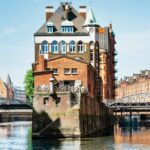
Speicherstadt is the star attraction for many people, and it’s easy to see why. You’ll ride past and stop near this UNESCO World Heritage area, where historic warehouse buildings shaped the port’s power.
What makes Speicherstadt click on a bike is the way you experience it in layers. You notice the brickwork and canal-like setting while you’re still moving, and then the stop time lets the guide explain the why behind the wow. That’s the difference between a quick glance and a real understanding.
This is also where the tour’s “off the main roads” feel shows up. Instead of being pushed along only the busiest pedestrian corridors, you get routes that make Hamburg feel more lived-in. And because you’re riding, you can cover ground without losing the ability to look closely.
Bring your camera for this section. You’ll want shots that show both the structures and the water-side layout, since the scenery works from multiple angles.
A few more Hamburg tours and experiences worth a look


HafenCity and modern Hamburg in the same breath
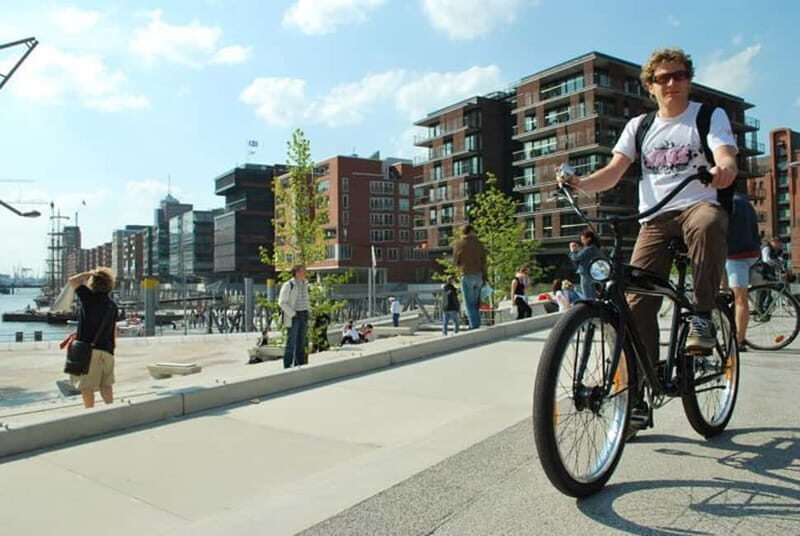
After Speicherstadt, you head into HafenCity. This part of Hamburg is all about the city’s forward motion—new architecture, redesigned waterfront areas, and the modern side of port life.
I like that the tour doesn’t treat these neighborhoods like separate “attractions.” By pairing Speicherstadt with HafenCity, you get a quick sense of continuity: the port past built the city’s muscle, and the modern waterfront is where that story is still being written.
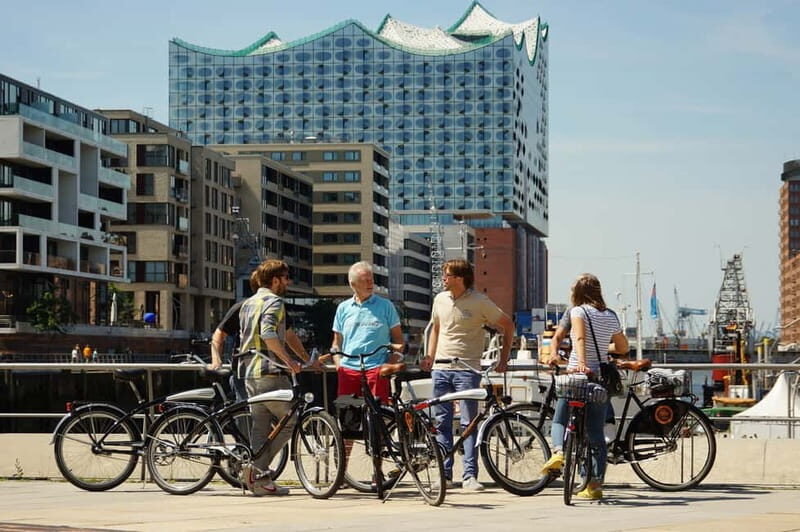
The Elbphilharmonie area is included, too, so you get the chance to see this landmark as the city’s cultural expression of a modern Hamburg. Even if you don’t go inside, the exterior views and surrounding waterfront context help you place it in the larger puzzle.
St. Michael’s Church and the best use of a church stop
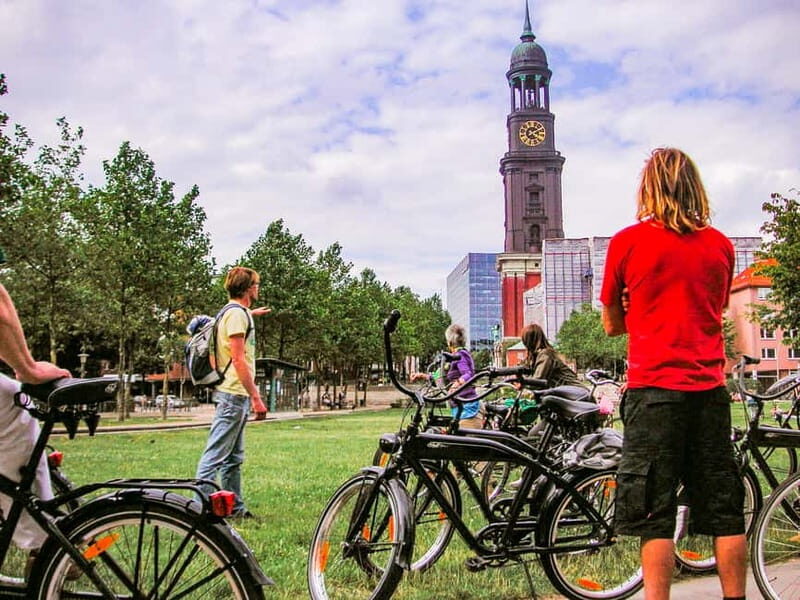
St. Michael’s Church (St. Michaelis) is on your route, with a scheduled stop. Church visits can feel like forced detours on tours, but this one tends to work because you reach it by bike—so you’re not stuck in a long transition from one mode of travel to another.
A stop at St. Michaelis also gives you a chance to slow down and look for details you might miss from the bike saddle alone. Since the guide is there to point out what matters—style, setting, and what the building symbolizes locally—you’ll leave with a clearer impression than a quick photo.
Even if you’re not a “church person,” you’ll probably appreciate this stop as a visual anchor. It breaks up the port-and-water rhythm with something distinctly Hamburg in tone and scale.
Piers and Reeperbahn: where Hamburg gets loud
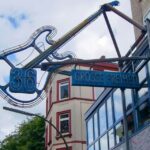
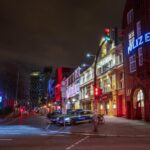
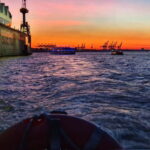
The tour loops back toward St. Pauli, and then you ride to the piers and the world-famous Reeperbahn. This is the “port city at street level” finale.
Reeperbahn is known for its nightlife energy, but on a bike tour it’s not about partying—it’s about seeing how the neighborhood breathes: storefronts, side streets, and the mix of visitors and locals that gives the area its character.
Ending near the piers also helps the whole tour feel balanced. You’ve spent time on historic warehouses and modern waterfronts, then you finish in a neighborhood that reminds you Hamburg is still a working city, not just a postcard.
If you want a final taste of Hamburg to extend on your own, this is a solid place to get it. You’ll have enough orientation by then to decide whether you want a late coffee, a longer waterfront walk, or a wander through back streets.
Stops, coffee, and guide time: why this route feels worth the hours
Most highlight tours are either fast and forgettable or slow and exhausting. This one tries to be both efficient and human.
At each attraction you get:
- a guided moment with interesting context,
- time for photos,
- and chances to ask questions.
That question time matters. Good bike tours aren’t just lectures—they’re conversations where the guide helps you connect what you’re seeing to how Hamburg works. Several guides leading this tour have been praised for answering questions in a friendly way and keeping the group together, even when conditions change.
There’s also a coffee break. That might sound minor, but it turns a 3-hour ride into an actual experience. You stop, reset, and then ride again with better energy (and better photos).
And yes—if weather turns ugly, you might be glad you booked this. Complimentary raincoats have been provided on wet days for some groups, which is a big deal in a city like Hamburg where the sky can change its mind.
Where the route can feel tricky: traffic and pace
Here’s the fair warning: this is a city-bike tour, not a car-free trail day. Even with careful routing, you’ll encounter junctions, sidewalks, and segments where you share space with vehicles.
So I recommend you do two things before the ride:
- If you’re not a confident city cyclist, mention it to the guide at the start.
- If you’re feeling uneasy, ask about pace early. It’s easier to adjust expectations at the beginning than to struggle for an hour.
Comfort also depends on bike fit. That’s why arriving 10 minutes early matters. A good saddle height and handlebar reach can turn “workout” into “easy sightseeing.”
Some riders have also noted that the tour can feel longer if you’re not used to biking in Europe’s traffic mix. That doesn’t make the tour bad—it just means your personal comfort level will shape your experience.
Price and value: why $46 can make sense
At $46 per person for about 3 to 3.5 hours, this tour has good value if you’re trying to maximize time in a short Hamburg stay.
Here’s what you’re paying for beyond the bike:
- live guide in German or English,
- bicycle included,
- helmet if required and a basket,
- stops at major highlights with explanation time,
- and a coffee break.
Food and drinks aren’t included, so you’ll still want to plan for that separately. But the structure is what you’re getting: an organized route that hits the biggest names—St. Pauli, the Alster lakes, Town Hall, Speicherstadt, HafenCity, St. Michaelis, the piers, and Reeperbahn—without you needing to map everything yourself.
If you’re the type who would otherwise spend your first day piecing together public transit and walking between areas, a tour like this can save you decision fatigue. You get orientation fast, plus local perspective that’s hard to get from a guidebook alone.
Who should book this, and who should pause
This tour is a great match if:
- you want a fast overview of Hamburg’s top neighborhoods,
- you’re comfortable with easy cycling and occasional urban traffic,
- you like explanations at stops instead of just riding through sights.
It’s also a good choice for families and mixed-age groups because the terrain is flat and the pace is built to be “easy-going.”
I’d think twice if:
- you strongly dislike biking near cars,
- you want a fully car-free, peaceful route the entire time,
- or you’re looking for deep museum time. This is a highlights route with quick stops, not an inside-the-building day.
Should you book the Hamburg 3-Hour Bike Tour?
If your goal is to get oriented and see the core of Hamburg without burning your day, I’d say yes. The route connects the city’s water sides (Alster and waterfront), its historic engine (Speicherstadt), its modern direction (HafenCity and Elbphilharmonie), and its street-level energy (St. Pauli piers and Reeperbahn) in one smooth ride.
Book it especially if you like the idea of a guide who stops often, answers questions, and helps you notice more than you would on your own. Just go in with realistic expectations about city cycling: it’s easy on the legs, but not risk-free for beginners. If you’re comfortable with that, you’ll come away with a much clearer, more personal picture of Hamburg than you’d get from walking alone.
FAQ
Where does the tour meet?
The meeting point is Hamburg City Cycles at Gebrüder-Wolf-Platz (Hopfenstr. 15b). It’s on the square with an Aldi supermarket and a bakery, about 150 meters from the Reeperbahn along Taubenstraße.
How long is the Hamburg bike tour?
The tour is listed at 3 hours, and the experience typically runs about 3 to 3.5 hours depending on the timing of stops.
What sights do you see?
You’ll pass through and stop at major Hamburg highlights including St. Pauli, the Alster Lakes, Town Hall, Speicherstadt, HafenCity, Elbphilharmonie, St. Michael’s Church, the piers, and the Reeperbahn.
What’s included in the price?
Included are the bicycle and the guided city tour. A basket is also included, and a helmet is provided if required.
Are food and drinks included?
No. Food and drinks are not included, though the tour includes a coffee break during the ride.
What languages is the guide available in?
The live tour guide is available in German and English.
Is the ride difficult?
Hamburg is very flat, and the tour is described as easy-going. It’s suitable for all ages and riding abilities, but you should still be comfortable cycling in a city environment.
Should I reserve for children?
Yes. Child seats or children’s bicycles should be reserved in advance.