REVIEW · GERMANY
Weimar Private Walking Tour With A Professional Guide
Book on Viator →Operated by Global Guide Services · Bookable on Viator
Weimar rewards slow walking. A private walking tour turns big names like Goethe and Schiller into real street corners, and a guide like Alexander or Tori can keep the story sharp and clear.
I especially like how the route stays compact and practical, so you’re not guessing where to look or what you’re seeing.
You’ll also like the easy pace. This is about 2 hours on foot, with all the main stops close together in a very pedestrian city.
One thing to consider: it’s walking-only, so if you’re hoping for lots of time sitting inside museums, you’ll need to plan separate visits on your own.
In This Review
- Key highlights worth your time
- A 2-hour Weimar loop with real names behind real doors
- Market Square and Theaterplatz: where classicism becomes a street map
- The House of the Weimar Republic: democracy’s story told in one walkable stop
- Saint Peter and Paul Church: Luther, Herder, and Anna Amalia in one stop
- Weimar Palace and Democracy Square: from ducal power to democratic space
- Anna Amalia’s Library and Park an der Ilm: letters, trees, and design thinking
- Goethe’s House on Frauenplan: the study where Faust took shape
- Liszt Haus and Schiller’s House: music lessons and the creative meeting point
- Price and logistics: does $244.41 per group feel fair?
- Who this walking tour suits best
- Should you book this Weimar Private Walking Tour?
- FAQ
- Where does the tour start and end?
- How long is the Weimar private walking tour?
- Is this tour private?
- What language is the tour offered in?
- Do I need transportation for this experience?
- How hard is the walking?
- How many people can be in the group?
- Do I get a ticket for the tour on my phone?
- What is the cancellation policy?
Key highlights worth your time
- Goethe and Schiller, mapped to actual squares and houses, not just a lecture
- Weimar Republic context in one spot, tied to 1919 decisions and what happened next
- Saint Peter and Paul Church connections, including Martin Luther and important burials
- Anna Amalia’s Library details, including a document linked to Goethe’s early presence
- A guide who answers off-script questions, not just a script read aloud
A 2-hour Weimar loop with real names behind real doors
Weimar can feel like a “literary city” on posters. On the ground, it’s something else. It’s a town of squares, memorials, churches, and palace fronts that let you see how Germany’s ideas played out in everyday places.
This private walking tour is built for that. You start near the Market Square, then move through the classicist heart of town: Theaterplatz for the Goethe and Schiller memorial, the Weimar Republic site, and the major cultural addresses tied to the writers and thinkers you’ve probably heard about in school. With a small private group (up to 15), your guide can pace the story to your questions instead of marching everyone on autopilot.
And the best part is the time math. About 2 hours is short enough to stay fresh, long enough to understand the through-line: Weimar as a place where culture, politics, and religion all rubbed shoulders. It helps that Weimar is pedestrian-friendly, so you’re not spending the tour “traveling between stops.”
You can also read our reviews of more walking tours in Germany


Market Square and Theaterplatz: where classicism becomes a street map
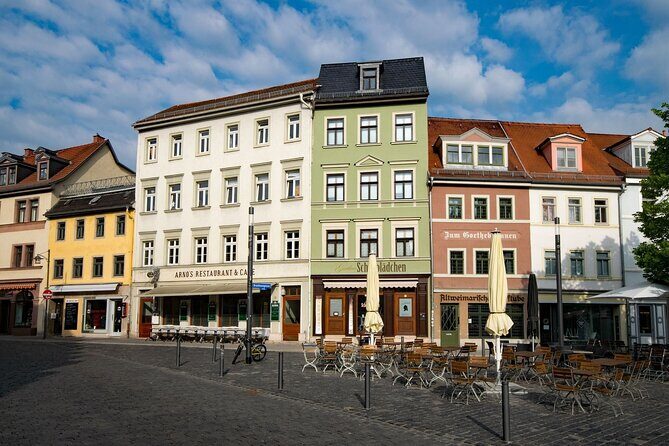
You begin at Market Square (Markt 20), a busy meeting point where the city’s identity shows up fast. The area has architecture that still reflects its older feudal days. You’re also in the right zone to understand why so many visitors come here for the classicists. Weimar is compact, so the important places feel like part of the same conversation.
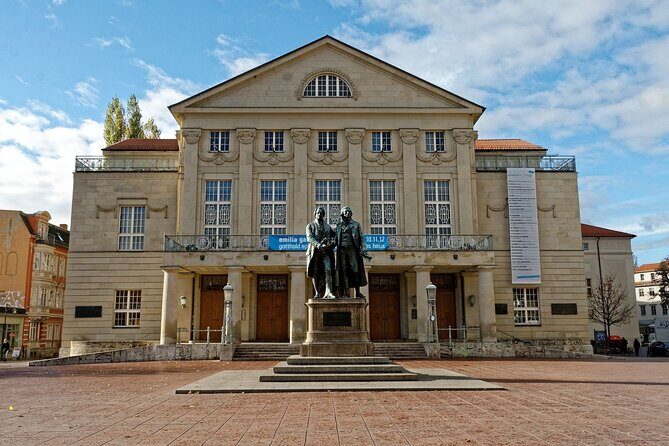
From there, you head toward Theaterplatz to meet the Goethe and Schiller memorial in front of the National Theater. This is where the story gains a key character: Anna Amalia. She’s described here as the dowager duchess who hosted major gatherings that included both writers. When you stand on the square, that hosting role makes more sense. It’s not just “they lived here.” It’s that Weimar had a system that let ideas gather, get tested, and grow.
A nice touch is how the guide connects nearby buildings to the larger theme of who held power and who shaped culture. You’re seeing the classicists in the same spaces that were once tied to courts and institutions.
What I like: you get the “why” behind what you’re looking at.
What to watch: if you arrive already exhausted from other sightseeing, this early focus on big names can feel like a lot. But the route is short and the guide can slow down if you ask.
The House of the Weimar Republic: democracy’s story told in one walkable stop
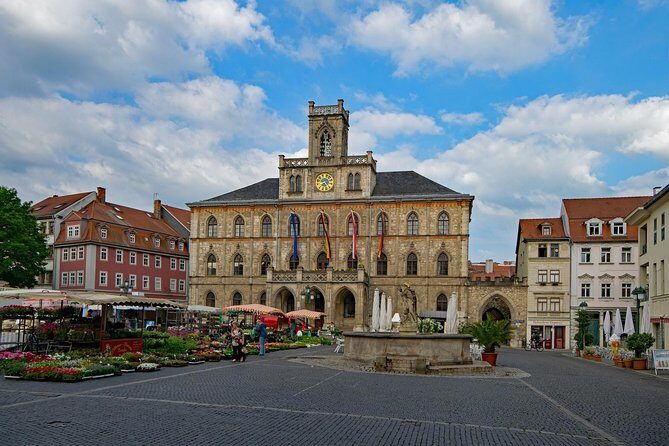
At The House of the Weimar Republic, the tour shifts gears from literature to political history. This renovated building is tied to 1919, when the National Assembly gathered to plan the future of Germany after World War I and the fall of the German Empire.
The guide connects the dots you might not know offhand: the Republic of Weimar was Germany’s first serious attempt to build democracy after defeat, and it was later destroyed when the Nazi party took power in 1933. That timeline can be heavy, but standing in the place where the National Assembly met makes it concrete instead of abstract.
Inside, the story is told through the Forum for Democracy. Even if you don’t spend much time inside during the walk, the point lands: Weimar isn’t just authors in stone. It’s also a real experiment in how a society tries to govern itself.
Value for your trip: this stop prevents the tour from becoming only a cultural highlights reel. It gives you a political backbone you can feel as you keep walking.
Saint Peter and Paul Church: Luther, Herder, and Anna Amalia in one stop
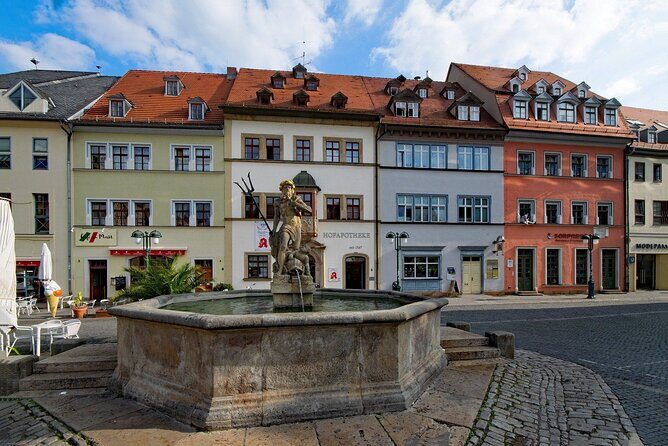
Next comes the Saint Peter and Paul Church, described as the most important church in Weimar. It sits on foundations from a 13th-century church, then was developed in the 16th century in Gothic style. The architectural mix matters because it mirrors the church’s changing role over centuries.
The religious history here is specific, not vague. The tour points out that the church was converted to Lutheran belief in the 16th century, and that Martin Luther himself preached there. Then it adds layers: theologian Johann Gottfried Herder is buried in the church, and he had been its superintendent. Duchess Anna Amalia is also buried there.
Before you even step fully into the historical weight of burials and conversions, you’ll notice the Herder Memorial in front of the church, dedicated in 1850. It’s a good example of how Weimar marks people who shaped ideas and belief, not just rulers.
Why this matters: it shows you how culture and leadership aren’t separate tracks in this city. Authors, theologians, and patrons were all part of the same ecosystem.
Weimar Palace and Democracy Square: from ducal power to democratic space
After the church, the walk heads to Weimar Palace, once the residence of the dukes of Saxe-Weimar and Eisenach. The tour description includes a key detail: the site began as a medieval castle and was first mentioned in the 10th century, then reshaped over and over after fires, eventually becoming the residential palace you can picture today. The time span here is huge—about 500 years of rebuilding and transformation.
That long development gives you a mental model for Weimar: this town keeps adapting its structures as political power and priorities shift.
Then comes Democracy Square, which used to be called the Duke’s Square. The location is surrounded by royal buildings, including the so-called red and yellow palaces and the house where Duke Charles Augustus lived. It’s a clever setup: you’re standing in a space that got rebranded as democracy later, right next to where ducal authority once anchored daily life.
This contrast is the reason this stop hits harder than it sounds. You’re not just learning a fact. You’re reading an old city in political layers.
You can also read our reviews of more guided tours in Germany



Anna Amalia’s Library and Park an der Ilm: letters, trees, and design thinking
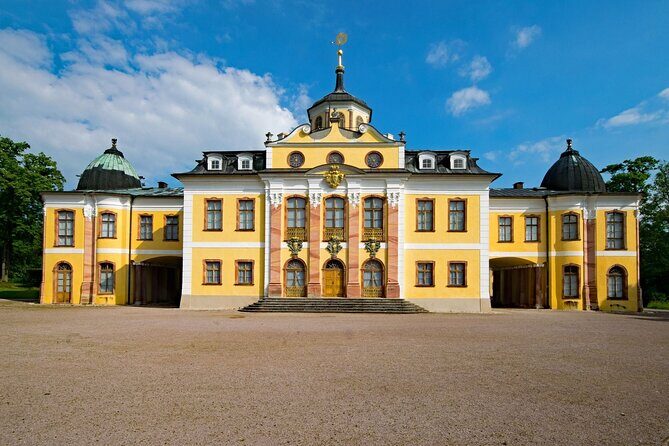
Right next to the Democracy Square area is Anna Amalia’s Library, a small palace that served as a library for centuries. The guide focuses on Anna Amalia’s role again—this time as a patron who supported the library decisively. The point is that access to books and learning wasn’t an accident; it was funded and protected.
One highlight tied to the library: a document that provides a first indication of Wolfgang von Goethe’s presence in the city. The tour also notes that Goethe ran the library for decades. When you hear that, you start to understand why Weimar’s cultural output feels so concentrated. It wasn’t only inspiration; it was access and time.
From there, you walk toward Park an der Ilm, created in the 18th century. The park is known for valuable trees and architectural gems, including ruins of the Tempelherrenhaus. Goethe wasn’t just a visitor here; he played a part in designing the park, and you’ll hear how he spent his first years in Weimar in a house given by Charles Augustus.
This is a good moment to reset your brain. After palaces, politics, and churches, the park gives you space to connect the ideas to place. It’s also an easy area to slow down and take in details at your own pace, since the tour keeps walking but doesn’t force a sprint.
Goethe’s House on Frauenplan: the study where Faust took shape

Next is Goethe’s House on Frauenplan, where he moved after 1782 into a more impressive residence. The tour emphasizes that many rooms still look like they did in the poet’s last years. That kind of continuity makes a difference. It’s easier to picture the man working if you aren’t constantly imagining what the room used to look like.
The most practical stop here is the study, linked to major works. The guide points out that the study where Goethe wrote, including works like Faust, is unchanged. It’s the kind of detail that turns a famous title into something you can connect to daily habits: writing, revising, thinking in a specific room.
Goethe stayed in Weimar until his death in 1832, and you’ll hear how his time in the city shaped both his writing and the cultural reputation Weimar gained.
Tip for you: when the tour reaches this house, lean into the small questions. Ask what the guide notices about how the rooms are arranged. Those answers tend to explain more than the obvious highlights.
Liszt Haus and Schiller’s House: music lessons and the creative meeting point
The tour adds musical momentum with Liszt Haus, where composer Franz Liszt lived for many summers as a gift from the local duke. The guide highlights something that makes this more than a postcard stop: Liszt taught young pianists from all over Europe for free in his Weimar home.
That detail changes how you think about celebrity in history. Liszt wasn’t only composing in private. He was teaching, pulling in students, and spreading skills beyond the ducal circle that supported him.
Then you reach Friedrich Schiller’s House, where the guide explains how an assembly brought Schiller and Goethe together. Goethe, impressed by Schiller, invited him to Weimar. After that, an intense creative association formed between them.
This is a great closing idea for the tour: it ties together the whole theme. Weimar as a place where the right people met, built relationships, and turned interaction into work that outlived them.
Finally, you head back to the Market Square for convenience, which makes the end feel easy to plug into the rest of your day.
Price and logistics: does $244.41 per group feel fair?
The price is $244.41 per group, up to 15 people, for about 2 hours. That’s private-tour pricing, not a per-person museum ticket.
Here’s how I’d judge the value:
- If you have a group of 3–6, you’re likely paying for the convenience of a guide-led route plus the ability to ask questions. In that case, the cost often feels reasonable because Weimar’s key stops are close together, so you’re getting a lot of explanation per hour.
- If it’s just two of you, the price can feel steep. But if you care about the meanings behind the squares and houses—especially the shift from classicism to the Weimar Republic—then the guide’s interpretation can be worth it.
Also note: you get a mobile ticket, the tour runs in English, and your guide can customize the walk on the spot. That flexibility matters in a small city where your interests might lean more religious, more political, or more writer-focused.
In short: this tour is strongest when you want a guided narrative, not just photos.
Who this walking tour suits best
This tour works well if you:
- want Weimar’s big names organized into a route you can follow without stress
- like history that connects places to real turning points (1919, 1933, and the thinkers tied to them)
- prefer an easy walk rather than a long day of museum hopping
It’s also a smart choice for first-timers. Even if you’ve heard of Goethe, Schiller, Luther, and Liszt, the tour links them in a way that helps you remember what each person represents.
Should you book this Weimar Private Walking Tour?
I’d book this tour if you want your Weimar visit to feel like a guided story across the city’s key addresses—especially if you care about the political and cultural mix, not just literature as wallpaper.
Skip it (or plan something else) if you mainly want to spend time inside lots of buildings during one sitting, because this is structured as a walking route with an easy pace rather than a long, indoor museum day.
If you do book: wear comfortable shoes, bring a phone for the mobile ticket, and don’t be shy about questions. The guide’s strength is answering beyond the basic talking points, and that’s where the tour really becomes worth your time.
FAQ
Where does the tour start and end?
It starts at Markt 20, 99423 Weimar, Germany, and ends at 99 Weimar, Germany.
How long is the Weimar private walking tour?
The tour lasts about 2 hours.
Is this tour private?
Yes. It’s a private tour/activity, and only your group participates.
What language is the tour offered in?
The tour is offered in English.
Do I need transportation for this experience?
No transportation is needed. It’s a walk-only tour.
How hard is the walking?
The activity level is easy, and it’s suitable for any age.
How many people can be in the group?
Up to 15 people per group.
Do I get a ticket for the tour on my phone?
Yes, the tour includes a mobile ticket.
What is the cancellation policy?
Free cancellation is available. You can cancel up to 24 hours in advance for a full refund. Canceling less than 24 hours before the start time isn’t refunded.