REVIEW · POTSDAM
Potsdam Highlights – Private sightseeing tour by minibus
Book on Viator →Operated by Berlins Taiga · Bookable on Viator
Potsdam clicks into place fast on this route. You’ll ride in a vintage UAZ Buchanka, guided by a Potsdam native, and hit the city’s big landmarks and Cold War hotspots without wasting time. It’s a compact, comfortable way to see the essentials in just a half day.
I like two things a lot: the human pace of a private tour and the storytelling focus on what makes Potsdam different from nearby Berlin. With stops like the Nikolaikirche and the Cold War–linked Rechenzentrum Potsdam, you get both the pretty city center and the harder history in one sweep.
One thing to consider: several of the palace stops require separate admission tickets (Neues Palais, Sanssouci Palace, and Schloss Cecilienhof). If you want to go inside, plan for that extra step and time.
In This Review
- Key things worth knowing before you go
- A vintage Buchanka route that keeps Potsdam moving
- Price and timing: is $30 good value for 4–5 hours?
- Old Market Square and the Nikolaikirche: getting oriented fast
- Rechenzentrum Potsdam: the DDR building with a Cold War mosaic
- Sanssouci area palaces: Neues Palais and Sanssouci with separate tickets
- Alexandrovka and Klein Glienicke: the offbeat corners
- Neuer Garten and Schloss Cecilienhof: UNESCO park time plus postwar history
- Glienicke Bridge: the Cold War agent bridge moment
- Park Babelsberg and Babelsberg Castle: UNESCO plus escape stories
- The Babelsberg villa district: big names and big-scale history
- The guide factor: Holger’s passion and the fun of learning
- Practical tips for making the most of the 4–5 hour loop
- Who should book this Potsdam Highlights tour (and who might want something else)
- Should you book Potsdam Highlights by minibus?
- FAQ
- How long is the Potsdam Highlights private sightseeing tour?
- Where does the tour start and end?
- Is this a private tour?
- Is pickup available?
- Are admission tickets included for all stops?
- What vehicle is used?
- Do I get a mobile ticket?
Key things worth knowing before you go
- Vintage UAZ Buchanka transport makes the ride part of the fun, not just the commute
- Private touring means only your group, so questions and pace stay flexible
- A tight loop of major sights keeps you from crisscrossing Potsdam on your own
- Cold War stops are built in, including Glienicke Bridge and the border story around Babelsberg
- UNESCO parks show up twice, with Neuer Garten and Park Babelsberg
- Some palaces are ticketed separately, so interiors may mean extra planning
A vintage Buchanka route that keeps Potsdam moving
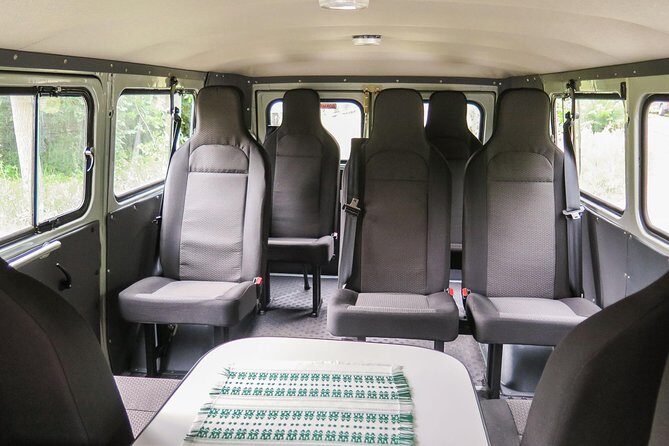
Potsdam can feel stretched out when you’re on your own. This tour solves that by using a minibus built around the vintage UAZ Buchanka (sometimes written as Buchanka), so you spend less time figuring out transfers and more time looking at the places that shaped the city. The vibe is practical and fun: you get from point to point, but you still get windows, stops, and photo moments.
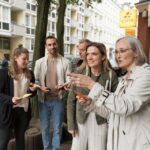
The second “why this works” is the guide. Your guide is a Potsdam native, and that comes through in how the stories get grounded. Instead of just reciting names, you’ll hear how places connect—church, palaces, borders, and the era after World War II all sit close together on the map.
You can also read our reviews of more private tours in Potsdam

Price and timing: is $30 good value for 4–5 hours?
For around 4 to 5 hours and a price listed at $30, the value comes from what you’re buying: a guided highlights route that would be hard to recreate efficiently alone. You’re not just getting a bus ride. You’re getting a structured sequence of major sights, with short on-the-ground stops so you can see what you came for.
That timing also matters for comfort. Several stops are about 10 to 20 minutes, with a couple longer ones (like Babelsberg Park). It’s enough time to understand what you’re looking at and grab photos, but it won’t replace a slower day focused only on palaces.
If you’re the kind of traveler who wants to go inside every palace museum, you’ll likely need a second visit. But for orientation plus standout viewpoints and key history, this tour hits a sweet spot.
Old Market Square and the Nikolaikirche: getting oriented fast
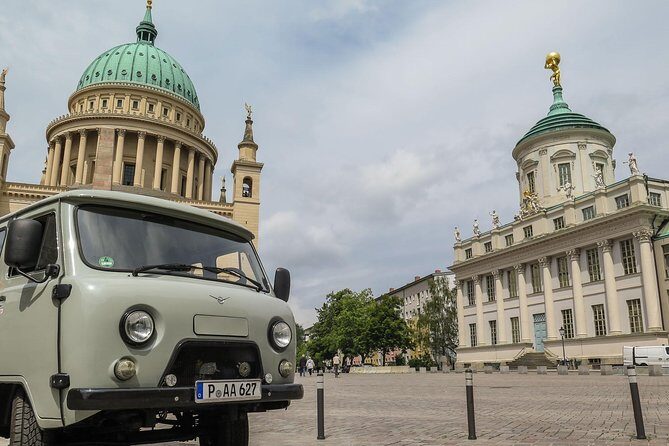
You start in central Potsdam at Old Market Square, the historic city core. With about 25 minutes here and no admission ticket needed, it’s a good place to reset your bearings. You’ll be able to connect the name Potsdam to the “real” center, not just the palace side of town.
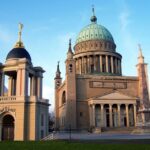
Then you head to St. Nikolai-Kirchengemeinde, where the Nikolaikirche is Potsdam’s most famous church. The visit is short (around 10 minutes), but it gives you a classic anchor point: Potsdam isn’t only royal residences. It also has a strong civic-and-religious identity that shaped daily life long before the Cold War era.
If you’re traveling with limited time—say you’re using Potsdam as a day trip from Berlin—this first block is the fastest way to feel like you understand the city’s layout.
Rechenzentrum Potsdam: the DDR building with a Cold War mosaic
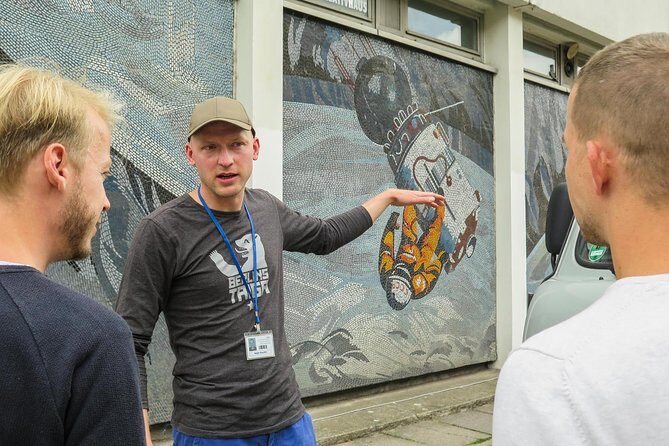
One of the most memorable stops is Kunsthaus Rechenzentrum Potsdam. Plan for about 15 minutes and free admission. This is a DDR-era building with a 70-meter-long mosaic tied to Cold War themes and the space race.
What I like about this stop is the angle. Many “highlights” tours focus on palaces and overlooks. Here, you get a different kind of landmark: a building that reflects political culture through design. Even if you don’t spend long inside, the exterior and the idea behind the mosaic give you a key that unlocks other Cold War references you’ll see later.
Sanssouci area palaces: Neues Palais and Sanssouci with separate tickets
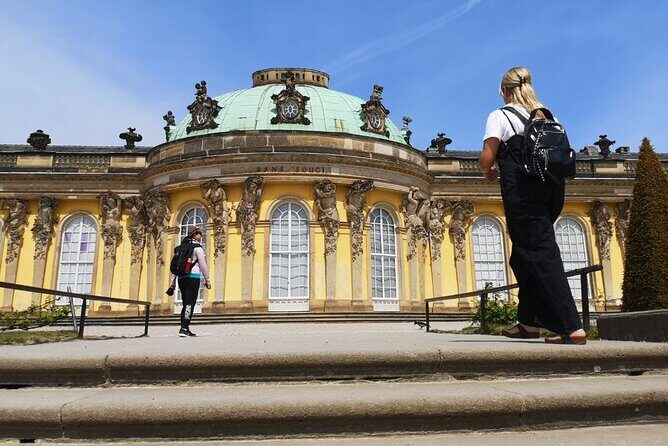
After the Cold War clue, the tour turns toward the famous royal side of Potsdam. You’ll stop at Neues Palais (about 20 minutes), the second major palace in Sanssouci Park, and then at Sanssouci Palace (also about 20 minutes), the summer residence of Frederick the Great and Potsdam’s signature landmark.
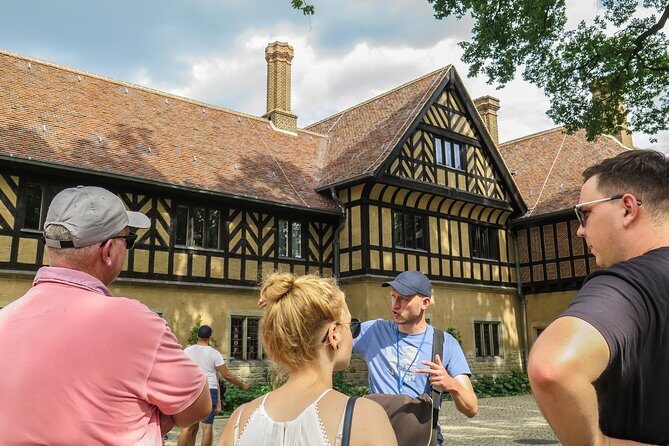
Here’s the practical note: admission tickets for these stops are not included. That doesn’t make the stops less worthwhile, but it changes what you can do. If you want only the exterior views and quick photo time, you’re fine. If you want to enter, you’ll need to buy tickets separately and accept that your “time on site” can shrink a bit.
I think this is still a good tradeoff on a highlights tour. You get the famous shapes and you understand the park’s layout, and you can decide on the spot how much “inside time” you really want.

Alexandrovka and Klein Glienicke: the offbeat corners
Potsdam has some unusual layers, and the tour leaves room for two of them.
You’ll see the Russian colony Alexandrovka, known for Russian wooden houses from the 19th century. This isn’t the royal-castle story. It’s a reminder that Potsdam’s identity was shaped by real communities and political relationships, not only by kings and emperors.
You’ll also encounter Klein Glienicke, described as a GDR enclave in the West Berlin area, where the GDR’s narrowest point is referenced. That combination—everyday neighborhood scale plus Cold War geography—helps you understand how borders weren’t abstract lines. They affected where people lived and where escape possibilities existed.
Even if you don’t go deep into these areas, the contrast is what makes the whole day feel complete.
Neuer Garten and Schloss Cecilienhof: UNESCO park time plus postwar history
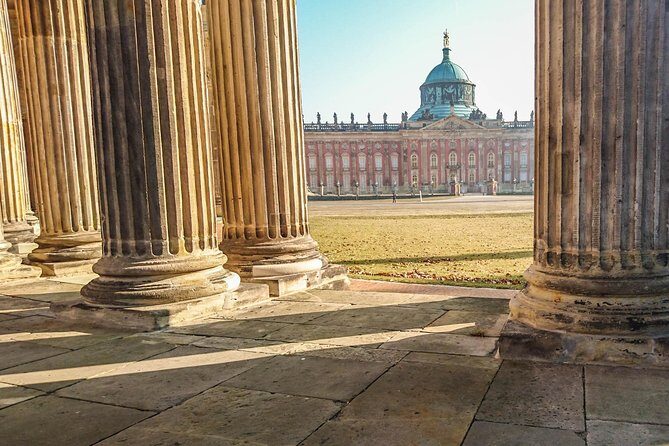
Next comes Neuer Garten, part of the UNESCO World Heritage site. Expect about 20 minutes with free admission. This gives you another palace park perspective, helping you see how Sanssouci isn’t the only “park-palace” world in Potsdam.
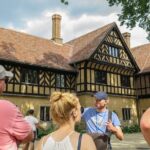
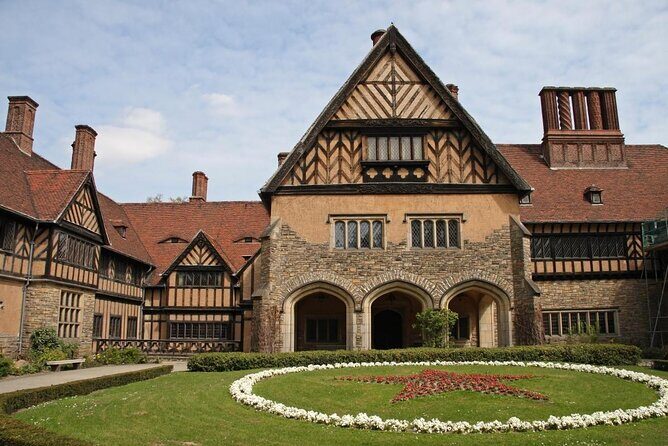
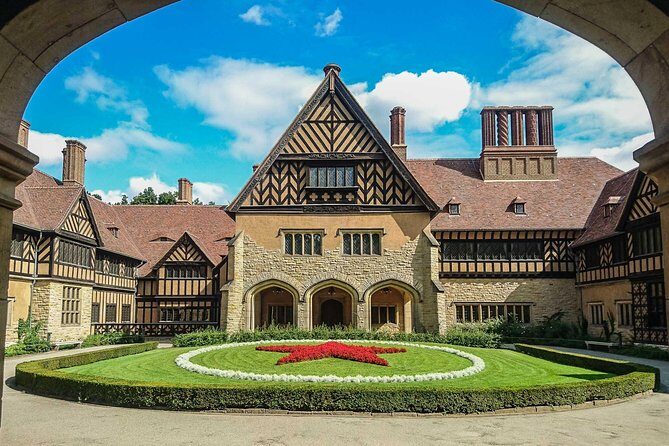
Then the tour moves to Schloss Cecilienhof, where the Potsdam Conference took place in summer 1945. The stop is about 20 minutes, and admission tickets are not included.
This combination works well on a highlights loop because it shifts your lens. You’re not just admiring landscaping and architecture. You’re seeing how Potsdam turned into a stage for major decisions after the war.
If you’re the type of traveler who loves understanding “what happened here,” Cecilienhof is a standout moment. If you only like exterior views, the stop still gives you the setting that makes the conference matter.
Glienicke Bridge: the Cold War agent bridge moment
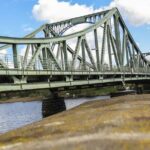
Now you hit one of the most iconic Cold War symbols around Berlin: Glienicke Bridge. Expect around 15 minutes, with free admission.
This bridge is described as a symbol of the Cold War and a so-called agent bridge, becoming world famous because of exchanges tied to that era. Even with only a short stop, the meaning lands quickly. You’re looking at a piece of infrastructure that became famous for politics, espionage, and human risk.
What helps is that you’ve already seen the DDR building context and the palace context earlier. The bridge then feels less like a random photo stop and more like the logical next chapter.
Park Babelsberg and Babelsberg Castle: UNESCO plus escape stories
The tour spends about 30 minutes at Park Babelsberg, a UNESCO World Heritage park. Admission is free here. What makes this stop powerful is the Cold War detail: during that era, border fortifications of the Berlin Wall led directly through the park, and there were numerous escape attempts in the area.
That’s the kind of information you don’t get from a typical scenic park stroll. You’ll look at the park and realize it was also a space of tension and desperation. It changes how you interpret views and pathways, even if your time on the ground is limited.
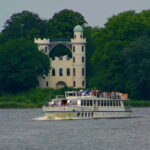
From there, you move to Babelsberg Castle for about 15 minutes, also free admission. The castle is described as the residence of Wilhelm I, rising above the Potsdam cultural landscape. The viewpoint gives you a strong sense of why this area became important for power and representation.
The Babelsberg villa district: big names and big-scale history
A final city-layer stop happens at Rudolf-Breitscheid-Straße 203. This is described as part of the Babelsberg villa district, with numerous prominent villas associated with major leaders—Harry S. Truman, Winston Churchill, and Josef Stalin are specifically mentioned.
The tour time here is about 15 minutes, with free admission. Since this is a villa district, you should treat it as a sight-and-context stop. You’ll get a sense of the scale of the area and the way Potsdam’s surroundings became linked with top-level diplomacy.
If you’ve ever wondered why Potsdam is more than a picturesque neighbor of Berlin, this kind of stop explains it: the city’s setting mattered to the people making decisions in Europe.
The guide factor: Holger’s passion and the fun of learning
One of the most consistent themes from the experience is the guide’s energy. Your guide is named Holger, and he’s described as bringing a lot of passion for his city. That matters because Potsdam can be easy to “see” but harder to truly understand in a short time.
There’s also a small but memorable detail from the experience: a companion described as box bread during a beautiful tour. It’s a tiny touch, but it fits the overall feel—this isn’t just lectures. It’s a guided day where you’re cared for, with moments that make the history feel less like a textbook and more like a lived place.
If you like asking questions and getting answers that connect the dots, a private format helps a lot.
Practical tips for making the most of the 4–5 hour loop
Here’s how to get the best day out of a compact highlights tour like this.
Wear shoes you can stand in. Stops vary from 10 to 30 minutes, and the point is to see and understand quickly, not to linger for long museum visits.
Bring a plan for ticketed interiors. Neues Palais, Sanssouci Palace, and Schloss Cecilienhof are marked as not included for admission tickets. If you want to go in, factor in the extra time and pick what matters most to you—otherwise you may end up outside for longer than expected.
Use the stops to build a story, not a checklist. The tour is intentionally structured: city center orientation first, then Cold War landmarks, then UNESCO parks and conference history. If you follow that flow, you’ll feel you learned something real.
And yes, enjoy the ride. Traveling in a vintage Buchanka adds character to the day, and it keeps the momentum going between stops.
Who should book this Potsdam Highlights tour (and who might want something else)
This tour is a good fit if:
- you want to see major Potsdam highlights without planning transport between sites
- you like guided context, especially around the Cold War
- you want a private experience where your group sets the pace
It may be less ideal if:
- your main goal is long palace interior time and museum depth
- you dislike tours with short stop durations (the schedule is built around quick, meaningful stops)
The best “match” is travelers who want a strong first look at Potsdam—history plus landmarks—then maybe come back later for a slower, more detailed palace-focused day.
Should you book Potsdam Highlights by minibus?
I’d book it if you want a smart, time-efficient overview of Potsdam that covers both the famous palaces and the Cold War geography that people often skip. The private setup, the UAZ Buchanka ride, and the fact that the route includes UNESCO parks plus the Glienicke Bridge story make this feel like more than a basic sightseeing loop.
If you’re excited about Sanssouci Park and Cecilienhof interiors, just be ready for separate admission tickets on those key stops. Otherwise, you’ll still get a lot out of exterior views and viewpoints paired with a guide who actually cares about the city.
If you want a practical half-day plan that doesn’t feel rushed, this one fits.
FAQ
How long is the Potsdam Highlights private sightseeing tour?
It runs about 4 to 5 hours.
Where does the tour start and end?
It starts at Bahnhofspassagen Potsdam, Babelsberger Str. 16, 14473 Potsdam, Germany, and ends back at the same meeting point.
Is this a private tour?
Yes. It’s a private tour/activity, so only your group participates.
Is pickup available?
Pickup is offered.
Are admission tickets included for all stops?
No. Some stops are free, while admission tickets are not included for Neues Palais, Sanssouci Palace, and Schloss Cecilienhof.
What vehicle is used?
The tour is described as taking place with the vintage UAZ Buchanka.
Do I get a mobile ticket?
Yes, a mobile ticket is included.