REVIEW · BERLIN
Berlin Wall Self-Drive Trabi Tour
Book on Viator →Operated by East Car Tours GmbH & Co. KG · Bookable on Viator
Berlin traffic in a Trabant sounds insane, but it works. You’ll roll through major Cold War sites with a live guide, guided convoy style, and a very real-feeling slice of East Germany. I love the guided car drive (or ride) because it turns Berlin’s big sights into a story you can actually follow, not just read about. I also love the souvenir Trabant driver’s license, which makes the whole thing feel like more than a quick photo stop. One consideration: it’s manual-shift only, so if you don’t have a non-automatic license (or you hate gear changes), this may be stressful instead of fun.
Expect a compact route that hits key Cold War landmarks, plus a Wall-related stop with murals you can’t really replicate by walking. The vibe is friendly and structured: a safety briefing first, then your guide leads and keeps the convoy together. The tradeoff is time and handling—streets can be busy, and some cars get exhaust in from vehicles ahead, so it’s not a “sit back and relax” kind of sightseeing.
In This Review
- Key things to know before you go
- Why a Trabant convoy is such a clever way to see Berlin
- Price and value: what your $119.48 really buys
- Manual transmission reality check (and how to decide fast)
- Meet at TrabiWorld: where the adventure starts
- Inside the convoy: what driving feels like in a Trabant
- Stop-by-stop: the Cold War route in plain English
- Trabi-Safari / TrabiWorld welcome
- Central Berlin crossroads and a neoclassical monument moment
- Red Town Hall from 1870
- East Side Gallery: murals on a Berlin Wall remnant
- TV tower square, former border crossing, and a central memorial
- The souvenir Trabant driver’s license: silly, sweet, and actually worth it
- The practical side: what to plan and what to pack
- Who this tour suits best (and who might want a different day)
- Booking advice: when to say yes
- FAQ
- FAQ
- Is the Berlin Wall Trabi tour offered in English?
- Do I need a driver’s license if I want to drive the Trabant?
- Is the Trabant tour cars manual or automatic?
- How many people fit in each Trabant?
- Is hotel pickup or lunch included?
- What if I need to cancel?
Key things to know before you go
- Manual-shift Trabant cars: no automatics here, and you’ll need the right driver’s license if you want to drive
- Small groups and tight seating: max 4 people per Trabant, and the overall tour caps at 12 travelers
- Radio-style guiding: history is delivered through the car’s radio system so you can hear it from the back seat
- Souvenir driver’s license included: even if you ride, you still take home the Trabant credential
- A short, efficient Cold War route: quick stops at major points like the East Side Gallery and Berlin Wall memorial sites
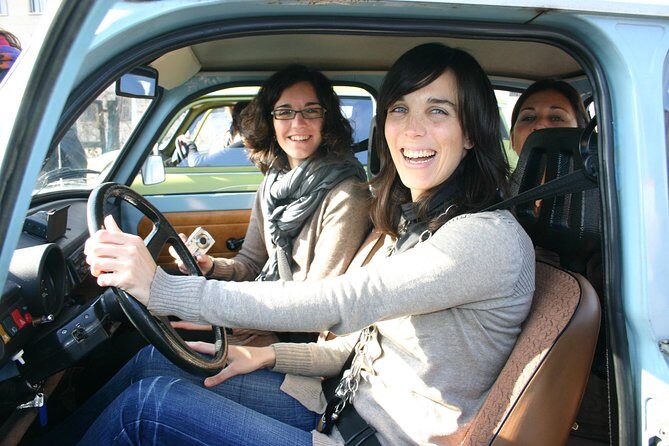
- Old-car realities: column-mounted stick shift, no power steering feel, and mirrors that don’t behave like modern cars
Why a Trabant convoy is such a clever way to see Berlin
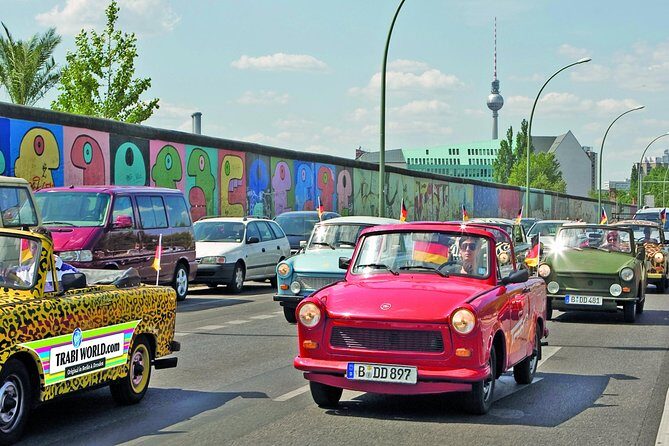
This tour is built around one idea: Berlin’s divided past is easier to grasp when you’re moving through it in the same kind of machine people once did. The Trabant is iconic for a reason. It’s small, basic, and unmistakably East German. When you’re surrounded by that look and sound as you pass Cold War landmarks, the city stops being “a list of places” and becomes a sequence of moments.
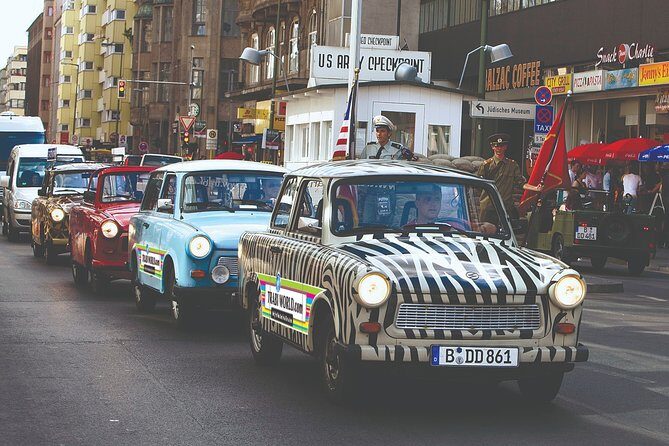
You also get something you don’t get with a normal bus tour: you’re visible. In a convoy, you’ll attract attention—people often take photos as you roll past. That’s not just entertainment. It keeps you moving at a human pace, and it makes you slow down for your own “wait, this is exactly where that history happened” moments.
And the guide doesn’t just point and shrug. You’ll get a history brush-up geared to what you’re seeing, including the meaning of the Berlin Wall and the role these areas played during the division.
You can also read our reviews of more tours and experiences in Berlin.



Price and value: what your $119.48 really buys
At $119.48 per person for about 2 hours 15 minutes, the ticket price is usually the kind you justify with one or two “aha” moments. Here, you get more than one.
You’re paying for:
- A live guide in person (history, route control, convoy coordination)
- Transport by Trabant car (you’re not just visiting sights; you’re driving through them)
- The souvenir Trabant driver’s license (included, and it’s part of the fun payoff)
Lunch and hotel pickup are not included, so plan for that. But the format is tight: you spend your time on the road and at the key stops, not shuffling between transit lines.
One more value point: cars are only for a small group. With four passengers allowed per Trabant (and only 12 travelers maximum overall), you’re less likely to feel lost in a crowd. You can still hear the guide through the radio system, too, which matters if you’re sitting farther back.
Manual transmission reality check (and how to decide fast)
This is the big fork in the road for your enjoyment.
The Trabant cars are manual shift only—no automatics. If you’re planning to drive, the tour requires evidence of a driver’s license for non-automatic cars for all drivers. If you don’t have that, you might still ride, but you’ll want to confirm how your group assigns driving roles once you arrive.
Now, let’s be honest about difficulty. Berlin streets can be busy—cars, bikes, scooters, and pedestrians. Some intersections can feel intense in a vintage car. If you’re anxious about gears or smooth starts, this could feel like stress.
If you’re okay with challenges, it can also be the point. One strong theme from experience reports is that driving can be tricky at first, then suddenly you’re in it—especially once you get used to the column-mounted stick shift and how the car behaves in traffic.
Practical tip: if you haven’t driven manual in a while, treat this like a “practice session with history.” Focus on calm driving, not perfection.
Meet at TrabiWorld: where the adventure starts
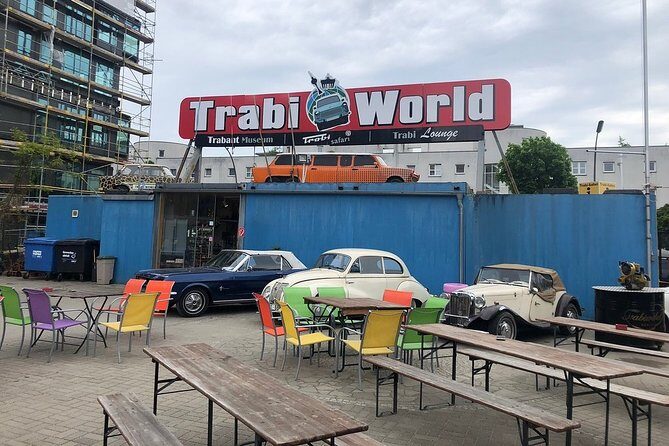
You’ll meet at TrabiWorld Berlin, Zimmerstraße 97–100, 10117 Berlin. The start time listed is 11:30 am, and the tour ends back at the meeting point.
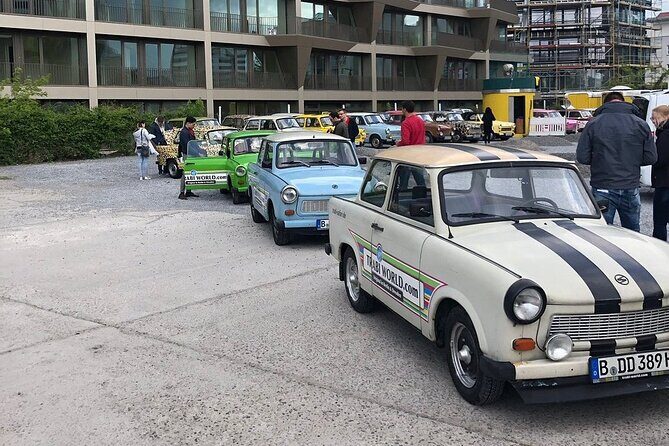
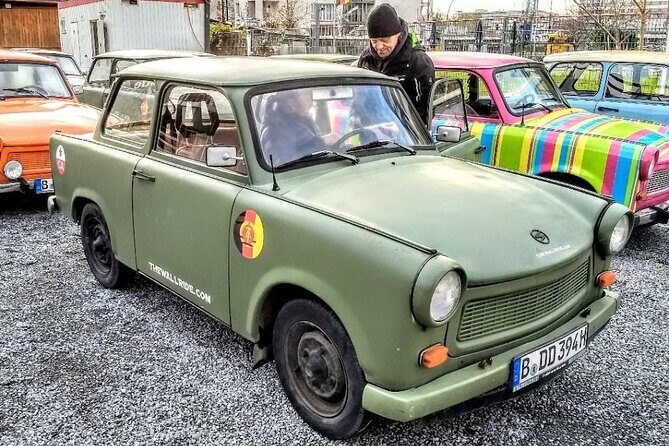
Check-in is set up to be straightforward. Colors are first come, first served, so if you care about the car color, show up ready. You’ll pick your Trabant before you head out, and the whole thing starts with a welcome and safety briefing.
If you’re thinking about parking your day: this tour is not a long walking circuit. It’s a short drive with quick stops. That means you can usually build in other sightseeing afterward, but you should still keep your schedule flexible for traffic and convoy pacing.
Inside the convoy: what driving feels like in a Trabant
After the briefing, your guide leads a convoy through Berlin. You’re not stuck guessing where to go. The guide’s role is part history teacher, part traffic manager for the group—making sure the cars stay together and you don’t get separated at crossings.
You’ll receive commentary through a radio system. That’s a big deal because it means the guide’s narration isn’t swallowed by wind noise or street noise. Even if you’re in the back seat, the audio is designed to carry.
One fun detail: some driving groups have swapped roles during the tour, so you’re not always stuck doing only one thing the whole time. It’s not guaranteed, but if you’d like a chance to drive and also a chance to ride, it’s worth asking early while you’re with the staff.
What to expect from the car itself:
- It’s an older design, with no power steering feeling (so it takes more physical effort than a modern car)
- Mirrors can be harder to manage than you’re used to
- You’ll deal with the real ventilation situation of older cars in traffic
One real comfort note: the exhaust from cars ahead can get into your space, and it can feel harsh on your throat. If you’re sensitive to smells or smoke, you might want to pick your seating position thoughtfully.



Stop-by-stop: the Cold War route in plain English
This tour is short. That means each stop matters, and the route is designed to connect the big ideas of division with visible parts of the city.
Trabi-Safari / TrabiWorld welcome
You start with a brief welcome and orientation at TrabiWorld. This first chunk is there for two reasons: you’ll get the safety briefing, and you’ll get oriented before you’re thrown into real traffic.
It’s also where the mood locks in. You’re standing next to a line of colorful Trabants, which helps you understand why people take photos before you even leave.
Central Berlin crossroads and a neoclassical monument moment
Next, you’ll move into central Berlin and hit an important public square and traffic intersection. This is the kind of location that helps you “map” Berlin quickly, especially if it’s your first day.
After that, you’ll pass a famous 18th-century neoclassical monument. Even if you’ve seen similar styles in other European cities, here the experience is different: you’re traveling by convoy through modern Berlin while the guide frames it with Cold War context.
Why this matters: it anchors the history to places that still exist and still function today. You’re not only visiting memorials—you’re learning how the city’s political split shaped everyday spaces.
Red Town Hall from 1870
Then you’ll pass the Red Town Hall (from 1870). It’s a landmark in its own right, but on this tour it’s also part of the contrast the guide will explain: a city that looks unified now has layers of division in how it moved people, borders, and power.
Potential drawback: because the tour is efficient, you won’t have a long, slow look around every exterior. If you want museum-level time, save that for separate stops on another day.
East Side Gallery: murals on a Berlin Wall remnant
The key Wall stop is the East Side Gallery, where murals are painted along a stretch of the Berlin Wall remnant. The mural section is open-air, and it’s long—about 1,316 meters—so even a short time here gives you scale.
You’ll have a short stop (about 5 minutes based on the timing), so think of it as a “see it first, then return later if you want more.” The guide’s explanation is likely to make the artwork feel more grounded because you’ll understand what you’re looking at beyond the visuals.
What you’ll get out of it: a direct visual link between the wall’s physical presence and the way Berlin later repurposed that space.
TV tower square, former border crossing, and a central memorial
After the mural stop, you’ll pass:
- a public square famous for the TV tower
- a former border cross point
- and a central memorial site connected to German division, located in the middle of Berlin
These parts work best as a sequence. The TV tower is a recognizable skyline anchor. The border cross point is where the city’s politics became immediate reality. And the central memorial gives you a pause point for reflection, even if your stop time is limited.
How to make it land: take a few minutes during the drive pauses to look around and imagine what “crossing” meant when borders were closed.
The souvenir Trabant driver’s license: silly, sweet, and actually worth it
At the end, you’ll bring your Trabant back to TrabiWorld, and then you’ll take home your own souvenir Trabant driver’s license.
Even if you weren’t the one driving, you get it. That small detail is why the experience feels complete. It turns the tour into a keepsake you can show later, rather than a fading memory of a road trip.
This also adds an extra bit of structure to the day: there’s a beginning, a middle, and a clear “wrap” moment at the end—like a themed workshop, but outdoors and on streets.
The practical side: what to plan and what to pack
You don’t need much, but the car is old and the route is active, so do the basics well.
Plan on:
- Comfortable shoes (even quick stops involve getting in and out)
- Clothes that handle Berlin weather (you’re outdoors for a few moments)
- Bringing what you need for yourself—since lunch is not included
Seating and comfort:
- You’re limited by max 4 persons per Trabant, so don’t assume you’ll have tons of space.
- If you’re sensitive to exhaust, consider seat choice.
Driving considerations:
- If you want to drive, bring your non-automatic license proof.
- Remember it’s manual. If you’re rusty, you’ll learn on the job. The convoy format helps because you’re not trying to find your own route.
And do keep in mind that the car is vintage. One report described the cars as basic, with the feel of older systems and quirks that add charm—but also add realism.
Who this tour suits best (and who might want a different day)
This is ideal if you:
- want a fun, hands-on way to see Cold War landmarks
- enjoy street-level city travel more than museum-only afternoons
- are comfortable with a challenge (manual driving, busy intersections, old-car handling)
- want an experience that’s clearly different from the usual walking tour
It may be less ideal if you:
- hate the idea of manual transmission or you don’t have the right license proof
- get stressed in traffic
- are very sensitive to exhaust smells from vehicles ahead
It’s also great for people who like a “first day Berlin orientation.” You’ll pass major sights and then you’ll often know where to return later by foot.
Booking advice: when to say yes
If it’s your first time in Berlin and you want your history with motion, I’d book this sooner rather than later. The tour is small and you’ll have a guide in your ear through the radio system while you travel.
Go for it if you like:
- seeing the Wall in context (not just as a distant monument)
- photo moments as you pass
- the experience of driving a Trabant, even if it takes a minute to get comfortable
Think twice if:
- manual driving scares you
- you want long museum-style time at each stop
- exhaust exposure would ruin the day
One last nudge: if you can, show up ready and relaxed. This works best when you treat it like an adventure with training wheels, not a test.
FAQ
FAQ
Is the Berlin Wall Trabi tour offered in English?
Yes. The tour is offered in English.
Do I need a driver’s license if I want to drive the Trabant?
Yes. Evidence of a driver’s license for non-automatic cars is required from all drivers.
Is the Trabant tour cars manual or automatic?
They’re manual shift only. The tour does not offer automatic cars.
How many people fit in each Trabant?
Each Trabant allows a maximum of 4 persons.
Is hotel pickup or lunch included?
No. Hotel pickup/drop-off and lunch are not included.
What if I need to cancel?
The experience is non-refundable and cannot be changed for any reason. If you cancel or ask for an amendment, the amount you paid will not be refunded.