REVIEW · BERLIN
Historic center of Berlin – Tour in Italian
Book on Viator →Operated by Vive Berlin Tours · Bookable on Viator
Berlin can feel heavy and thrilling at once. This 3.5-hour Italian-speaking walking tour strings together the big turning points of 20th-century Berlin. I like that it’s small group style, so the guide can keep things moving without losing you in a crowd.
What I really like is the way the route forces you to connect places you’ve only seen in photos—like the Berlin Wall area, Checkpoint Charlie, and Brandenburg Gate—into one clear story. The other big win is how the guide’s explanations stay practical and human, with real names like Paolo, Giulia, Fabio, Chiara, Elena, and Daniele showing up in past groups for being prepared and attentive to different needs.
One possible drawback: many stops are brief (often around 5–15 minutes), so if you want slow, in-depth time at fewer sights, this might feel fast-paced.
In This Review
- Key highlights that make this Berlin walking tour worth it
- Italian-language Berlin in 3.5 hours: what the tour really covers
- Starting at Potsdamer Platz and the easy first steps to find the group
- Potsdamer Platz, Sony Center, and the idea of preserved ruins
- Topography of Terror: where the route turns serious
- Checkpoint Charlie: the Cold War’s most famous bottleneck
- The former Aviation Ministry building: power, offices, and afterlives
- Fuhrerbunker: learning what’s missing, not just what’s there
- Holocaust Memorial (Memorial to the Murdered Jews of Europe): a pause that changes your pace
- Reichstag outside views and how the dome visit fits in
- Brandenburg Gate and Unter den Linden: reunification symbol to palace avenue scars
- Bebelplatz, the book burning memorial, and Humboldt University context
- Neue Wache: a memorial for rejecting war
- Berliner Dom and Museum Island: finishing with monumental Berlin
- Group size, pace, and who this tour fits best
- Value check: is the $27.91 price fair for what you get?
- Should you book this Italian Historic Center of Berlin tour?
- FAQ
- What language is the guide?
- How long is the walking tour?
- Where does the tour start and what is the meeting point?
- Where does the tour end?
- Is the mobile ticket included?
- What is included in the price?
- Do I need to worry about weather?
- Is the Reichstag visit inside?
Key highlights that make this Berlin walking tour worth it
- Italian guide, clear storytelling across major Cold War and Nazi-era landmarks
- Small group capped at 28, which helps with pacing and attention
- Berlin Wall–era stops including an original Wall segment area and Checkpoint Charlie
- Emotion-forward sites such as the Holocaust Memorial for the Murdered Jews of Europe and Neue Wache
- Practical ending point at Pergamon Museum, with guidance on what to do next
Italian-language Berlin in 3.5 hours: what the tour really covers
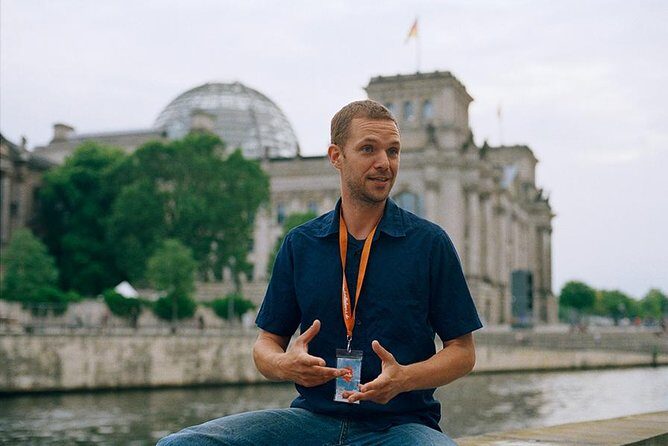
This is a 3 hours 30 minutes guided walk through central Berlin, focused on how the city changed—sometimes violently—over the last century. You’ll move from Potsdamer Platz out toward the heart of Berlin’s monumental government and memorial zones, with an intentional rhythm: modern Berlin first, then the Nazi era, then the Cold War, then reunification symbols.
Because it’s a walking route with many iconic stops, it’s great for first-time orientation. It’s also a smart choice if you want one guided thread that ties together Brandenburg Gate, Berlin Wall references, and the Holocaust Memorial without having to plan each stop yourself.
You should also know the tour doesn’t center on museum interiors. Most moments are outside viewing and short explanations. The guide helps you place what you’re seeing in context, then points you to where you can go deeper on your own.
You can also read our reviews of more historical tours in Berlin


Starting at Potsdamer Platz and the easy first steps to find the group
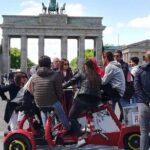
Your start is Potsdamer Platz 10, near the S/U-Bahn Potsdamer Platz station. The meeting point is easy to spot if you follow the instructions: look for the blue bicycle linked to VIVE BERLIN TOURS and a flag with the logo.
Potsdamer Platz is a good place to begin because it’s one of Berlin’s “before and after” zones. The square has been rebuilt into a modern focal point, so it instantly sets up the theme of the walk: the city you see now grew out of destruction and political change.
You’ll get a short intro right away, with the guide setting expectations for what the route will cover. That matters because several of the stops are emotionally intense, and you’ll understand why the guide is steering you to each location in the order they chose.
Potsdamer Platz, Sony Center, and the idea of preserved ruins
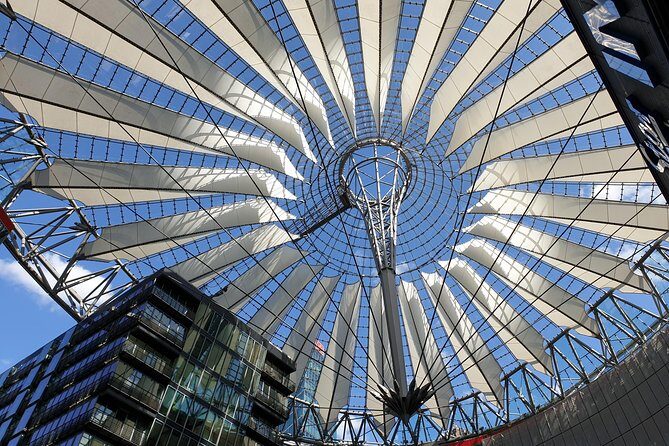
From Potsdamer Platz, the tour heads toward Sony Center. This stop is quick, but it has a powerful visual lesson: the Sony Center area incorporates remnants from older structures that were destroyed during World War II.
Even in a short visit, it gives you a pattern you’ll see again and again throughout Berlin: rebuilding doesn’t always erase the past. Sometimes it layers the past into the present, so you need the guide’s context to notice what’s hiding in plain sight.
If you’re the kind of traveler who likes “what am I looking at?” questions answered fast, this tour format fits. If you want lots of time for photos and slow wandering, you may find yourself moving more briskly than you’d like.
Topography of Terror: where the route turns serious
Next up is Topography of Terror, a symbolic site tied to Nazi persecution. The guide explains it as the area connected with the former headquarters of the Gestapo and SS, which changes how you look at the walls, markers, and surrounding buildings.
This is also where you can spot nearby landmarks in the broader area, including buildings such as the former Nazi aviation ministry and the Martin Gropius Bau museum. There’s also an especially important detail here: an original segment of the Berlin Wall can be seen from the area, which helps connect the Nazi story to the Cold War story without switching neighborhoods in your mind.
One practical note: since the time here is short, use the moment to ask yourself what you’re trying to understand—then let the guide steer you. You’ll likely leave with clearer “who did what, when” mental structure, even if you don’t read every label.
Checkpoint Charlie: the Cold War’s most famous bottleneck
Checkpoint Charlie is one of those places where the photos are everywhere, but the meaning is easy to miss if you just look at signage and uniforms. Here, the guide frames it as a peak moment of Cold War tension and explains how the Berlin Wall divided the city under communist rule.
This stop works well on a guided walk because it’s not just about the site itself. It’s about the psychology of division—how movement, access, and surveillance shaped everyday life for people on both sides.
You’ll get a short, focused explanation, and then you move on. That’s useful because you don’t get stuck spending too long at one place while the rest of the story sits behind you.



The former Aviation Ministry building: power, offices, and afterlives
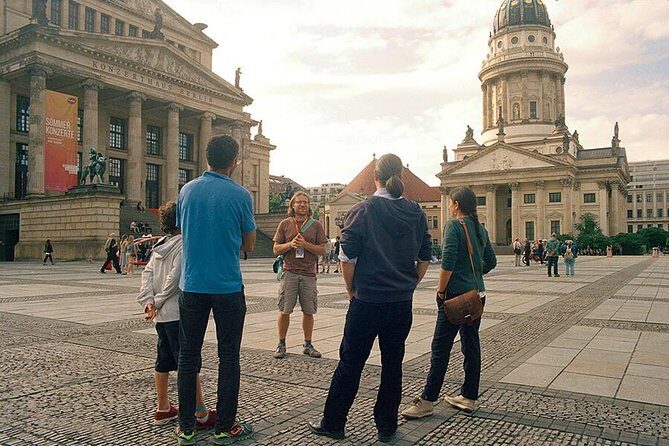
The tour continues toward the Aviation Ministry of Berlin. The building is imposing, and the guide’s job is to make its size make sense.
During the Nazi dictatorship, it housed offices connected to the Ministry of Aviation led by Hermann Göring. Later, in the Cold War period, the building served as part of the communist “home of the ministries.” Today it’s used as a ministry by the Federal Republic of Germany.
That “afterlife” matters. Berlin isn’t only about monuments; it’s also about how governments reuse powerful architecture. Watching the function change over time helps you understand why Berlin’s history feels so close to the present day.
Fuhrerbunker: learning what’s missing, not just what’s there
Next comes the Fuhrerbunker site—the place where Hitler spent his last days. This stop is brief, but it’s one of the most symbolic on the route because it teaches a tricky Berlin lesson: sometimes the most important historical spot is marked even when the original structure is gone.
The guide explains the meaning of the place and why it exists in today’s cityscape the way it does. It’s the kind of context that can turn a quiet location into something you understand instead of just passing.
If the theme of the day feels heavy, this is also where the emotional arc stays honest rather than skipping hard parts. You’ll likely appreciate that the tour doesn’t treat memorials as sightseeing props.
Holocaust Memorial (Memorial to the Murdered Jews of Europe): a pause that changes your pace
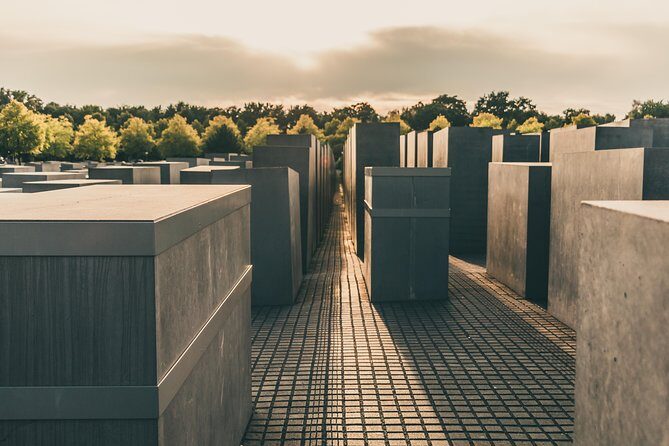
The route then reaches the Holocaust Memorial for the Murdered Jews of Europe. This is one of the most emotion-heavy stops on the entire walk, and the guide’s narration is central to getting the point.
The site is designed for reflection, and the guide’s storytelling helps you see it as a symbol of the greatest crime committed by the German state during Nazism. Even if you’ve read about it before, the combination of physical space plus a focused explanation tends to land differently than facts on a page.
Because you spend about 10 minutes here, treat it like a reset. Put your phone away for a moment. Let the scale and layout do some of the work before you get back to walking.
Reichstag outside views and how the dome visit fits in
The tour moves to the Reichstag Building, seat of the German Parliament. You’ll visit only outside. The guide explains how to book a visit to the dome, which is useful because it gives you a direct next step if you want that “from inside the democracy” perspective later.
This stop is short, but it’s strategically important. It anchors the tour in how Germany rebuilt its political identity after dictatorship and division.
If you’re planning your day, this is a good moment to decide whether you’ll add the dome. The guide can help you connect timing so you don’t end up scrambling.
Brandenburg Gate and Unter den Linden: reunification symbol to palace avenue scars
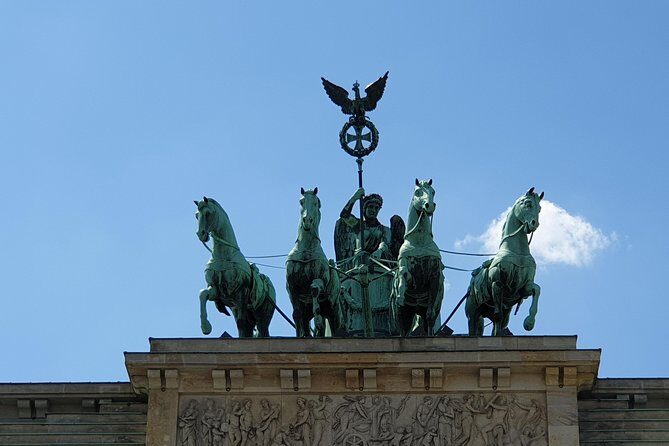
Brandenburg Gate is the iconic finale-to-the-story moment. The guide tells the story of the gate moving from a symbol tied to monarchy and strength to a Cold War landmark and then into a symbol of German reunification.
It’s hard not to take photos here. Still, the guided context helps you understand why the gate became more than an architectural landmark. It also helps you connect it to what happened around it in the decades after division.
After that, you’ll walk down Unter den Linden, the grand avenue once linked to the access road to the emperor’s palace. The guide points out how you can recognize construction periods and also the wounds left by war.
This stretch can feel like the tour slows emotionally, even if your feet keep moving. It’s a strong “then and now” walk where Berlin’s layers show up in the architecture.
Bebelplatz, the book burning memorial, and Humboldt University context
Then comes Bebelplatz. The guide frames it as the square tied to the burning of books during the Nazi dictatorship. It’s also where you have the seat of Humboldt University and the Catholic Cathedral in the same wider view.
A separate stop highlights the Book Burning Memorial at Bebelplatz. The guide explains the monument and what it represents—specifically the propaganda action of book burning, remembered today through a memorial in the center of the square.
This is one of the most educational stops if you care about how authoritarian regimes attacked ideas. When you hear the story alongside the location, the memorial feels less abstract and more like a warning.
You also get Humboldt University time—just a few minutes—to hear the university’s history and learn about famous students. It’s short, but it helps you link Berlin’s dark political past with an important tradition of learning.
Neue Wache: a memorial for rejecting war
At Neue Wache, the stop shifts to a memorial against war’s horrors. The guide points to the idea represented there: a mother cries her son, a soldier who fell in battle.
This is a very different tone from the Holocaust Memorial, even though both are dealing with suffering. Neue Wache is about mourning and rejection—an anti-war message that adds balance to the story.
Because the stop is about 5 minutes, I’d treat it as a quick emotional check-in. If you’re tired, this kind of short pause can be the thing that keeps the rest of the day from feeling numb.
Berliner Dom and Museum Island: finishing with monumental Berlin
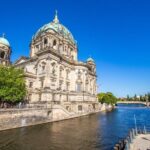
Next is Berliner Dom. The guide explains how, in the idea of the emperor who had it built, it was meant to be a major church landmark for Lutheran religion—something on the scale of St. Peter’s in Rome. You’ll have about 10 minutes here, which is enough to appreciate its size and the story attached to it without turning the day into a long cathedral visit.
Then you reach Museum Island, a UNESCO World Heritage Site. This is where the tour officially ends. The guide wraps things up and gives you directions for what to do next in the area—helpful if you want to keep the momentum going right away.
Your endpoint is the Pergamon Museum area at Bodestraße 1-3. Even if you don’t plan to enter the museum immediately, it’s a great finish because it puts you in a central spot with tons of options nearby.
Group size, pace, and who this tour fits best
With a maximum of 28 travelers, this isn’t a tiny private tour, but it also isn’t a huge bus-like mob. You’ll still be able to hear the guide, especially if you stand closer and stay aware when the group moves.
The main pacing challenge is the number of stops versus the time at each one. The guide gives you context fast, and then you move on. If that’s your style, you’ll love it. If you want long, detailed museum reading sessions, plan on doing those separately after the walk.
This tour is best for:
- First-timers who want a guided “storyline” around Berlin’s most famous and most difficult sites
- Travelers who prefer learning from a guide rather than building an itinerary stop-by-stop
- People who want to finish near a major museum zone and keep exploring on their own
It may not be ideal if you need a lighter, less heavy day focused mostly on art, shopping, and nightlife.
Value check: is the $27.91 price fair for what you get?
At $27.91 per person for about 3.5 hours with a local guide, this reads as strong value if your goal is to see the big names and understand the connections. You’re paying for guided interpretation of multiple landmark categories—monuments, memorials, government symbolism, and Cold War geography—rather than just walking past them.
It also includes local taxes and a mobile ticket, which usually means fewer headaches on the day. It’s not built around food, so you’ll want to plan your meals separately.
If you already know Berlin’s headlines and want only quick photo stops, you might feel it’s not for you. But if you want your Berlin photos to come with meaning you can actually explain later, the price makes more sense.
Should you book this Italian Historic Center of Berlin tour?
Yes, if you want a guided, Italian-language walk through Berlin’s most important turning points—especially the places tied to the Berlin Wall area, Checkpoint Charlie, the Holocaust Memorial, and Brandenburg Gate—and you like moving efficiently from stop to stop.
Consider skipping or pairing it with something else if you get stressed by short time at each location. This tour is built for orientation and context, not slow wandering or deep museum time.
If you book, come with good shoes, an open mind, and a willingness to let the guide’s story set your pace. By the time you reach Pergamon Museum and Museum Island, you’ll have a clearer sense of what Berlin is trying to remember—and why it matters.
FAQ
What language is the guide?
The tour is guided by an Italian-speaking guide.
How long is the walking tour?
The duration is about 3 hours 30 minutes.
Where does the tour start and what is the meeting point?
It starts at Potsdamer Platz 10, 10785 Berlin, Germany (S/U-Bahn Potsdamer Platz). Look for the blue bicycle by VIVE BERLIN TOURS with the company logo flag.
Where does the tour end?
The tour ends near the Pergamon Museum at Bodestraße 1-3, 10178 Berlin, Germany.
Is the mobile ticket included?
Yes, the tour uses a mobile ticket.
What is included in the price?
The price includes local taxes and a local guide.
Do I need to worry about weather?
It operates in all weather conditions, so dress appropriately.
Is the Reichstag visit inside?
You only visit the Reichstag building outside. The guide can explain how to book a visit to the dome.