REVIEW · DRESDEN
Historic Dresden Small-Group Walking Tour in English
Book on Viator →Bookable on Viator
Dresden tells its story block by block. In this small-group English walk, a licensed guide (often guides like Laura, Leo, Christina, Doris, or Karen) connects major sights to the city’s rise, breakage, and rebuild. I love the Frauenkirche-centered storytelling, and I also like the way you get time for questions instead of getting herded along. One possible drawback: the tour doesn’t include headsets, so if the group runs closer to the top end, hearing the guide can be harder.
You’ll spend about 2 hours moving between Dresden’s big architectural anchors and a few quieter corners that make the whole place feel human. Expect some walking on uneven ground, plus a few stairs.
If you want a solid first introduction to Dresden that still leaves you free to explore on your own after, this is the kind of tour that helps you do that fast.
In This Review
- Key things I’d zoom in on
- Starting at Schloßplatz: a 2-hour route that actually helps
- Theaterplatz: the Semper Opera House view that sets the tone
- The Dresden Zwinger: a palace idea that became an art show
- Residenzschloss courtyards: built, burnt, rebuilt
- Stallhof and the quieter court vibe
- Fürstenzug and the Dresden Cathedral: porcelain and faith politics
- Brühl’s Terrace and Neumarkt: the Balcony of Europe to the rebuilt symbol
- Why the guide’s narrative matters more than a checklist
- Small-group value and the one real downside (hearing without headsets)
- Price check: $30.25 feels fair if you use the guidance well
- Who should book this walking tour
- Should you book Historic Dresden Small-Group Walking Tour in English?
- FAQ
- How long is the Historic Dresden Small-Group Walking Tour?
- Is the tour offered in English?
- What’s the group size?
- Are entrance tickets included for the sights?
- Where does the tour start and end?
- Do I get a ticket on my phone?
- Are service animals allowed?
- Is the walking tour suitable for most people?
- Can I get a full refund if I cancel?
- Is tips/gratuities included in the price?
Key things I’d zoom in on
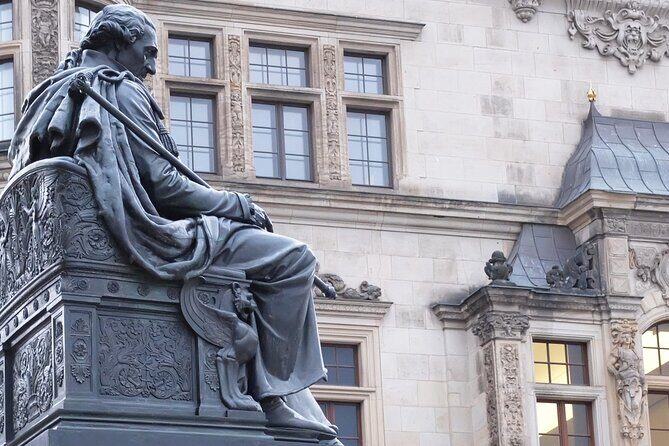
- A 15-person max small group means you’re more than just background noise for the guide.
- Semper Opera House and the Zwinger get explained as part of one courtly story, not separate photo stops.
- Residenzschloss courtyards show the built-and-burned cycle, with Renaissance sgraffito details you can actually look at.
- Fürstenzug (the 100-meter porcelain procession mural) is one of those Dresden facts that feels too specific to skip.
- Brühl’s Terrace views help you understand how to explore the Elbe and the wider city later.
- Neumarkt and Frauenkirche come with the emotional reconstruction story you’ll want before you go inside on your own.
Starting at Schloßplatz: a 2-hour route that actually helps

Most people want two things in Dresden: a mental map and a sense of what to prioritize. This walk is built for that. You start at Schloßplatz (near the central historic area), and you end back near the start area, so you’re not stuck miles away when you’re done.
The format is short enough to keep your energy up, but long enough that your guide can stitch the sights together with context. That matters in Dresden, because the city’s face is shaped by major moments: the court’s ambition, the later devastation, and then the careful rebuilding that defines how Dresden feels today.
You’re also working with a group size that stays at a maximum of 15 travelers. That translates into a more conversational pace. People can ask questions and get real answers, not just a quick pointer toward the next corner.
You can also read our reviews of more walking tours in Dresden

Theaterplatz: the Semper Opera House view that sets the tone
The walk begins at Theaterplatz, a square designed to impress. The star here is the elegant Semper Opera House, one of Dresden’s most recognizable statements about culture and power. Your guide doesn’t just point it out. You’ll hear how Dresden’s musical identity connects to the people who shaped the city.
From this area, you can also orient yourself toward several other major landmarks at once, including the Zwinger and the Residenzschloss complex. That wide-scope view is useful because it stops the tour from feeling like a bunch of disconnected stops. Instead, it becomes a tour of the same historic center, seen from different angles.
If you want a quick win: ask your guide to point out the Old Masters Gallery area from here. Even if you don’t plan to enter a museum right away, knowing where it sits helps you decide later with less guesswork.
The Dresden Zwinger: a palace idea that became an art show

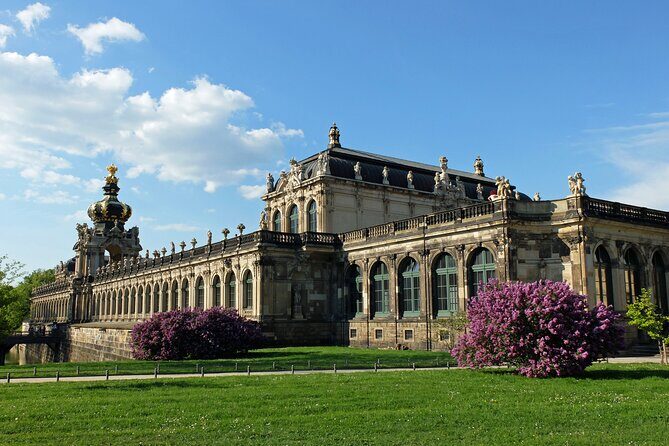
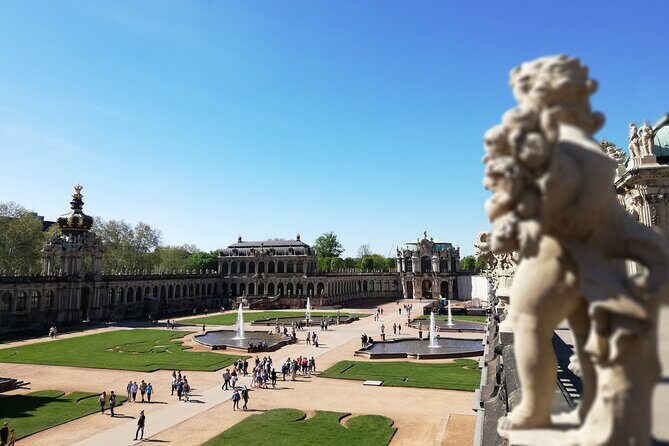
Next comes the Zwinger, famous for looking like one unified object of beauty. The key story your guide will bring is that it was planned as an opulent gateway to a grand palace project that never materialized the way people expected.
That detail changes how you look at it. Instead of seeing it as only decorative Baroque architecture, you start noticing the ambition behind it: the idea of staging beauty for visitors, court life, and big celebrations. The Zwinger becomes a kind of oversized statement of taste.
There’s also a small optional moment if conditions allow. If it’s open, your guide may show an open-air grotto that’s tucked away from the typical view. This is exactly the sort of thing that makes a guided walk worth it: you don’t just learn facts, you learn where to look.
As far as practicalities go, this stop is quick—enough to take in the design and listen, without swallowing your whole tour time.
Residenzschloss courtyards: built, burnt, rebuilt
The tour then pivots from showy squares into something more layered: the Residenzschloss area, Dresden’s royal palace complex. The theme your guide uses is simple and brutal—built, burnt down, rebuilt, repaired, extended, and then shaped again by history.
You don’t go inside the museum on this walk, which is smart if you’re trying to keep the tour to about 2 hours. Instead, you’ll move through a courtyard space that reveals court art and technique. One standout detail mentioned on the route is sgraffito, a painstaking Renaissance surface treatment. You can stand close enough to see how much work went into it, and you get a feel for the Renaissance style without needing a separate ticket right then.
Your guide will also help you decide what to do next. Since you’ll be near the palace’s collections, you can ask what’s most worth your time if you plan to return later for an indoor visit. That kind of recommendation helps you spend money only where it counts.
Stallhof and the quieter court vibe

Not every palace stop needs to be loud. After the major palace energy, the route includes Stallhof, an enclosed Renaissance courtyard tucked behind the Residenzschloss.
This is where Dresden feels more intimate. You’ll get a quieter sense of courtly life, including the idea that this space once hosted royal events and jousting-style pageantry. The arcaded galleries and sandstone columns make the courtyard feel like a stage set. It’s one of those pauses where you can catch your breath and let the bigger story sink in.
This part of the tour is short, but it’s a good contrast. It breaks up the heavier themes so the whole walk doesn’t feel like one long museum lecture.
You can also read our reviews of more historical tours in Dresden





Fürstenzug and the Dresden Cathedral: porcelain and faith politics
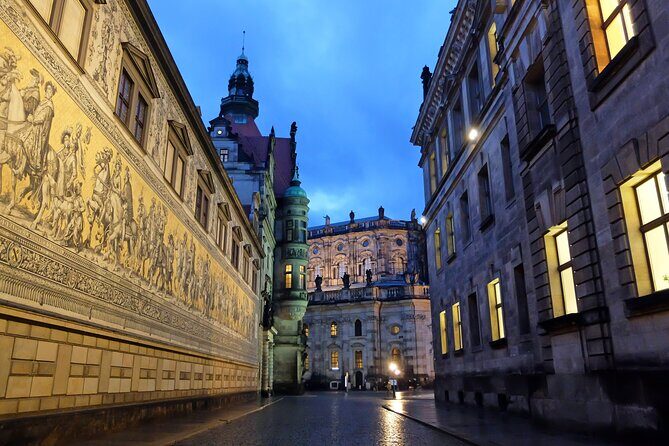
Then you hit a Dresden signature that’s hard to forget: the Fürstenzug, the outdoor porcelain procession artwork. It’s described as 100 metres long and made from 24,000 tiles, and it’s known as the longest outdoor porcelain artwork in the world.
That means you don’t just look at one scene. You search. You start spotting details and small stories hidden within the procession, and the guide will help you frame what you’re seeing so it doesn’t feel random.
From there, you’ll also see the Royal Cathedral of Dresden from the outside, which is the former court church (the famous Hofkirche area). The key story here is how political and religious lines shaped architecture: it was built in secret by a Catholic ruler in Protestant Saxony. That tension shows up in the building’s past, and your guide will share the unusual angles of the story.
You also learn how it connects to the Royal family’s burial history. Even without going in, the guide’s framing makes it feel like more than a pretty facade.
Brühl’s Terrace and Neumarkt: the Balcony of Europe to the rebuilt symbol
Now the walk shifts to open air. Brühl’s Terrace is often called the Balcony of Europe, and it earns that name. The viewpoint gives you sweeping energy over the Elbe River, plus the city unfolding beyond.
What I like here is that it’s not just about scenic photos. Your guide can point out landmarks that help you plan the rest of your day: the river itself, historic ships on the Elbe (the White Fleet), church steeples, and even distant wine slopes. Even if you don’t go far beyond the historic center, this view helps you understand what directions to explore.
Then the tour brings you to Neumarkt, the revived 18th-century square anchored by the Frauenkirche. Neumarkt feels lively and social today, with colorful baroque facades framing the space and lots of places to stop for food after.
The highlight is the Frauenkirche story. Your guide explains the destruction, the long reconstruction, and the international effort that helped rebuild this Baroque church. It’s not delivered as a dry timeline. It’s explained as a symbol of reconciliation, which is why the building hits harder than a normal landmark.
You typically finish the walk here, so you can decide whether to go inside later. You can also go down to the crypt to see a small exhibition about the rebuilding, which gives you a quick, structured way to continue the story after your walk.
Why the guide’s narrative matters more than a checklist

A list of sites is easy. A good guide makes those sites connect.
Across the guides who lead this route, a consistent theme shows up: they’re not only recounting dates. They explain motivations—who wanted what, why the architecture looked the way it did, and how history changed the plan. That kind of storytelling is why many people rate this tour so highly.
It also helps that the pace is designed for questions. With a group of up to 15, you can ask things like what to prioritize next, what to skip, and how to fit in independent museum time without wasting your day. Guides such as Christina and Laura are described as energetic and attentive to smaller details, which is exactly what you want when you’re trying to get Dresden right on your first trip.
If you’re the type who likes facts and also likes people, this format usually clicks fast.
Small-group value and the one real downside (hearing without headsets)
The price isn’t just paying for time—it’s paying for interpretation. At $30.25 per person, the big value is that you get a professional guide for the full 2 hours and you see a cluster of top Dresden landmarks in a logical order.
Most of the major stops are free to view, and the tour doesn’t require you to buy separate entry tickets just to get the guided experience. The one thing to remember is that you’re not entering every museum on the walk. If you want to go inside later, your guide can help you choose what’s worth an additional ticket.
The main drawback is also practical: the tour doesn’t include headsets. One visitor experience described a harder time hearing when the group was larger than hoped. The tour is meant to stay at 15, but it’s still worth planning like you might be at the higher end. If you know you struggle to hear in groups, sit closer to the guide when you can.
Price check: $30.25 feels fair if you use the guidance well
Let’s talk value like a budget friend.
You’re paying for four things:
- A licensed professional guide for about 2 hours
- A tight route linking major sights without you having to plan minute-by-minute
- Free viewing of key landmarks, with optional add-ons later
- Space for questions, which saves you time after the tour
If you’re the kind of traveler who would otherwise grab a generic audio guide and then drift, this is different. The guided framing helps you decide faster what to visit next on your own. That can easily outweigh the ticket cost if you’re spending any money on museums afterward.
On the other hand, if you already know Dresden deeply and you just want to walk and photograph, you might feel the price less strongly. For most first-timers, though, this is a strong deal because it compresses a lot of context into a manageable time block.
Who should book this walking tour
This tour is a great match if:
- You want a clear first introduction to Dresden without booking several separate guided activities.
- You like architecture stories and also want the human story behind the rebuilding.
- You prefer small groups where questions don’t feel awkward.
- You want a walking plan that helps you choose what to do later around Neumarkt and Frauenkirche.
It may be less ideal if:
- You’re very sensitive to hearing in groups (no headsets).
- You hate walking on uneven streets or don’t do well with stairs. Some walking includes stairs, and while it’s described as manageable for seniors by at least one visitor, it’s still not a flat stroll.
If you’re a solo traveler, a couple, or traveling with family who wants guided context, this is also a comfortable format.
Should you book Historic Dresden Small-Group Walking Tour in English?
Yes, if you want your first hours in Dresden to be productive, not random.
Book it if you value guided context at major landmarks like Theaterplatz, Zwinger, the Residenzschloss courtyards, Fürstenzug, and the Frauenkirche. The tour is built to help you understand why the city looks the way it does, and it ends where you’ll likely want to linger anyway.
Skip it only if you already have a strong plan to visit museums in depth and you’re looking for a self-guided wandering day. Otherwise, this is a smart way to get your bearings fast and enjoy Dresden with a clearer head for the rest of your trip.
FAQ
How long is the Historic Dresden Small-Group Walking Tour?
It runs for about 2 hours.
Is the tour offered in English?
Yes, the tour is offered in English.
What’s the group size?
The tour has a maximum of 15 travelers.
Are entrance tickets included for the sights?
The stops are listed as admission ticket free for what you’ll see on the walk. The tour does not go into the museum itself, but you can go in later on your own.
Where does the tour start and end?
It starts at Schloßplatz (Schloßpl., 01067 Dresden-Altstadt, Germany) and ends back at the meeting point.
Do I get a ticket on my phone?
Yes. It uses a mobile ticket.
Are service animals allowed?
Yes, service animals are allowed.
Is the walking tour suitable for most people?
Most travelers can participate. The route includes some stairs.
Can I get a full refund if I cancel?
Yes. You can cancel up to 24 hours in advance for a full refund.
Is tips/gratuities included in the price?
No. Tips and gratuities are not included.