REVIEW · FRANKFURT
Frankfurt: Private or Shared Walking Tour
Book on GetYourGuide →Operated by Show-me-Frankfurt.de · Bookable on GetYourGuide
Frankfurt’s story is written in stone and steel. On this 1.5-hour Altstadt walk, I like how it ropes you into the historic core fast, from Römerberg’s Justitia-Brunnen to the Paulskirche, where the first German national assembly took place. I also like the smart contrast: you cross the Eiserner Steg and then keep moving so the modern skyline becomes part of the same conversation as the old buildings.
The main thing to consider is simple: the tour is in German. If your German is basic, plan to follow along by using your eyes at each monument and catching the guide’s key explanations, or consider a private group where timing can be more flexible.
In This Review
- Key highlights you’ll actually care about
- Why Frankfurt’s Altstadt and Neue Altstadt matter together
- Starting at Römerberg: Justitia-Brunnen sets the pace
- Crossing the Eiserner Steg (1868) and seeing war-era change up close
- Römer and Paulskirche: the first German national assembly in context
- Neue Altstadt: why Frankfurt keeps rebuilding its “old town”
- How the guide keeps the old and the skyline in the same frame
- What makes the guides stand out (like Sanel’s style)
- How long is 1.5 hours, and what you’ll (and won’t) cover
- Price and value: $17 for a landmark-dense story
- Who this tour suits best
- Should you book the Frankfurt walking tour?
- FAQ
- Where do I meet the guide?
- How long is the walking tour?
- Is it a private tour or a shared tour?
- What language is the tour guide?
- What landmarks does the tour focus on?
- How much does it cost?
- What’s the cancellation policy?
Key highlights you’ll actually care about
- Justitia-Brunnen (Römerberg) meeting point that’s easy to find and sets the tone for the Altstadt
- Eiserner Steg built in 1868, with context on WWII damage and a major 2008–9 renovation
- Römer and Paulskirche tied directly to the first German national assembly
- Neue Altstadt: Frankfurt’s newest “old town” project, so you see how the city is rebuilding identity
- A guided walk that keeps pointing out the contrast between historic buildings and skyscrapers
Why Frankfurt’s Altstadt and Neue Altstadt matter together
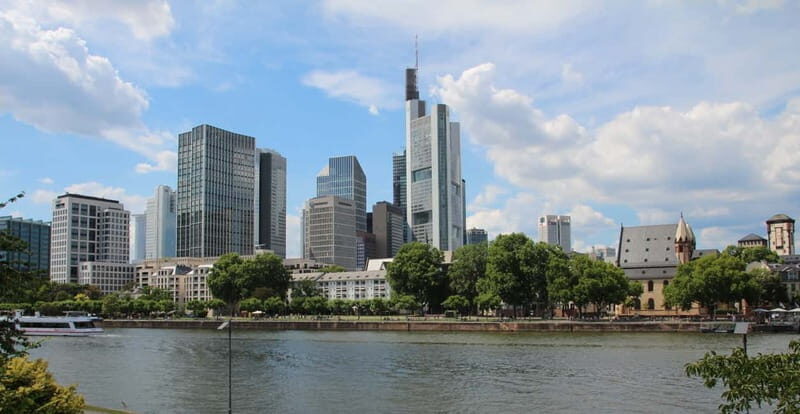
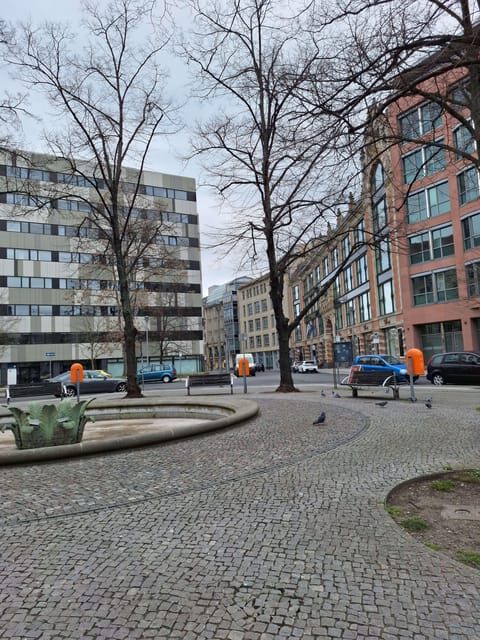
Frankfurt can feel like two cities at once. You’ve got the pre-war, post-war, and rebuild layers of the Altstadt. Then, just a short distance away, the skyline shows how aggressively the city modernized. This tour is built to keep those two sides in one frame, so you’re not just sightseeing monuments—you’re learning how Frankfurt thinks about space, memory, and change.
The value here is the comparison. Instead of treating old streets as a museum and the modern area as a separate “thing to see,” you’ll keep switching lenses as you walk. That makes the history stick, especially because the guide points out what was lost, what was rebuilt, and what’s still in motion.
And that’s what makes the Neue Altstadt more than a trendy headline. It’s Frankfurt projecting its future while borrowing the shape of its past. Even if you don’t care about planning debates, you’ll feel the difference when you’re standing in front of it.
You can also read our reviews of more walking tours in Frankfurt



Starting at Römerberg: Justitia-Brunnen sets the pace
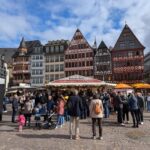
You meet your guide at the Justitia-Brunnen statue in Römerberg. That’s a good start because Römerberg isn’t some random plaza—it’s one of the anchors of Frankfurt’s old center. You’ll begin with the guide orienting you to the area and then move quickly into the story of the city.
If you’re the kind of person who likes to understand what you’re looking at before you zoom ahead, this works well. The guide helps you “read” the space: where the old civic power lived, why this area is still the emotional center of the city, and how the walk will connect landmarks instead of just listing them.
Römerberg also makes it easier to line up your next move after the tour. Once you’ve got the layout in your head, you can return on your own to linger in the places that grab you.
Crossing the Eiserner Steg (1868) and seeing war-era change up close
Next, you head toward the Eiserner Steg—the iron footbridge built in 1868. It’s the kind of structure that feels “practical” and historic at the same time. You’re not just walking past a pretty bridge; you’re crossing a piece of Frankfurt’s industrial-era engineering that still functions as a pedestrian route.
What makes this stop especially useful is the way the guide ties the bridge to the city’s turning points. You’ll hear how many of the grand buildings were destroyed during World War II, and you’ll also get the detail that the bridge went through a major renovation in 2008–9. Those two facts together help you understand why Frankfurt looks the way it does today: layers, rebuilds, and careful repair rather than a single snapshot in time.
As you move along and take in views, you’ll also start getting the “old versus new” framing. Even from a bridge, you can catch the skyline and feel how Frankfurt grew without erasing everything around it. That’s a great reminder for your brain: this isn’t one timeline—it’s multiple timelines stacked.
Römer and Paulskirche: the first German national assembly in context
After the bridge segment, the tour focuses on Frankfurt’s historic heart, including the Römer and Paulskirche. These stops connect the city’s architecture to a big national story, not just local trivia.
Paulskirche is the key moment: it’s the location of the first German national assembly. Standing near a place like that changes the whole tone of sightseeing. You stop thinking of it as a church-shaped building and start thinking about it as a stage where ideas were argued—where Germany’s political future was debated in a formal setting.
Römer is the other anchor. It’s tied to Frankfurt’s civic identity, the sense that this city was more than a pass-through stop. On this walk, the guide helps you connect why these places matter side by side: one is about public life and governance, the other is about national representation and political milestones.
If you’re a first-timer in Frankfurt, this pairing is efficient. You get major landmarks plus the meaning behind them, in about 90 minutes total. If you’ve been once and felt like you missed the plot, this kind of guided threading can change your whole understanding of the city center.
Neue Altstadt: why Frankfurt keeps rebuilding its “old town”
One of the most interesting parts of the experience is exploring the latest project of the city of Frankfurt: the Neue Altstadt, or new old town. The name is a little paradoxical, but that’s the point. Frankfurt is actively shaping how its historic center should look and function today.
You’ll use this part of the walk to compare the historic monuments with the direction the city is taking now. In plain terms, you’re watching the process of reconstruction and interpretation happen in real time. Not everything old can come back exactly as it was, but cities can choose what they rebuild—and how.
This is also where the guide’s explanations pay off most. It’s easy to walk through a redevelopment area and just see streets and buildings. It’s harder to grasp what’s “new” versus what’s an echo of older forms. With a guide pointing it out, you can spot the design choices that carry the city’s identity forward.
You can also read our reviews of more private tours in Frankfurt



How the guide keeps the old and the skyline in the same frame
The tour is designed to let you compare historic monuments with modern skyscrapers. That doesn’t happen by accident. The guide’s job is to keep turning your attention—first to details of the Altstadt, then to what Frankfurt did with its future.
This is the difference between a sightseeing loop and a story-based walk. When you’re only moving from one photo spot to another, it stays surface-level. When someone keeps reminding you what was rebuilt, what was preserved, and what replaced it, the city starts to feel like a living argument between eras.
The contrast also makes the walk visually satisfying. On a clear day, you’ll get both riverside engineering vibes and the sharp angles of the modern city nearby. Even on a rainy evening, the route still gives you moments of shelter and short bursts of view rather than long exposed stretches—plus, the structure of a 90-minute walk prevents you from getting stuck feeling bored.
What makes the guides stand out (like Sanel’s style)
The experience is led by a live guide in German, and the quality shows in how people describe their time on the tour. A name that came up in feedback is Sanel, praised for giving a deep, detailed look at Frankfurt’s history. That matters because this isn’t a “three bullet facts and go” type of walk. The explanations connect the architecture to the bigger events that shaped the city.
You’ll also hear appreciation for flexibility on private tours. One private-group experience described a guide as time-flexible even when the evening was shortened by weather, while still providing solid insights. Another highlight was how well a guide handled a multi-generation family group, from a child to an adult in their late 80s. That’s a good sign if you’re bringing people with different attention spans or knowledge levels.
If you want a walk that feels like conversation more than lecture, this kind of guide approach is exactly what to look for.
How long is 1.5 hours, and what you’ll (and won’t) cover
Ninety minutes is a sweet spot for a city center walk: long enough to connect landmarks, short enough that you don’t feel trapped on your feet all day. The structure is paced so you can see the major anchors—Justitia-Brunnen/Römerberg area, the Eiserner Steg, Römer, Paulskirche, and the Neue Altstadt segment—without turning it into a marathon.
The tradeoff is that you won’t have time to linger for long at every single detail. If you’re the kind of person who loves slow reading of façades, you might want to plan your own follow-up time after the tour. Treat the guide as the “fast decoder ring,” then return later for the parts you liked most.
Also, because the tour is in German, you might want to decide in advance how you’ll handle it. You can still enjoy the visuals and the big-picture story even if you miss some wording. If you need more back-and-forth, private can help.
Price and value: $17 for a landmark-dense story
At $17 per person for a 1.5-hour guided walk, this is priced in the “good deal” range for a Frankfurt-focused experience that covers multiple major stops. You’re paying for three things: a guide, a curated route, and interpretation that connects the landmarks into one narrative.
For the value side, look at what you get in that time: the Eiserner Steg built 1868, contextual history around WWII destruction and a 2008–9 renovation, the Römer/Paulskirche area tied to the first German national assembly, and the Neue Altstadt redevelopment. That’s a lot of high-density content for one afternoon plan.
A shared tour usually makes sense if you’re comfortable walking with other people and want to keep the per-person price low. A private option can be worth it if you’re traveling as a family, have limited time, or want the guide to flex to your pace.
Who this tour suits best
This works well if you:
- Want a first Frankfurt overview that doesn’t stop at generic facts
- Like history that’s tied to places you can stand in front of
- Enjoy the contrast between old architecture and modern skyscrapers
- Prefer a compact itinerary that fits into a busy day
It’s also a good choice for families, including mixed ages, as long as everyone is okay with a mostly walking-based format and a German-language guide.
If you’re traveling solo and want context, shared is fine. If you want more patience for questions, private group can feel smoother—especially if your schedule is tight or weather might change plans.
Should you book the Frankfurt walking tour?
If you want to understand Frankfurt in a way that feels connected—Altstadt to skyline, WWII impact to rebuilding, civic landmarks to national political meaning—then yes, I’d book this. The stop selection is strong for a 90-minute format, and the Neue Altstadt element gives you a forward-looking angle instead of a purely old-world stroll.
Book it especially if you’re the type who likes your sightseeing to have a point. Meeting at Römerberg and walking through Eiserner Steg toward Paulskirche gives you both atmosphere and context in the same route.
If your German is very limited and you dislike guided listening, consider private so you can pace and clarify more easily. Otherwise, don’t overthink it—your eyes plus the guide’s storytelling will do most of the work.
FAQ
Where do I meet the guide?
You meet your guide at the Justitia-Brunnen statue in Römerberg.
How long is the walking tour?
The tour lasts 1.5 hours.
Is it a private tour or a shared tour?
Both options are available. The format depends on what you select when booking.
What language is the tour guide?
The live tour guide speaks German.
What landmarks does the tour focus on?
You’ll see the Altstadt highlights including the Eiserner Steg, the Römer, Paulskirche (linked to the first German national assembly), and the Neue Altstadt.
How much does it cost?
The price listed is $17 per person.
What’s the cancellation policy?
You can cancel up to 24 hours in advance for a full refund.