REVIEW · COLOGNE
Cologne: Melaten Cemetery Celebrities and Curiosities
Book on GetYourGuide →Operated by Tours & Tales · Bookable on GetYourGuide
One cemetery walk can feel like time travel. In Cologne, Melaten Cemetery is a calm park world packed with dramatic tombs, plus stories you won’t get from a guidebook. I like the way the tour turns cemetery architecture and symbols into clear, human-scale explanations, not just dates on stone.
What I really enjoyed was the focus on specific, memorable tales—like the drunkard story that somehow ties back to part of his favorite pub—and the chance to spot the cemetery’s visual “social map,” including the Millionaires Alley paths set aside for the wealthy. One thing to consider: this is a walk through grounds and monuments, so you’ll want comfortable shoes and a bit of patience for rain if the weather turns.
In This Review
- Key things to look for on this Melaten Cemetery tour
- Melaten Cemetery: a calm park world with Cologne’s personality
- Starting at the old main entrance: getting the map before the walking
- How Melaten Cemetery evolved: from lepers and executions to remembrance
- Millionaires Alley: where the wealthy paths shape what you notice
- Extraordinary tombstones and art you can actually interpret
- The stories: prominent Cologne citizens and the pub twist
- The oldest grave and the architect’s tomb at the finish
- Private group format: why the 2 hours feel comfortable
- Pricing and value: $94 per group up to five
- Who should book this Melaten Cemetery tour?
- Should you book Melaten Cemetery Celebrities and Curiosities?
- FAQ
- How long is the Melaten Cemetery Celebrities and Curiosities tour?
- Where does the tour start?
- Is the tour available in German?
- Will the tour run in bad weather?
- How many people are in a group?
- Is the tour wheelchair accessible?
- How much does it cost?
- Is free cancellation available?
Key things to look for on this Melaten Cemetery tour
- Old main entrance start: you get context before you start wandering
- Park-like design: a quiet oasis feel inside the city
- Millionaires Alley: main paths reserved for the wealthy
- A mix of styles: Classicist to Neo-Gothic to Neo-Baroque monuments and sculptures
- Famous-curiosity stories: prominent Cologne citizens, plus oddball anecdotes
- A clear finish point: the architect’s tomb at the end
Melaten Cemetery: a calm park world with Cologne’s personality
Melaten Cemetery sits in Cologne like a pause button. Over two centuries old, it’s described as an oasis of peace and quiet in the middle of a major metropolis, and the grounds really support that idea. You’re not just looking at graves—you’re moving through a designed park space where monuments, symbols, and art compete for your attention in a controlled, readable way.
I also like the scale. With about 55,000 graves, you can easily imagine how a big cemetery can feel overwhelming. The tour helps you avoid that. Your guide steers you toward the standout sections, the most meaningful monuments, and the stories that connect the stone to actual Cologne lives.
Finally, there’s a practical emotional benefit: cemeteries can make people feel awkward. This experience keeps the tone respectful but not heavy. The result is that you leave feeling informed, with a little humor in your pocket.
You can also read our reviews of more tours and experiences in Cologne.



Starting at the old main entrance: getting the map before the walking
The tour begins at the old main entrance, and that’s a smart move. Before you start counting details, you get a short history of how the area evolved. That early orientation matters because Melaten isn’t just one “type” of place—it changed roles over time.
Your local guide explains that this area used to be a village for people affected by leprosy. It also served as a place of execution at one point, and later became a central cemetery. Even if you’ve visited other German cemeteries, this layered origin gives you a different lens. You start noticing how the cemetery reflects changing ideas about community, punishment, and remembrance.
Tip for your comfort: expect steady walking for the full 2 hours. It’s wheelchair accessible, but the experience still involves being out among paths and monuments. If you’re someone who likes to stop and read everything, you’ll likely want to pace yourself and let the guide’s priorities do the heavy lifting.
How Melaten Cemetery evolved: from lepers and executions to remembrance
One of the most striking parts of the tour is how it frames the cemetery’s past. You’re told the area began as a leprosy village—an uncomfortable, historically real phase that sets the tone for why this location became separated and controlled. Then you hear about executions, which adds another layer of darkness to the landscape you’re standing in.
What I appreciate is that the guide doesn’t treat these topics like trivia. It helps you understand why cemeteries often end up as complicated places: they’re not only about loss, they’re also about social order, boundaries, and power. When the tour moves forward to the cemetery era, you feel the transition more clearly.
And then you shift from the heavy backstory to the physical space itself. The park-like design and the artful monuments create a contrast that you can actually see. That contrast is part of what makes this cemetery visit feel more like a guided walk through Cologne’s identity than a purely solemn stop.
Millionaires Alley: where the wealthy paths shape what you notice
As you walk, you’ll come to Millionaires Alley, referring to the main paths reserved for the wealthier families buried there. Even without getting lost in names and dates, this section helps you understand how cemeteries can act like social records.
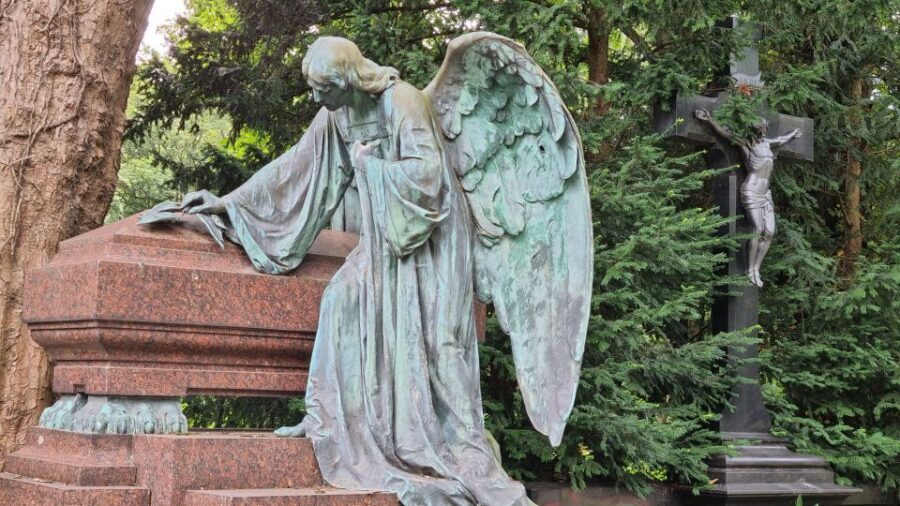
The guide points out the architecture and monument styles, and that makes the “rich vs. not rich” idea more visual. You see classicist to Neo-Gothic and Neo-Baroque influences, along with symbols and sculptures carved to communicate status and meaning. This is where the tour feels most “designed,” because the space is arranged in a way that guides your eye and your footsteps.
I also like that this isn’t a cynical lesson in inequality. It’s more about how people used art, design, and symbolism to express identity. Once you recognize that, you start reading the stone like a language—still respectful, but no longer just blank granite.
Extraordinary tombstones and art you can actually interpret
Melaten isn’t just a cemetery with occasional impressive graves. It’s packed with monuments and objects of traditional and contemporary art, and the guide helps you notice what matters. You’re encouraged to admire everything from Classicist approaches to Neo-Gothic and Neo-Baroque grave monuments, including the symbols and sculptural elements.
That interpretation piece is key. Many cemetery visits fail because visitors either try to read everything and get exhausted, or they breeze past and miss the point. Here, your guide gives you a way to look: what to watch for, what symbols can signal, and how certain design choices fit the era and the person.
You’ll also discover that Melaten’s scale can become a strength. As you move along the main paths, the cemetery’s different artistic “moods” come into view. It’s like walking through a timeline, but without turning it into a dry museum lecture.
If you’re an architecture or art fan, this part is where the tour earns its “Celebrities and Curiosities” theme. If you’re more history-focused, the art still gives you a human anchor—why a monument looks the way it does and what it was trying to communicate.



The stories: prominent Cologne citizens and the pub twist
This tour’s strongest moments are the stories. You’ll hear about prominent Cologne citizens buried here, and you’ll get curious anecdotes that make the cemetery feel alive in a careful way.
One detail that stands out: the tale of a drunkard who ended up with a part of his favorite pub. That kind of story works because it’s specific and strange, the kind of human twist that makes you remember what you saw on the walk. It also acts as a bridge between stone and real life. Instead of only thinking about death, you start thinking about character, behavior, and community—and how those things show up in the way people were remembered.
Your guide also helps connect the cemetery’s sections and monuments to those stories. That matters because it prevents the experience from feeling like random stops. You’re moving through a route where each area has a purpose: history context near the start, then art and social structure in the middle, and closure at the end.
As a bonus, humor shows up naturally. A review specifically praised guide Manfred Speier as something like a walking encyclopedia—humorous, interesting, and guiding people to places that you wouldn’t necessarily find or understand on your own. Even if you don’t get the same guide, the effect is similar: you’re guided, not just shown.
The oldest grave and the architect’s tomb at the finish
Every good walk needs a landing. This one ends at the tomb of the architect of the graveyard, which gives the tour a satisfying sense of structure. You’re not simply left wandering after the “best bits.” You reach a final focal point that feels intentional.
Before that finish, you’ll also visit the oldest grave of the cemetery. That stop gives you perspective fast. When you see the early burial point, it’s easier to imagine how the cemetery grew and adapted—how a place can start with one function and expand into a monumental, art-rich environment with 55,000 graves.
Ending with the architect’s tomb also changes how you think about what you’ve walked through. Cemeteries aren’t only spontaneous. They’re planned spaces with pathways, section logic, and visual priorities. Seeing the architect’s resting place reinforces that this park-like oasis has an underlying design story.
Private group format: why the 2 hours feel comfortable
This experience runs for 2 hours, and it’s offered as a private group. There’s a group size limit of up to five people per group, which is a big deal for a cemetery tour.
Small groups mean you can ask questions without waiting in line for attention. It also keeps the guide’s pacing manageable. Cemetery visits work best when you can slow down at a few meaningful spots rather than sprint through everything.
In my view, the private setup also makes the stories land better. When you’re in a compact group, the guide’s humor and pacing work like a conversation. It’s easier to focus on the details your guide highlights—especially the mix of styles and the symbolic elements that can otherwise be easy to miss.
Also, the tour runs rain or shine. That’s normal for outdoor walks, but it’s worth planning mentally. Bring a layer you can move in, and consider how you’ll handle steady damp weather on stone surfaces. Your best defense is comfort and patience rather than hoping for perfect conditions.
Pricing and value: $94 per group up to five
The price is listed at $94 per group (up to 5), and that’s where the math gets interesting. Cemeteries can cost you time more than money if you’re piecing together multiple stops, audio guides, and research on your phone. This tour compresses a lot of meaning into a tight 2-hour route with a live guide.
Because it’s per group, the value improves as your group fills up. With up to five people, you can split the cost and turn what could be a solo “slow walk with reading” into something more like a guided story circuit. The guide’s role matters here: you’re paying for interpretation of monument styles, historical transitions, and the curious anecdotes that connect people to places.
If you’re traveling with friends, this is a practical buy. If you’re solo, it can still be worth it if you know you prefer explanation over self-guided wandering. The main tradeoff is personal: if you don’t enjoy walking through many carved details, you may prefer a shorter stop or a museum-style option.
Who should book this Melaten Cemetery tour?
This is a good fit if you like any of these:
- Cemetery art and architecture (Classicist, Neo-Gothic, Neo-Baroque styles, sculptures, symbols)
- Story-driven history that turns stone into people
- A small-group pace where you can actually absorb what you see
- A Cologne experience that’s more reflective and specific than a quick sightseeing sprint
It may be less ideal if you want purely scenic photos without stopping for context. Even though the grounds are peaceful, the tour is built around learning and stories, so you’ll get the most from it if you’re willing to pay attention.
Should you book Melaten Cemetery Celebrities and Curiosities?
I’d book this if you want a respectful, practical way to understand one of Cologne’s most distinctive burial spaces. The combination of a quiet park-like setting, Millionaires Alley, the oldest grave, and a guided explanation of how the site evolved from lepers’ village to execution site to central cemetery makes it feel more structured than a casual cemetery visit.
If your group includes at least a couple of people who like architecture, odd historical anecdotes, or guided storytelling, the price per group starts to look especially fair. And if you’re lucky enough to have a guide with the style reviewers highlighted—like Manfred Speier—you’ll likely find the time flies, and the stone details stick with you.
FAQ
How long is the Melaten Cemetery Celebrities and Curiosities tour?
The tour lasts 2 hours.
Where does the tour start?
It starts at the cemetery’s old main entrance.
Is the tour available in German?
Yes. The live tour guide speaks German.
Will the tour run in bad weather?
Yes. The tour takes place rain or shine.
How many people are in a group?
It’s a private group with a maximum of up to 5 people per group.
Is the tour wheelchair accessible?
Yes. The tour is listed as wheelchair accessible.
How much does it cost?
The price is $94 per group up to 5.
Is free cancellation available?
Yes. You can cancel up to 24 hours in advance for a full refund.