Augsburg rewards slow reading. This private 3-hour tour helps you get up to speed fast, then puts you right in front of the city’s big-name sights—especially Fuggerei with its living social housing story, guided by a private expert you can actually question. It’s a smart way to skip the endless research rabbit hole and still feel like you understand what you’re seeing.
I also love how the route mixes church art, civic landmarks, and standout architecture, including the baroque splendor of Schaezlerpalais. The main thing to plan for is that two interiors cost extra on the spot: Schaezlerpalais (€7) and the Goldener Saal (€2.50)**.
In This Review
- Key points to know before you go
- Why this private Augsburg tour is a smart shortcut
- Meeting at Augsburg Town Hall and keeping your pace realistic
- Rotes Tor to St. Ulrich and Afra: the opening clues of the city
- Schaezlerpalais: baroque palace artistry you’ll want to see up close
- Hercules’ Fountain and the Augsburg fountain logic
- Goldener Saal in the Augsburg Town Hall: ceiling art and war scars
- Perlach Tower: a 10th-century watchtower that still anchors the city
- St. Anne’s Church and Augsburg Cathedral: two different layers of sacred architecture
- Fuggerei: why this stop is the heart of the tour
- Price and value: when $417.72 per group makes sense
- Who this tour suits best (and who might want a different style)
- Book it or skip it? My call
- FAQ
- How long is the Augsburg private historic tour?
- How much does the tour cost, and how many people can join?
- What are the main sights you’ll see during the walk?
- Are entrance fees included?
- Where do I meet the guide, and where does the tour end?
- What’s the cancellation policy?
Key points to know before you go
- Fuggerei is the world’s oldest social housing complex that’s still in use (since 1516)
- Schaezlerpalais delivers baroque style from 1765, and it costs €7 to enter
- The Goldener Saal (completed 1643) includes ceiling paintings, and it was rebuilt after a 1944 air raid
- A tight, walkable route strings together Rotes Tor, multiple churches, and the Augsburg Town Hall area
- It’s truly private, so you can ask questions and set the pace to your preferences
- Two paid stops sit inside a mostly free lineup, so budgeting stays manageable
Why this private Augsburg tour is a smart shortcut
Augsburg is one of Germany’s oldest cities, but that can be a downside when you’re on your own. The story is layered, and it’s easy to see beautiful buildings without really knowing why they matter.
This private format fixes that. You get an official guide to connect the dots across centuries, while you walk past major stops like the red-gated Rotes Tor, the basilica of SS. Ulrich and Afra, and the cathedral area. The value here isn’t just ticking boxes—it’s getting context in real time, right where the details live.
And since you’re with only your group, the guide can slow down when you want more explanation, or speed up when you’re ready to move on. One practical example from past groups: guides like Kristen have a reputation for handling the start and end of the day with care—meeting people at a station and escorting them back at the end. Stephanie is also noted for being flexible, tailoring the tour to what a group wanted most. That kind of attention matters in a historic city where small streets and overlapping eras can otherwise feel confusing.
You can also read our reviews of more private tours in Augsburg
Meeting at Augsburg Town Hall and keeping your pace realistic
The tour starts at Augsburg Town Hall (Rathausplatz 2, 86150 Augsburg) and ends near Fuggerei by the Jakobskirche (86152 Augsburg). That’s a useful setup: you begin in the civic center and gradually walk into the old core around Fuggerei.
Time-wise, you’re looking at about 3 hours, with many stops at 10–30 minutes each. That’s not a long day, so you’ll want to treat it like an ordered route rather than a “linger forever” sightseeing crawl. The good news: most stops have free admission, so you spend your time looking at the place, not lining up for tickets you didn’t expect.
Also, the experience notes that most people can participate, and it’s near public transportation, which helps if you’re building Augsburg into a longer Germany trip.
Rotes Tor to St. Ulrich and Afra: the opening clues of the city
You kick things off at Rotes Tor, the famous red gate. The basics you get right away are helpful: it was renovated in the 20th century, so it’s not just medieval scenery. It’s a reminder that Augsburg kept caring for its landmarks long after their first construction.
Next comes the Basilica of SS. Ulrich and Afra. This stop is special because the guide can link the present church to an older story: it traces its origins to the Roman tomb of St. Afra, martyred in 304. Even if you don’t consider yourself a church-history person, that kind of connection makes the architecture feel less random and more intentional.
Why this matters for your visit: churches here weren’t only religious buildings. They were also anchors for identity and memory. With a guide, you’ll understand what you’re looking at as you look at it.
Practical note: both of these early stops are listed at 15 minutes and have free admission, so they work well as a warm-up. If your legs are good, you’ll still feel fresh when the baroque and interior-ticket stops arrive.
Schaezlerpalais: baroque palace artistry you’ll want to see up close
Then you hit one of the tour’s biggest “pause and look” moments: Schaezlerpalais. This is described as an important historical monument and an artistic palace in baroque style, with origins dating to 1765.
This is also where your budget needs a small adjustment. Schaezlerpalais entry is €7 per person and is not included. If you’re used to “free walking tours,” that can feel like a surprise. The upside is that you’re paying for a specific interior/palace experience, not a vague photo stop.
What to do with the extra time here: don’t just snap pictures and move on. Baroque architecture rewards attention to proportions and details, and the guide is exactly where you’ll get the “why this is significant” explanation instead of only seeing shapes.
If you prefer to keep costs down, you can still enjoy the exterior and the general context—but the tour’s structure strongly suggests this palace moment is one of its core points. Decide your priority accordingly.
Hercules’ Fountain and the Augsburg fountain logic
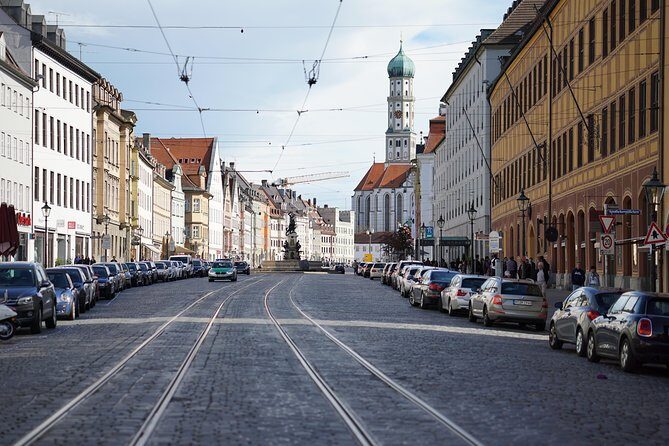
A short walk brings you to Hercules’ Fountain, made in 1597. The bronze sculpture shows Hercules killing the hydra, drawing on Greek mythology.
Why a fountain like this is more than decoration: in Augsburg, public art in the streets often doubles as a story about values—strength, victory, order—made visible in bronze and stone. With a guide, the myth isn’t just an image. You understand why that myth is being performed in civic space.
Then you’ll also see Augustusbrunnen, cast between 1588 and 1594, located in the Town Hall square area. Think of this as your “civic power” pairing with the Hercules myth—two different ways the city expresses itself outdoors.
These are quick stops (the fountain time blocks are around 10–15 minutes), but they’re a good way to break up the cathedral/church weight of the tour. If you want photos, fountains are perfect because you can step back, frame, and still keep moving within the schedule.
You can also read our reviews of more historical tours in Augsburg


Goldener Saal in the Augsburg Town Hall: ceiling art and war scars
Next up is the Goldener Saal, a ceremonial room in the Augsburg Town Hall. It’s known for ceiling paintings and golden wall decoration, and it was completed in 1643.
Here’s the moment that makes it emotionally real, not just decorative: the Town Hall and Goldener Saal were destroyed in a 1944 air raid and then reconstructed after the war. So when you look at those details, you’re also looking at a rebuilding effort—proof that civic identity mattered enough to restore.
The interior ticket is €2.50 per person, not included. That’s a pretty low add-on for an indoor, historically specific stop, especially in a tour where most other stops are free.
One tip for getting value: go in with the expectation that you’ll spend your time on what the guide points out—ceiling work and key decorative elements—rather than trying to read every corner yourself in a rushed moment.
Perlach Tower: a 10th-century watchtower that still anchors the city
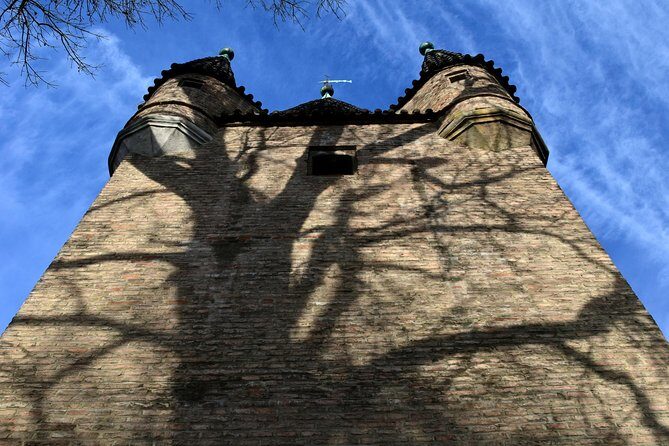
Then you visit Perlach Tower (Perlachturm), a 70-meter tower in central Augsburg. It began as a watchtower in the 10th century, which makes it one of those “you’re standing in the continuity line” experiences.
Tower stops are sometimes awkward on tours because they can become either too short (no impact) or too long (no room for the rest of the route). Here, the time block is 10 minutes with free admission, which is a good compromise. You’ll get the basics you need—what it is, where it came from, why it mattered—without stealing time from other higher-priority sights.
If you like city orientation, this stop helps. You get a landmark that acts as a mental map point for where you are in Augsburg’s center.
St. Anne’s Church and Augsburg Cathedral: two different layers of sacred architecture
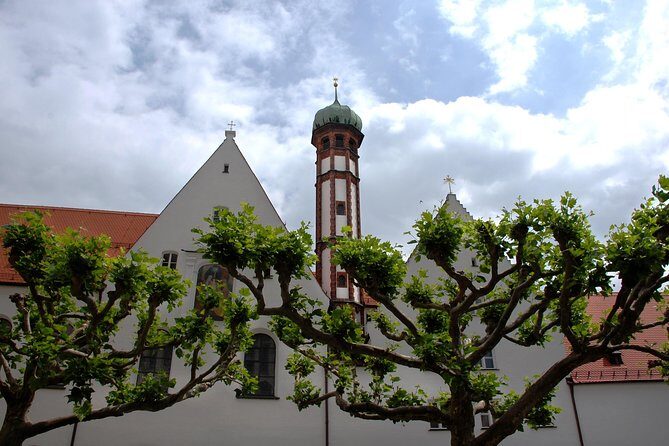
The tour continues with St. Anne’s Church (built 1321), originally part of a monastery and noted for elaborate interior decoration. This stop is about 15 minutes and free.
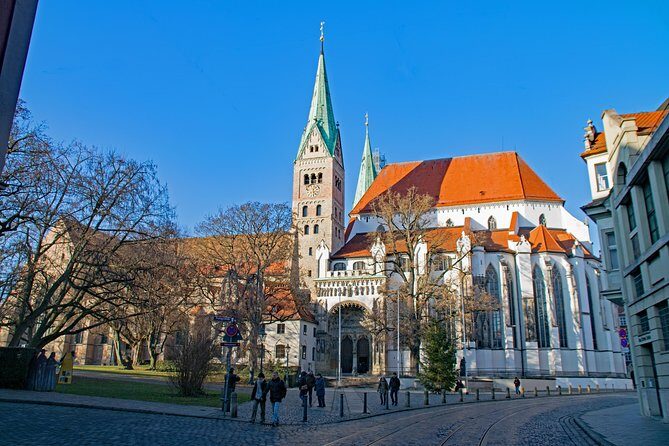
From there you move to Augsburg Cathedral, a Roman Catholic church founded in the 11th century with Gothic additions in the 14th century. The cathedral tower is about 62 meters high. This is again a 15-minute stop with free admission.
What I like about combining these two: they show how sacred buildings in a historic city can evolve without losing their role. St. Anne’s gives you the medieval monastery-connected feel; the cathedral adds the longer arc, with Gothic changes arriving later.
A practical consideration: these stops are quick. If you want to linger for independent exploring, consider asking your guide if there’s a feature you should prioritize in the limited time.
Fuggerei: why this stop is the heart of the tour
You finish with Fuggerei, described as the world’s oldest social housing complex that’s still in use. It’s named after the Fugger family, founded in 1516, and created so needy citizens of Augsburg could be housed.
This is the stop that tends to land hardest because it changes the way you see old buildings. Fuggerei isn’t a museum holding onto the past. It’s a living social structure that still carries the original purpose. When your guide explains how the concept worked and why it endured, you stop thinking of it as a “sight” and start thinking of it as a real civic system.
The tour includes about 15 minutes here, with free admission. That’s enough time to understand the setup and take in the key features without turning it into a long standalone visit.
Also, the way the tour ends here is smart. After the last church-and-cathedral moments, Fuggerei offers a different kind of connection—social rather than only architectural.
Price and value: when $417.72 per group makes sense
The price is $417.72 per group for up to 15 people, and the duration is about 3 hours. That means the cost isn’t per head—it scales with group size. If you can fill a small group, the per-person value improves quickly. Even if you don’t fill all 15 spots, you’re paying for a private guide and a structured route that saves you time planning and reduces the risk of wandering past important details without context.
What makes it good value for the money:
- Most stops are free, so you aren’t paying admission constantly.
- You do pay for Schaezlerpalais (€7) and the Goldener Saal (€2.50), but those are targeted interior experiences with clear payoff.
- A private guide means you get answers on the spot. In cities like Augsburg, that’s often what turns “cool buildings” into a real story you remember.
Booking timing also looks reasonable. It’s noted as being commonly booked around 13 days in advance, so if Augsburg is a fixed part of your trip plan, you’ll likely want to reserve early enough to get your preferred slot.
Who this tour suits best (and who might want a different style)
This is a strong fit if you:
- Want a guided route through major Augsburg landmarks in a short window
- Like history that connects architecture to people and civic life
- Prefer a private experience where you can ask questions without rushing
- Are the type who enjoys churches and civic buildings, not only scenic street walking
It might feel less ideal if you:
- Want a very slow, sit-down museum-style day
- Don’t want to pay any additional entry fees at all (two interiors here do cost extra)
Book it or skip it? My call
If you want Augsburg to feel coherent, not just photographed, I’d book this. The combination of Fuggerei, Schaezlerpalais, and the Goldener Saal hits the main story points of the city’s identity—religion, civic life, art, and social purpose—without eating your whole day.
I’d especially recommend it for first-timers, and for groups who want to compare notes afterward: the guide-led context makes the walk easier to remember.
If you’re in Augsburg for only a day or two and you care about understanding what you’re seeing, this private format is a practical way to get there.
FAQ
How long is the Augsburg private historic tour?
It lasts about 3 hours.
How much does the tour cost, and how many people can join?
The price is $417.72 per group, up to 15 people.
What are the main sights you’ll see during the walk?
You’ll cover stops including Rotes Tor, the Basilica of SS. Ulrich and Afra, Schaezlerpalais, Hercules’ Fountain, the Goldener Saal in the town hall, Perlach Tower, Augustusbrunnen, St. Anne’s Church, Augsburg Cathedral, and Fuggerei.
Are entrance fees included?
Most stops are free. The not-included entrance fees are Schaezlerpalais at €7 per person and the Goldener Saal at €2.5 per person.
Where do I meet the guide, and where does the tour end?
Meet at Augsburg Town Hall, Rathausplatz 2, 86150 Augsburg. The tour ends in Augsburg near Fuggerei by the Jakobskirche, 86152 Augsburg.
What’s the cancellation policy?
This experience is non-refundable and cannot be changed for any reason. If you cancel, the amount you paid is not refunded.