REVIEW · COLOGNE
Roman Cologne: A Self-Guided Audio Tour
Book on Viator →Operated by VoiceMap Audio Tours · Bookable on Viator
Roman Cologne is a city you can hear. This self-guided audio tour turns the streets around Cologne Cathedral into a running story about what was here in Roman times. You’ll learn what’s missing above ground and what still shows up in surprising places.
Two things I really like: the tour feels genuinely flexible (you can pause, start, and move at your own pace), and it includes offline access to audio, maps, and geodata after you download. One possible drawback: for the smoothest GPS-triggered playback, start at the planned beginning point near the cathedral area—trying to go in reverse or starting far off-route can make the timing feel awkward.
In This Review
- Key highlights and practical reasons this audio walk works
- Why Roman Cologne makes such a strong audio walk
- Price and value: $11.99 for a 1–1.5 hour Roman route
- Getting oriented: from Kreuzblume and the cathedral start
- Cologne Cathedral and the route’s Roman-to-medieval storyline
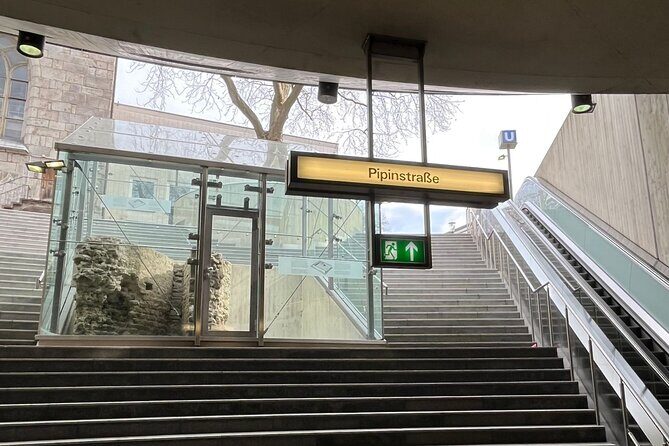
- The Roman Northern Gate: a street walk with a hidden edge
- Roman-Germanic Museum mosaics—seeing big art without buying a ticket
- Die Römische Hafenstraße (Roman Harbour Road) and Kurt Hackenberg Platz
- Romisches Praetorium: when you pass the Rhineland’s biggest Roman palace
- Alter Markt: reading a market square through Roman context
- Great St Martin Church: medieval on Roman warehouse foundations
- Schmitz Saule and the 1969 moon landing tie-in
- Gürzenich Köln facade: spotting Roman soldiers Marsilius and Agrippa
- St Maria im Kapitol in the former Roman temple district
- Ending near the Ubii Monument: oldest stone tower in Germany
- How the app experience feels in real life (and how to avoid the common hiccups)
- Who this tour suits best (and who might want something else)
- Should you book Roman Cologne: A Self-Guided Audio Tour?
- FAQ
- How long does the Roman Cologne audio tour take?
- Where does the tour start and end?
- What language is the tour offered in?
- Does the tour work offline?
- Do I need to buy museum tickets for stops on the route?
- Do I need to bring a smartphone and headphones?
- Can I pause and restart the tour while walking?
- Is this tour only for my group?
- Is the ticket refundable if my plans change?
Key highlights and practical reasons this audio walk works
- Lifetime access in English means you can come back and re-walk it later without worrying about an expiry date
- GPS-triggered audio lets you walk hands-free, with your phone used mostly to follow along
- Offline audio and maps help you keep going without needing constant mobile data
- You’ll spot Roman layers through street-level stops, not just from one big museum visit
- Stops include big-name sites and lesser-known details, from Roman harbour streets to a tower at the end
Why Roman Cologne makes such a strong audio walk
Cologne is one of those cities where the present sits right on top of the past. The trick is knowing what to look for while you’re walking—what counts as Roman, what’s medieval reuse, and what’s just a modern street with an older story underneath.
This tour helps with that exact problem. Instead of you trying to read every plaque, you get short context as you approach each place. The app uses GPS to automatically trigger the audio when you’re in the right spot, so you can keep moving and not constantly tap menus.
The best part is that you don’t need to be a Roman history expert. The stories are built to make the city readable: why buildings are where they are, what survived, and what was likely rebuilt or re-used over time.
You can also read our reviews of more guided tours in Cologne

Price and value: $11.99 for a 1–1.5 hour Roman route
At $11.99 per person, you’re not paying for museum tickets or a live guide. You’re paying for a guided walking experience—audio, maps, and offline geodata—so you can see a lot of stops in about 1 to 1.5 hours at your own rhythm.
That’s good value if:
- you like independent travel and short “guided” walks,
- you want Roman highlights without booking multiple timed attractions,
- you’re traveling at odd hours when ticketed sites might be closed.
It’s less of a steal if you want a museum admission day. Important note: the tour doesn’t include entry fees, and at least one key moment is designed as a window-view experience rather than a ticketed museum visit.
Getting oriented: from Kreuzblume and the cathedral start
The tour begins in the cathedral area—specifically in front of the Kreuzblume, and your listed start point is at Cologne Cathedral (Domkloster 4, 50667 Köln). This matters because the app’s GPS-based playback is tuned to that route.
Here’s how to set yourself up for an easy start:
- Download the tour first while you have reliable Wi‑Fi (offline content is included, but you still need the initial download).
- Stand at the cathedral-area start point before you hit play.
- Keep your phone volume up enough to hear directions.
One real-world lesson from the way the tour is built: you can’t count on “reverse walking” working smoothly. It’s set up as a forward narrative route, triggered by where you stand. If you start somewhere else, you may find the audio timing doesn’t match what you’re seeing.
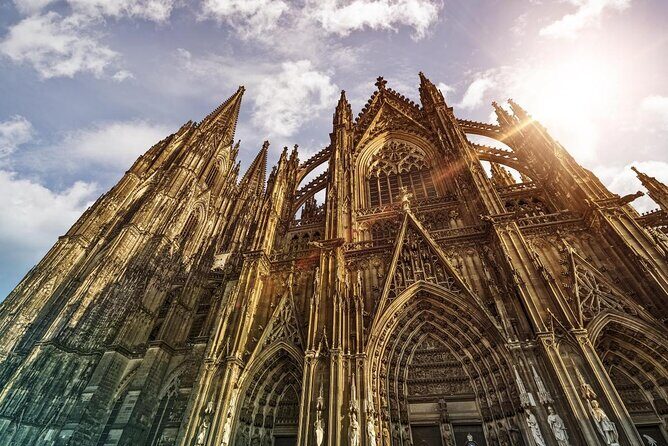
Cologne Cathedral and the route’s Roman-to-medieval storyline
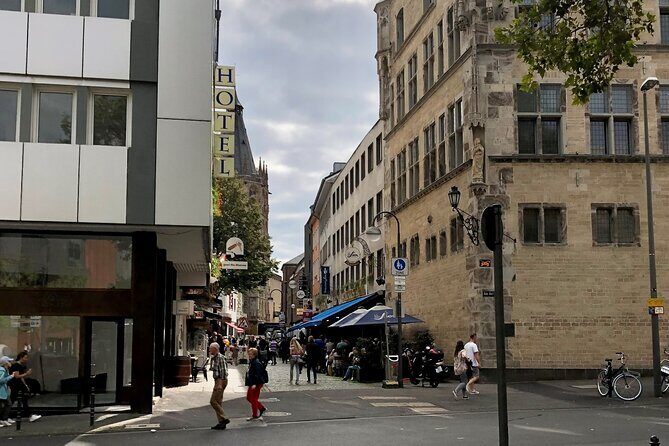
Walking by Cologne Cathedral is an obvious choice, but it works well here because the tour doesn’t treat the cathedral as a one-off stop. It uses it as a landmark anchor while shifting you backward in time.
You’ll hear about what the cathedral area represents in the bigger story of the city—why Cologne’s history is stacked, and how modern grandeur and older foundations coexist. Even if you’ve seen the cathedral before, hearing it explained through the Roman “what was here before” lens can change how you look at the surroundings.
The Roman Northern Gate: a street walk with a hidden edge
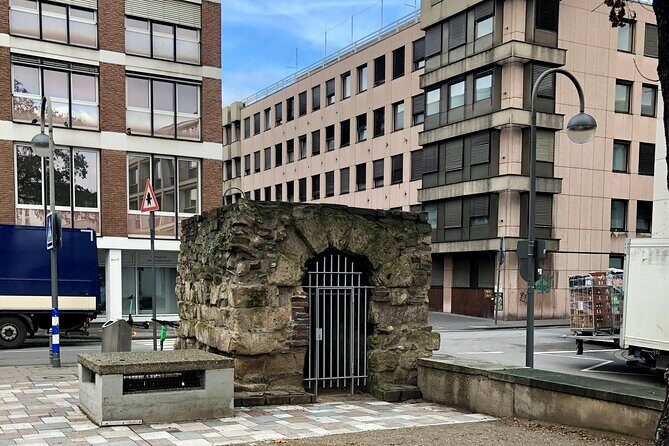
Next up is the Romans’ Northern Gate area. This is the kind of stop that makes an audio tour worthwhile: from the street, it can feel like you’re just walking alongside another urban facade. With narration, it becomes easier to place what you’re looking at in Roman Cologne’s layout.
The tour’s approach here is practical. Instead of asking you to spot tiny details, it guides your attention to the larger meaning of the structure and where it would have mattered in daily movement and defense.
A few more Cologne tours and experiences worth a look





Roman-Germanic Museum mosaics—seeing big art without buying a ticket
One of the most memorable “value” moments is when you peer through a window at the Roman-Germanic Museum to see one of the world’s largest and best-preserved Roman mosaics.
Two good things about this setup:
- You get a major Roman highlight without needing to plan museum hours.
- You still get that wow-factor, because mosaics are hard to make boring even when you’re just looking through glass.
The potential tradeoff is obvious: without included admission, you won’t be able to spend time inside the museum galleries. If you want a longer museum visit, you’d need to add that separately.
Die Römische Hafenstraße (Roman Harbour Road) and Kurt Hackenberg Platz
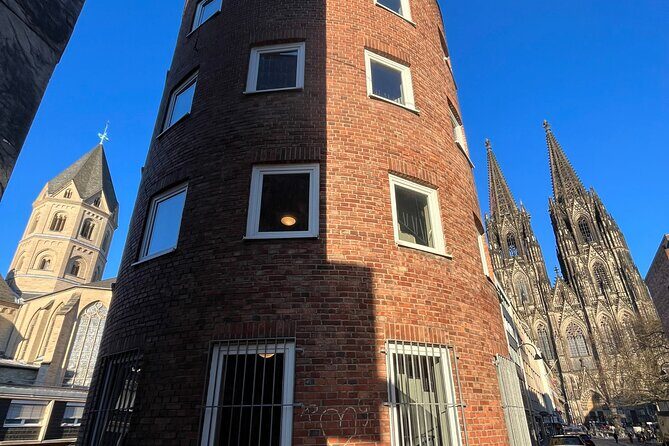
Then the tour moves you down Die Römische Hafenstraße area. Roman Cologne wasn’t just temples and gates—it also had infrastructure. Here, you’ll learn why the Roman harbour road wasn’t perfectly rebuilt in Kurt Hackenberg Platz.
This is one of those stops where narration gives you the “why.” Cities rarely rebuild in an exact copy of the past. Roads get reshaped, plans change, and later builders do what works for their time. Hearing the reasoning behind the imperfect rebuilding helps you interpret mismatches you’d otherwise chalk up to random street evolution.
Romisches Praetorium: when you pass the Rhineland’s biggest Roman palace
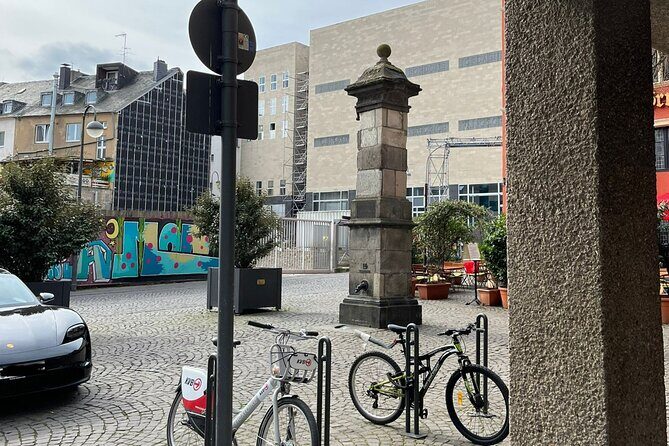
The tour brings you past the Romisches Praetorium, described as the largest Roman palace in the Rhineland. Even if you’re not a Rome-architecture person, this kind of stop is powerful because the scale is the point.
You’re walking through a modern city, but the story reminds you that this spot once belonged to Roman power. That context can turn an ordinary walk past a building into a moment of mental reconstruction: what would this space have felt like in Roman times, and why would it have dominated the area?
Alter Markt: reading a market square through Roman context
The tour passes through Alter Markt, the old market of Cologne. Market places tend to last because people keep coming back to the same practical locations—transport, access, and foot traffic.
The Roman angle helps here because it encourages you to think beyond “today’s square.” The tour nudges you to consider how the same general idea—trade and gathering—could have roots that go much deeper than the buildings around you suggest.
Great St Martin Church: medieval on Roman warehouse foundations
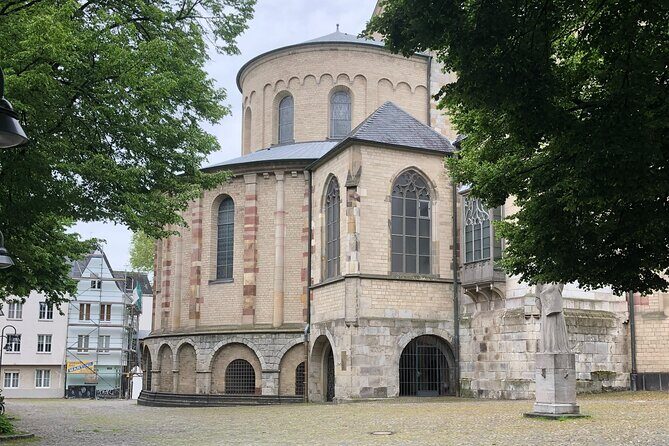
Next you’ll pass by Great St Martin Church, built in the Middle Ages on the foundations of a Roman warehouse. That combination—Roman utilitarian storage becoming medieval religious space—is exactly the kind of reuse that makes Cologne feel like a layered time machine.
This stop is also a good reminder that “Roman” doesn’t always mean a neatly preserved Roman ruin. Sometimes it means traces and foundations, and that’s where narration earns its keep.
Schmitz Saule and the 1969 moon landing tie-in
At Schmitz Saule, the tour connects the 1969 moon landing to ancient Romans in Cologne. This is a fun change of pace: it uses a modern reference point to pull you out of strict ancient history and show how people interpret older ideas in different eras.
Even if you’re not big on science-history crossovers, the narration is there to make the street stop feel playful and memorable, not like another “look at the old thing” moment.
Gürzenich Köln facade: spotting Roman soldiers Marsilius and Agrippa
On Gürzenich Köln’s imposing Gothic facade, the tour teaches you how to spot celebrated Roman soldiers: Marsilius and Agrippa.
This is one of my favorite kinds of walking-tour teaching points—turning what could be just decorative stonework into something readable. Once you know what you’re looking for, the facade stops being background.
It’s also a reminder that Cologne didn’t just preserve Roman ideas; it re-used and re-imagined them later, then built monuments that keep the Roman story visible even after the Roman world was gone.
St Maria im Kapitol in the former Roman temple district
The tour continues through the former Roman temple district and brings you to St Maria im Kapitol. You’ll hear how this area connects back to earlier sacred use, and how later architecture sits over those older layers.
This is a strong section for anyone who likes “why is this here?” questions. It helps you connect the dots between religious power, Roman urban design, and the way later generations placed their own symbols in the same general zones.
Ending near the Ubii Monument: oldest stone tower in Germany
The tour ends near the Ubii Monument, identified as the oldest stone tower in Germany. Your listed end point is Mühlenbach 35, 50676 Köln, and the app should taper off right around this area.
Ending at a landmark like this makes the whole walk feel complete. You start in the cathedral neighborhood, pass gates, markets, Roman palace context, and reused Roman foundations—then you finish with a specific anchor tied to Roman identity.
It’s a satisfying “close the loop” moment, and a good way to decide whether you want to keep exploring on your own afterward.
How the app experience feels in real life (and how to avoid the common hiccups)
This tour lives inside the VoiceMap app for Android and iOS, and the experience includes offline access to audio, maps, and geodata. That’s the key to stress-free walking.
Still, a few practical points will make a big difference:
- Bring your own smartphone and headphones. Those aren’t included.
- Download content ahead of time, so you’re not stuck when reception is weak.
- Because the audio triggers via GPS, keep location services on. The offline download isn’t the same thing as “no GPS required,” and the tour works best when the phone can reliably track where you are.
If you like control, this tour gives it to you. You can stop and start as needed. That’s handy if you hit a crowd near the cathedral or want a coffee break halfway through.
Who this tour suits best (and who might want something else)
I think this is a great fit if you:
- want a walking tour that’s mostly outdoors and flexible,
- like Roman Cologne stories tied to real street sightings,
- enjoy short “context bursts” rather than lectures,
- want something that still works on days when other plans are limited.
It may be a less perfect match if you:
- need a live guide style of engagement to stay interested,
- prefer tours that are easier to remix or wander in any direction (this one is built for a forward narrative route).
The good news: you can skip locations in the app if you want to tighten the time.
Should you book Roman Cologne: A Self-Guided Audio Tour?
I’d book it if you’re spending a few hours in Cologne and you want Roman highlights without complicated planning. The offline support, lifetime access, and the fact that it takes you past a sequence of meaningful sites makes the $11.99 price feel fair—especially if you like walking at your own pace.
I’d skip it (or pair it with other plans) if you expect museum entry as part of the deal. This is a street-level experience with at least one major museum moment designed as a view-through stop, not a paid interior visit.
If you’re curious about Cologne’s layered past and like the idea of turning your phone into a guide while you roam, this is an easy win.
FAQ
How long does the Roman Cologne audio tour take?
The experience is designed to last about 1 hour to 1 hour 30 minutes, depending on your pace and how long you spend at each stop.
Where does the tour start and end?
It starts at Cologne Cathedral (Domkloster 4, 50667 Köln) near the Kreuzblume area. It ends near the Ubii Monument at Mühlenbach 35, 50676 Köln.
What language is the tour offered in?
The tour is offered in English.
Does the tour work offline?
Yes. After you download the tour using the VoiceMap apps, the audio, maps, and geodata are stored on your device for offline use.
Do I need to buy museum tickets for stops on the route?
No. Tickets or entrance fees for museums or other attractions are not included, so you should plan on viewing what you can from the outside or where the route allows.
Do I need to bring a smartphone and headphones?
Yes. A smartphone and headphones are not included, but you will use the VoiceMap app on your phone to play the audio.
Can I pause and restart the tour while walking?
Yes. You can use the tour as you like, stopping and starting as you need.
Is this tour only for my group?
Yes. It’s listed as a private tour/activity, so only your group will participate.
Is the ticket refundable if my plans change?
No. The experience is non-refundable and cannot be changed for any reason.