Berlin holds resistance stories in every block.
This 2.5-hour walk strings together major wartime landmarks and lesser-known memories, with a small-group feel and on-foot storytelling that keeps the focus human, not abstract.
I love the way the guide uses then-and-now photos and maps to connect what you see today with what happened here. Guides such as Johan, Jochen, Scott, Jorg, and Benjamin are repeatedly highlighted for knowing the details and for making the connections clear as you move from site to site.
One possible drawback: expect plenty of standing and waiting between points, so plan for an active, slightly tiring pace even though the walking is manageable. Standing is part of the rhythm.
In This Review
- Key things to know before you go
- Why this Berlin walk focuses on resistance, not just tragedy
- Group size and timing: 2.5 hours with an on-foot rhythm
- Price and free entry: what the $48.01 includes
- Jewish life and forced confinement: Neue Synagoge to Moses Mendelssohn
- Grief made visible: the destroyed Jewish cemetery and Otto Weidt’s rescue work
- Protest, sabotage, and public fear: Rosenstraße, Lustgarten, and the Zeughaus plot
- Monuments and cultural erasure: Neue Wache, Bebelplatz, and Trains to Life–Trains to Death
- Should you book this tour in Berlin?
- FAQ
- How long is the Path of Resistance tour?
- What does the tour cost?
- Is the tour offered in English?
- How big is the group?
- Do I need tickets for the stops?
- Where does the tour start and end?
- Is a mobile ticket provided?
- Is food or drinks included?
- What is the cancellation policy?
- Are service animals allowed?
Key things to know before you go
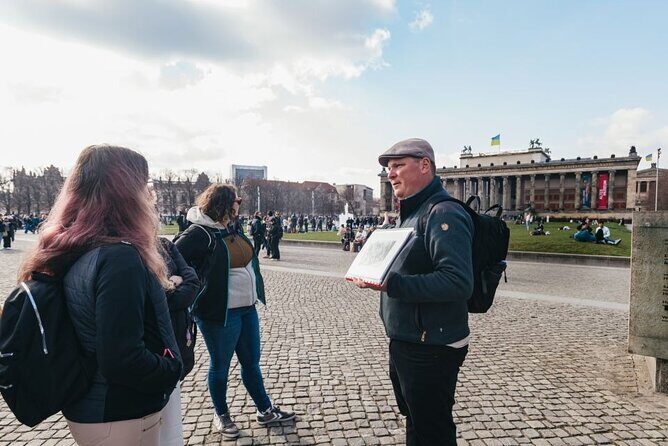
- Small group (max 15): easier questions, less rushing, and a more personal pace.
- Free admission at all listed stops: you can focus on the meaning, not extra fees.
- Resistance in many forms: faith, protest, rescue, and even armed sabotage all show up.
- Then-and-now photos and maps: helps you place events in the city you’re standing in.
- Ends at S+U Friedrichstraße: convenient rail connections after the tour.
Why this Berlin walk focuses on resistance, not just tragedy
Berlin is full of Holocaust reminders, but this tour is built around a different question: what did people do when the Nazis tightened control? I like that the stories move beyond victims’ fates alone and highlight choices made under impossible pressure—religious communities trying to survive, educators and students caught in deportation machinery, and rescuers who risked everything.
You’ll also notice that resistance isn’t only secret meetings or dramatic plots. Here it can be quiet courage (protecting people from deportation), public defiance (protests that briefly changed outcomes), or cultural resistance (pushing back against the Nazi attack on ideas). That mix matters because it reflects what resistance often looks like in real life: uneven, risky, and sometimes painfully brief.
If you want a Berlin tour that feels specific to place—what stood here, who was here, what was erased—you’ll likely enjoy how the route threads through major sites while keeping the emotional center on the people.
You can also read our reviews of more tours and experiences in Berlin.



Group size and timing: 2.5 hours with an on-foot rhythm
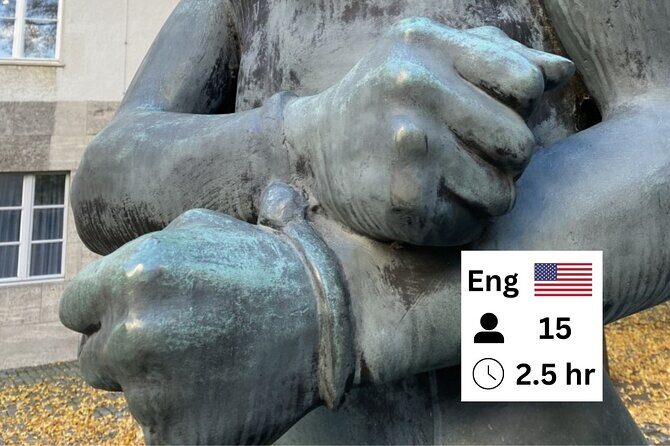
This is an English tour that runs about 2 hours 30 minutes. It’s designed for walking, with a steady sequence of landmarks that are close enough to stitch together into one coherent story.
The group cap is 15 travelers, which is big enough to keep it lively but small enough for your guide to slow down if you have questions. The experience also includes an expert guide, and many stops are short (around 10 minutes each on average), so you’re not stuck at any one location for too long.
One practical note: the route includes memorials and courtyards where you’ll likely stand for explanations, and the tour can feel tiring if you’re sensitive to standing time. Good shoes help. Bring a layer too, because you’ll be outside for long stretches and the tour requires good weather.
Price and free entry: what the $48.01 includes
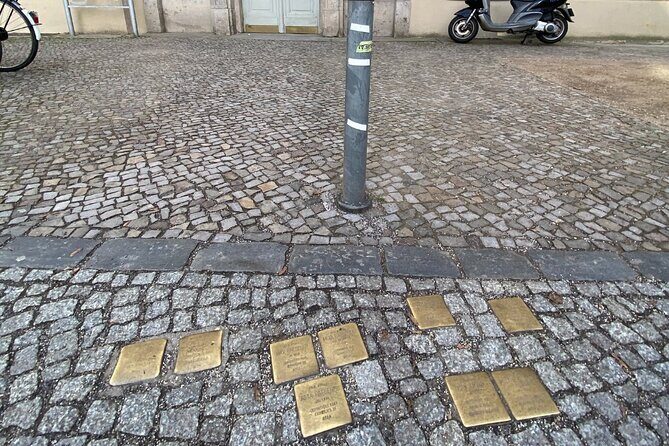
At $48.01 per person, the value here is less about a single ticket and more about what you get packed into the 2.5 hours: an expert guide, an exclusive small group, and a format built around walking, photos, and maps.
You also get a mobile ticket, so you’re not hunting for paper. Plus, each listed site has admission ticket free, which is a big deal for budget-minded travelers. There’s no constant stream of extra-cost stops where you’re asked to pay again and again.
Not included is food and drinks, and there’s no hotel pickup or drop-off. That’s common for city walking tours, but it’s worth planning: bring water, and plan your meal before or after you head to your next stop.
Finally, this tour tends to get booked ahead—on average about 37 days in advance—so I’d aim to lock in a date earlier rather than assuming you can grab the last slot.
Jewish life and forced confinement: Neue Synagoge to Moses Mendelssohn
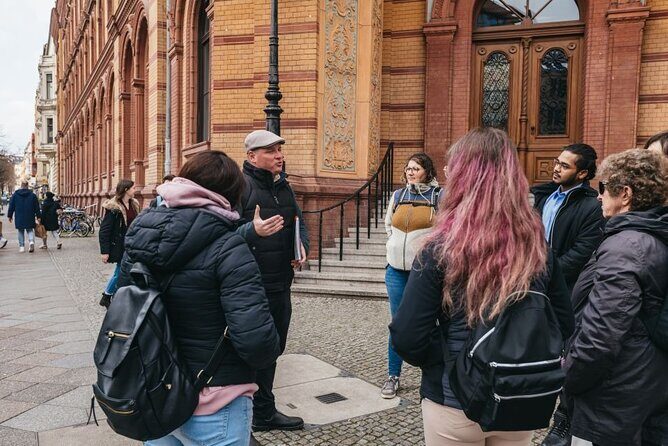
You start at Oranienburger Str. 36 near the Stiftung Neue Synagoge Berlin – Centrum Judaicum. The setting immediately frames the tour in a key way: this wasn’t only a story of destruction. It begins with community.
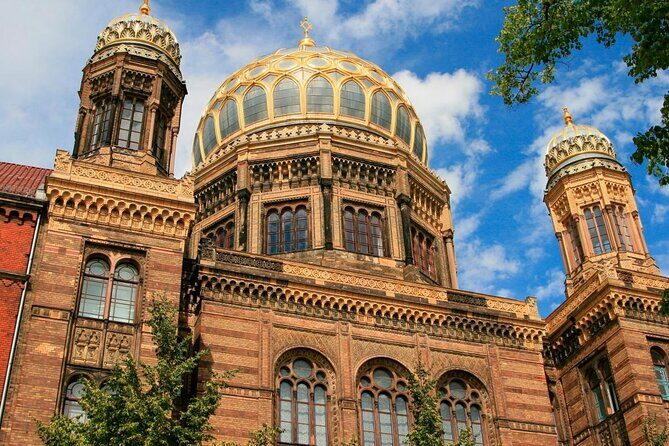
At the Neue Synagogue, built in 1866, the scale matters. It was described as the largest and most magnificent synagogue in Berlin, reflecting a city with a thriving Jewish population of about 160,000 people. Then the tour shifts to the violence: during Kristallnacht, the synagogue was saved from vandals. Later, it stayed in use until 1940, when it was confiscated by the Army and used to store military uniforms. An allied bombing raid severely damaged it in November 1943.
By 1958, the main hall was torn down, then partly rebuilt in 1988 and officially reopened in 1995. Today the synagogue houses the Centrum Judaicum foundation, focused on preserving Jewish memory and tradition. That arc—community to confiscation to damage to remembrance—is one of the tour’s most important through-lines.
A few steps along the story takes you to the Jüdisches Gymnasium Moses Mendelssohn, founded in 1779. This school is described as the first Jewish school in Germany without fees. Even more striking: it was open to all faiths and promoted liberal Jewishness, and it also accepted female students in 1931.
Then the Nazi system closes the door. In the fall of 1941, deportations to newly conquered eastern territories led to banning Jewish schools. In 1942, the building was turned into a transit camp under the SS, with windows barred and Jews crammed inside to await deportation. This stop is brief, but it hits hard because the building’s purpose flips so completely—from education to confinement.
Grief made visible: the destroyed Jewish cemetery and Otto Weidt’s rescue work
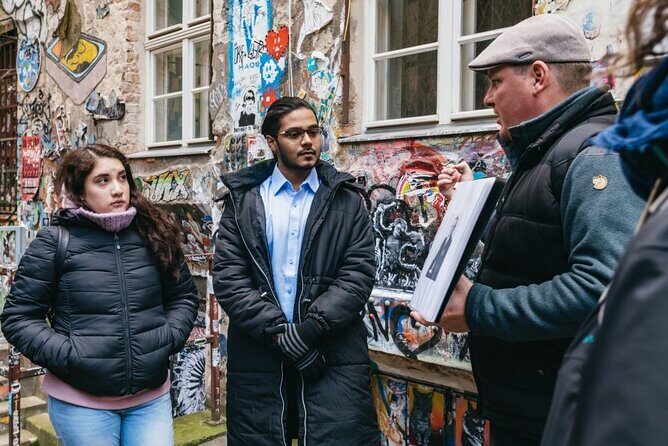
Next comes one of the tour’s most painful stops: the Jewish Cemetery and Holocaust Memorial. Between 1672 and 1827, about 12,000 Jewish community members were buried here. The tour doesn’t treat the cemetery as a background detail; it treats it as evidence that life existed here for generations before the Nazis tried to erase it.
In 1943, the Gestapo ordered the SS to destroy the cemetery. Thousands of gravestones were smashed, remains thrown away, and the tour notes a particularly brutal detail: SS members reportedly played football with skulls. In April 1945, burials took place again.
What shocked me when I read the structure of the story is that the memorial includes more than one type of victim. The site notes nearly 2,500 German soldiers and Berlin civilians killed during fighting or shot by the SS for hanging white flags from windows. Their mass graves are part of how Berlin remembers the final months—after terror, during collapse.
From there, you step into a different tone at the Museum Blindenwerkstatt Otto Weidt. It’s easy to miss: the workshop sits in a hidden courtyard, and that’s exactly the point. Otto Weidt’s workshop employed more than 30 blind and deaf Jewish workers from 1940 to 1945, supported by his wife Else.
As persecution intensified, Weidt tried to protect his employees from deportation—by bribing Gestapo officers and falsifying documents. The most dramatic detail is that he even traveled to Auschwitz to break one employee out. This stop matters because it shows resistance as action, not only protest. It’s risk measured in daily choices.




Protest, sabotage, and public fear: Rosenstraße, Lustgarten, and the Zeughaus plot
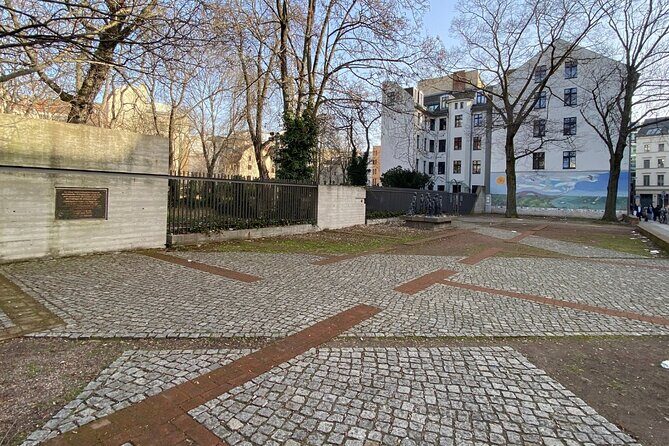
The tour then moves to an outdoor memorial: Denkmal Rosenstraße. On February 27, 1943, the Gestapo, Waffen-SS, and Berlin Police arrested around 2,000 Jewish men married to non-Jewish German women.
Here the story becomes public. Wives—numbering in the hundreds—gathered to protest. The tour highlights the danger: the women faced periodic threats of being shot if they didn’t disperse. Still, the women scattered briefly and returned in larger numbers. It worked in the short term. As pressure mounted, Goebbels authorized the prisoners’ release.
That’s why this stop is more than a lesson in suffering. It’s a case study in collective action under threat, and it shows that the Nazi machine wasn’t only brutal—it was also politically sensitive to disorder and optics. Even within that brutal era, protest could sometimes change outcomes.
After Rosenstraße, you reach Lustgarten, framed by the Berlin Cathedral, the Altes Museum, and the Zeughaus. Before the Nazis, it was a popular spot for protests and speeches. In the week after Hitler became Chancellor, 200,000 Berliners protested the new government. Later, Nazi rules tightened: the right to protest became dangerous, with fines and arrests used to control behavior.
By 1934, the Nazis paved over the space to make way for propaganda rallies, swearing-in ceremonies, and military parades. Standing in this kind of city square, the lesson becomes visible: regimes rewrite space to rewrite behavior.
Then you move to the Zeughaus, built in 1730 as an artillery arsenal—one of the oldest buildings along Unter den Linden. On March 21, 1943, it was chosen to exhibit captured Soviet weapons. The guide’s focus is on Wehrmacht resistance: Major General Rudolf Christoph Freiherr von Gersdorff led the exhibit planning. Despite 27 failed assassination attempts, Gersdorff agreed to blow himself up with Hitler.
How the plan worked (and what happened next) is part of what you’ll hear on the tour. Two concealed British clam mines were part of the mechanism. The tour explains the setup and the larger resistance context, giving you a clearer sense of how close German anti-Nazi actors came—again and again—to stopping Hitler.
Monuments and cultural erasure: Neue Wache, Bebelplatz, and Trains to Life–Trains to Death
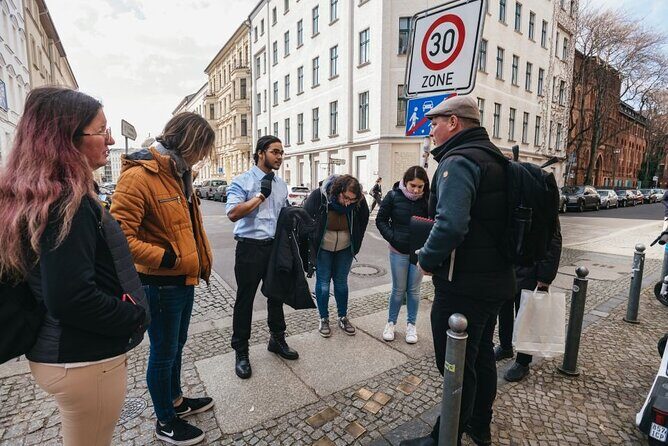
A short walk brings you to Neue Wache, a monument described as Germany’s central memorial for victims of war and tyranny. The mood shifts here from named stories to something more reflective. In a busy city, the memorial’s role is blunt: a reminder that suffering wasn’t limited to one category of person, and tyranny leaves a wide trail.
From there, you go to the Book Burning Memorial at Bebelplatz. On May 10, 1933, Nazi German Student Union members and their professors gathered at this square next to Humboldt University for a nationwide action against the un-German spirit. They burned upwards of 25,000 volumes of books deemed un-German.
This stop is useful because it connects censorship to physical action you can stand in front of. It’s not abstract. It’s a public spectacle that tells you what the Nazis planned to control: language, ideas, and who gets to think freely.
Finally, you reach Trains to Life – Trains to Death, an almost life-size sculpture by Frank Meisle. The monument contrasts two groups of Jewish children during the Nazi era—children facing different directions to represent children saved via the Kindertransport to England versus those deported to concentration camps.
Meisle’s connection is personal and part of the story: he was among those rescued by the Kindertransport, traveling from here to England in 1939. That detail tightens the circle from policy to human outcome.
As the tour ends, you’re directed to S+U Friedrichstraße, a major rail hub for getting across Berlin quickly—handy if you’re continuing the same day with museums or neighborhoods farther out.
Should you book this tour in Berlin?
Yes, I think this is worth booking if you want a Berlin walk that’s built around action and resistance, not only dates and general suffering. The format works for people who like structure: a fixed route, short stops, and clear context at each landmark. The small-group size and the emphasis on then-and-now photos and maps make the experience easier to follow, even when the topic is heavy.
I’d also book it if you appreciate moral complexity: protest in Rosenstraße, cultural suppression at Bebelplatz, and survival and rescue efforts like Otto Weidt’s workshop all land in one connected storyline. And because the listed stops are admission free, your money goes into the guide and the time—not a pile of extra tickets.
The only strong reason to hesitate is the tone and physical feel. The stories are about Holocaust-era persecution and resistance, so expect emotionally intense material. And with plenty of standing built into the stops, plan for an active 2.5-hour outing.
If you’re ready for that mix—and you want Berlin’s wartime story told through places you can actually stand in—this one is a smart pick.
FAQ
How long is the Path of Resistance tour?
It runs for about 2 hours 30 minutes.
What does the tour cost?
The price is $48.01 per person.
Is the tour offered in English?
Yes, it is offered in English.
How big is the group?
The tour has a maximum of 15 travelers.
Do I need tickets for the stops?
Admission ticket is listed as free for the stops included in the tour.
Where does the tour start and end?
It starts at Oranienburger Str. 36, 10117 Berlin, and ends at FriedrichstraßeGeorgenstraße 14/17, 10117 Berlin, near S+U Friedrichstraße.
Is a mobile ticket provided?
Yes, the tour includes a mobile ticket.
Is food or drinks included?
No. Food and drinks are not included.
What is the cancellation policy?
You can cancel for a full refund up to 24 hours in advance. The experience requires good weather, and it may be canceled if the minimum number of travelers isn’t met, with an option for another date/experience or a full refund.
Are service animals allowed?
Yes, service animals are allowed.