REVIEW · DRESDEN
Dresden: Walking Tour with Virtual Reality elements
Book on GetYourGuide →Operated by TimeRide GmbH · Bookable on GetYourGuide
400 years in 90 minutes, on your feet. A live guide leads you through Dresden’s center, and at nine spots you use a mobile VR headset to compare what you see now with what stood there centuries ago.
What I like most is the way the tour turns famous landmarks into something you can actually “read.” You’re not just looking at buildings; you’re getting 360-degree views tied to major eras, from the Baroque look of Dresden to the upheavals of the 20th century.
One thing to keep in mind: the VR experience relies on short film segments, and the tech can feel a bit clunky at moments. The overall effect is still strong, but it helps to be flexible about the pacing and screen smoothness.
In This Review
- Key takeaways before you go
- Walking Dresden while the city “rewinds” in VR
- Where to meet: the TimeRide GO! flag by TimeRide senseum
- How the VR headset changes your understanding of Dresden
- Price and logistics: is 38 dollars worth it?
- Stop-by-stop: from Zwinger areas to Postplatz
- Zwinger (first VR stop, then again)
- Postplatz, Dresden
- Old Market Square, Pirnaischer Platz, and Neumarkt: the city’s “layers”
- Old Market Square, Dresden
- Pirnaischer Platz
- Neumarkt, Dresden
- Fürstenzug photo stop and finishing at the Semperoper
- Fürstenzug (photo stop and guided segment)
- Finish at Semperoper Dresden
- The eras the tour covers—and why the “timeline” matters
- Equipment, pacing, and comfort: what to plan for
- Who should book this VR walking tour?
- Should you book the Dresden Walking Tour with VR elements?
- FAQ
- What is the duration of the Dresden VR walking tour?
- How much does the tour cost?
- Where do I meet for the tour?
- What’s included in the price?
- Is the TimeRide senseum or the Dresden 1719 exhibition included?
- What language is the tour guide?
- Is this tour suitable for young children?
Key takeaways before you go
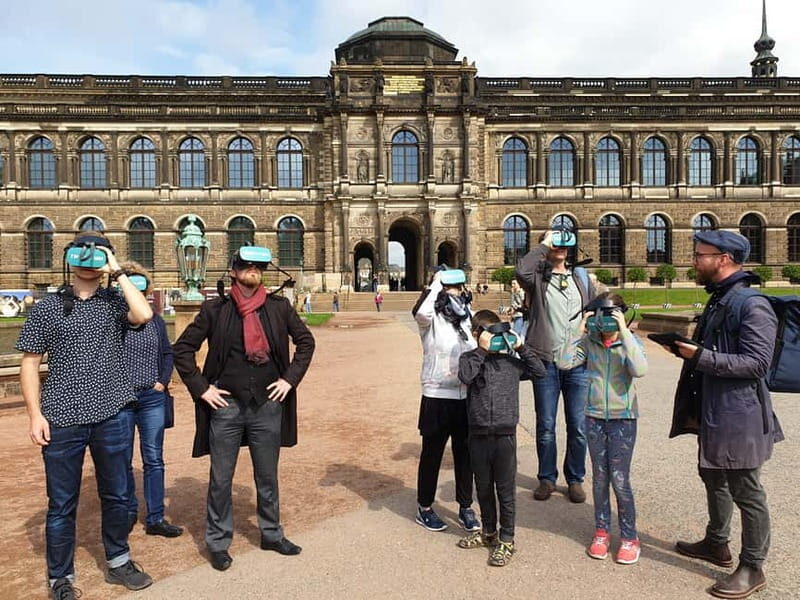
- Nine VR stops in the city center: multiple moments to match past and present, not one big VR show.
- 400 years of Dresden in order: Baroque, early modern changes, 20th-century destruction, socialism-era ideas, then reunification.
- A live guide with stories: you’re hearing context while you stand in the real place the story refers to.
- 360-degree views: you get a sense of scale and sightlines that photos can’t.
- Light walking, short legs: the route is made of quick hops (about 10 minutes between stops).
- German language tour: plan for German narration unless you speak it comfortably.
Walking Dresden while the city “rewinds” in VR
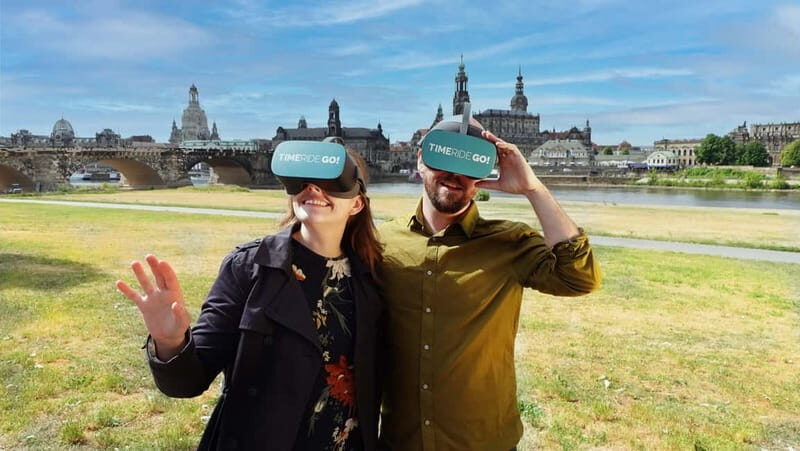
Dresden is a city where the skyline tells a story. But this tour adds a second layer: you stand at key Old Town locations, put on a headset, and watch the scene shift into earlier time periods. The magic isn’t that you’re seeing fancy graphics—it’s that you’re standing in the real street while the viewpoint changes around you.
You spend about 90 minutes moving through the center with a guide and VR at nine locations. Each VR moment gives you a 360° look at the area from a different era, while the guide explains what changed and why it mattered. That “here and then” comparison is the whole point.
If you enjoy history as a lived environment—how neighborhoods and buildings evolve—you’ll get a lot from this. And if you tend to get tired on long tours, the pacing helps: short walks, then short story-and-VR moments.
You can also read our reviews of more walking tours in Dresden


Where to meet: the TimeRide GO! flag by TimeRide senseum
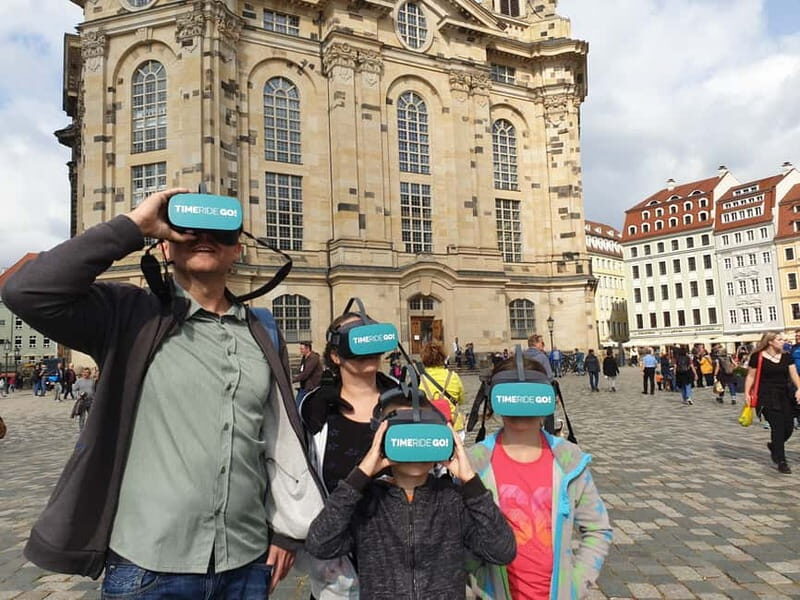
Plan to arrive a few minutes early. You meet at the TIME RIDE GO! flag in front of the TimeRide senseum. That matters because you’ll want to get settled before the guide starts distributing and fitting the headsets.
Also, remember that the VR equipment has to be handled with care. That means you should keep things steady, listen to any quick instructions, and avoid rushing at pickup time—especially if your group is larger.
The tour language is German, with a live guide. If German narration is a challenge for you, you’ll still see the visuals, but the real value comes from the stories connecting the footage to the street in front of you.
How the VR headset changes your understanding of Dresden
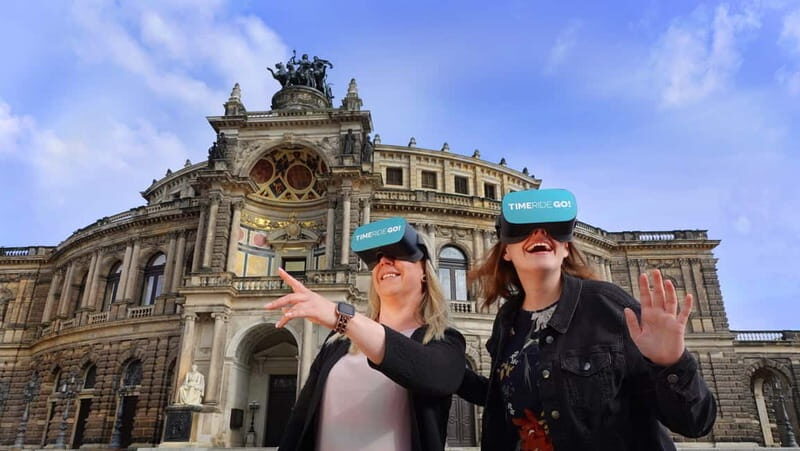
VR in a walking tour can go two ways: it can feel like an extra screen, or it can add real meaning. Here, it works because each VR moment is tied to a specific location you can see with your own eyes.
At the nine stops, the headset shows 360° city views and helps you compare the past cityscape with today’s version. The guide fills the gaps: you hear about the glamour of the Baroque era, how the city transformed up through the early 20th century (including the period into the 1920s), what happened during World War II, and the later ideas tied to socialism—then the shift after reunification.
That chronological flow makes the changes easier to grasp. Instead of memorizing facts about separate time periods, you start noticing patterns: what kinds of buildings appear, what damage altered the view, and how later rebuilding and ideology left their mark.
From the experience side, it helps to be patient with the device. One guide-led tour review highlighted that the film playback can be a bit “holprig” (rough/punky) at times. Don’t let that worry you—just don’t expect every moment to feel like a modern blockbuster. The impact still comes from standing in place and feeling the contrast.
Price and logistics: is 38 dollars worth it?
At $38 per person for about 90 minutes, you’re paying for three things: a live guide, a guided walking route through central Dresden, and VR hardware used during the tour.
If you’re thinking like a value shopper, ask yourself this: would you pay for a standard 90-minute walking tour plus a separate VR experience? Here, the “plus” is bundled into the route—nine VR moments across the city center—so the cost is less about transportation and more about what you’re getting while you’re there.
Two small notes for budgeting:
- Entrance to the TimeRide senseum and the Dresden 1719 exhibition is not included.
- The experience does note skipping the ticket line, which can matter if you’re trying to keep your day tight.
So, who is this good value for? For you if you want a guided overview of Dresden’s transformation without doing multiple ticketed add-ons. For you if you like learning by seeing the view change in front of you. For you if you’re okay with a German-language narration.
Stop-by-stop: from Zwinger areas to Postplatz
The route starts at Taschenberg 3, then you move through the Old Town with short walks between sites. Expect roughly 10 minutes between major stops, so you’re never stuck in one place for long.



Zwinger (first VR stop, then again)
You visit the Zwinger area two times. That can sound repetitive until you realize the tour is about comparison. Two separate VR moments in the same general landmark area can help you see how different eras changed the feel of the space—architecture, surroundings, and how the city fit together.
Practical tip: wear comfortable shoes and keep your phone handy for quick photos when the guide calls for it. VR moments can take your focus, so having your camera ready helps you capture the “real current version” before the headset resets you into the past.
Postplatz, Dresden
Next is Postplatz. This stop is another chance to line up the present-day square with what the VR segment shows in earlier time periods. A square is perfect for that comparison because you naturally orient yourself—there are clear sightlines and the space reads well from street level.
Don’t overthink it. When the VR starts, just watch the city around you as the guide explains what you’re seeing. If you’re the kind of person who likes to understand cause-and-effect, Postplatz is where the stories can start clicking into place.
Old Market Square, Pirnaischer Platz, and Neumarkt: the city’s “layers”
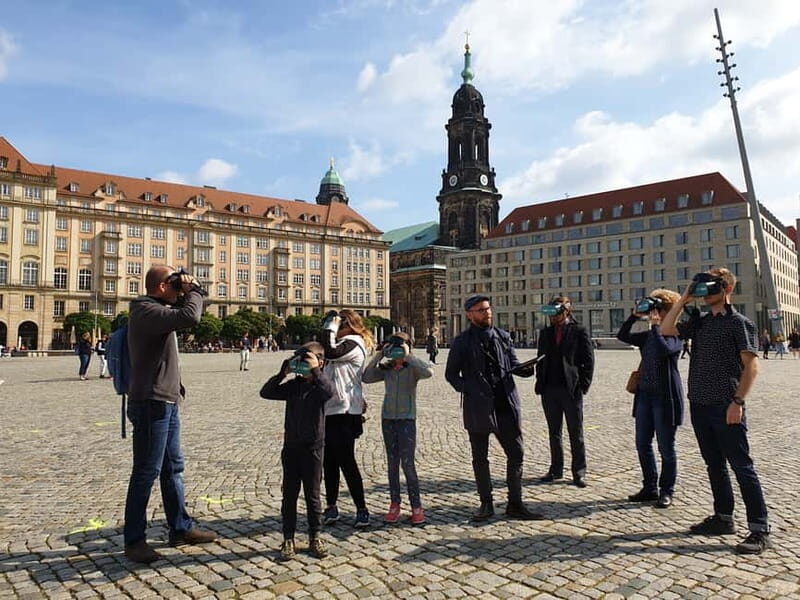
After Postplatz, the tour continues deeper into central Dresden with three more notable stops. These are the kind of places where the city’s identity shows up in layers: trade, power, rebuilding, and politics.
Old Market Square, Dresden
At Old Market Square, you’re in one of the central “living rooms” of the city. The VR segment at this stop gives you a 360° view, and the guide uses the setting to explain how Dresden changed over centuries. This is also where the history “feels” more understandable, because market squares naturally connect everyday life to big events.
If you like walking tours where you can keep checking your mental map, this stop is good. You’ll see why people gravitated to these public spaces and how time altered the surroundings.
Pirnaischer Platz
Then you head to Pirnaischer Platz. By now, you’ve had a few VR resets, so your eyes get better at comparing. You start noticing how rebuilding after major events can shift not only buildings but the overall rhythm of streets and open space.
A useful mindset here: try to identify what seems stable versus what changes. Even without memorizing building dates, you’ll get a feel for what the city kept and what it rebuilt differently.
Neumarkt, Dresden
Next is Neumarkt. This area works well for the tour’s theme of contrasts. When the VR shows you a different era, you can immediately test your own perception: is the current street pattern similar, or did the city reshape itself around new priorities?
The guide’s narration helps connect those visual comparisons to bigger chapters: the Baroque era, the transformation leading up into the early 20th century, then the traumatic turn of World War II, followed by later socialism-era changes and finally reunification.
Fürstenzug photo stop and finishing at the Semperoper
The last stretch includes a photo-focused stop and then a strong ending point.
Fürstenzug (photo stop and guided segment)
At Fürstenzug, you get a photo stop and a guided component. This is where it helps to move a bit with the group so you don’t get stuck behind for pictures. If the tour rhythm is tight, it’s better to take photos fast and keep listening than to chase the perfect angle.
Don’t worry if your VR experience didn’t “click” right away. By this point, the tour has already trained your brain to compare. So the Fürstenzug moment can feel like a payoff: you’re seeing today’s Dresden while the tour has already given you the earlier visual context.
Finish at Semperoper Dresden
You finish at Semperoper Dresden. Ending at such a landmark is more than convenient. It gives you a final reference point to carry into the rest of your day—especially if you plan to keep exploring after the 90 minutes.
If you want a simple next step, you can use the Semperoper area as a starting point for post-tour wandering, since you’ll likely feel more oriented than when you began.
The eras the tour covers—and why the “timeline” matters
The tour covers major chapters of Dresden’s story across roughly 400 years. You start with the glamorous Baroque period, then you move through the transformation that continued toward the 1920s, and later you confront the destruction during World War II. The guide then shifts into ideas tied to socialism, and you end with the era of reunification.
Here’s why this matters for you as a visitor: without a timeline, people tend to treat Old Town Dresden as one static picture. With the VR-and-walking format, you see how each political and cultural shift changes the city’s look and what’s possible there.
Also, the tour doesn’t just throw names at you. A key theme is comparing what you can still see and feel today with what used to be there. That’s a more satisfying way to learn than collecting isolated facts.
One review also pointed to the emotional weight of seeing images connected to the time after the bombing. The tour handles that through storytelling and the stark contrast between eras. So yes, it’s impressive. It can also be heavy. If that’s your thing, you’ll appreciate the honesty built into the sequence.
Equipment, pacing, and comfort: what to plan for
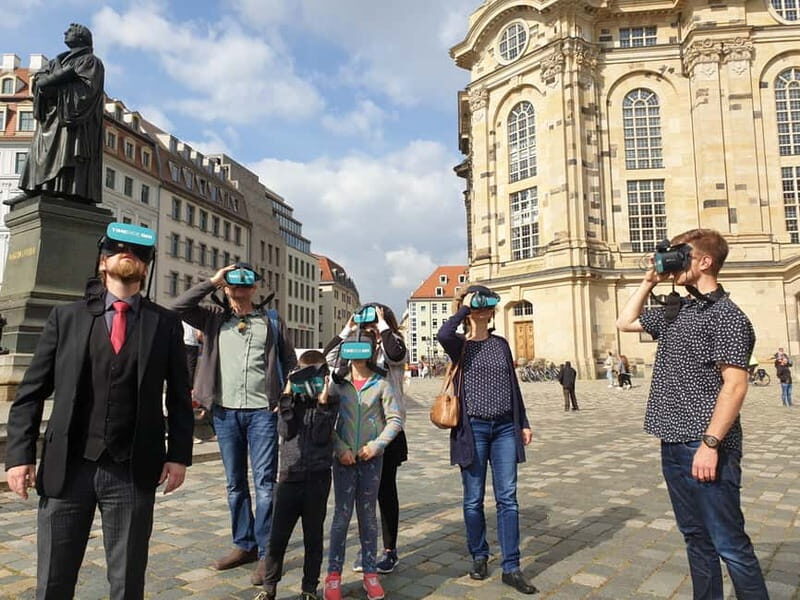
The experience is built around short walks and frequent headset use, so your comfort choices matter more than usual.
Bring:
- Comfortable shoes
- Weather-appropriate clothing
Why this matters: you’ll be outside through most of the tour, and you’ll be moving between stops at a steady pace. If the weather is truly bad, the tour may be canceled, so it’s smart to be ready with a flexible plan.
During VR segments:
- Handle the equipment carefully
- Listen to the guide’s instructions before putting the headset on
- Don’t expect unlimited free time at each stop. This is a guided sequence, so follow the rhythm
And one more practical note: the tour isn’t suitable for children under 6. That’s worth noting if you’re traveling with family and hoping for an early start.
Who should book this VR walking tour?
This tour is a strong match if you:
- Want a guided overview of Dresden that you can understand quickly
- Like history shown in place, not just in a museum room
- Enjoy 360° views and visual comparison more than long lectures
- Prefer a 90-minute format rather than a multi-hour deep dive
It may be less ideal if you:
- Don’t speak German well enough to follow the guide’s narration
- Get frustrated by tech hiccups and need everything to be perfectly smooth
- Prefer tours that stay purely outdoors without any headset use
If you’re the kind of traveler who loves a city’s “how did it become this?” story, this tour gives you a fast route into that answer.
Should you book the Dresden Walking Tour with VR elements?
I’d book it if your ideal Dresden day includes both walking and learning, and you like the idea of standing in the exact location while the city changes around you. For $38 and 90 minutes, you’re buying something more interactive than a typical guided stroll: nine VR moments paired with real street context.
Skip it or reconsider if you’re not comfortable with German-language guidance, or if you’re sensitive to minor VR playback roughness. The visuals and stories still do the work, but the experience isn’t filmed like a flawless arcade attraction.
FAQ
What is the duration of the Dresden VR walking tour?
It lasts 90 minutes.
How much does the tour cost?
The price is $38 per person.
Where do I meet for the tour?
Meet at the TIME RIDE GO! flag in front of the TimeRide senseum.
What’s included in the price?
You get a live guide and a virtual reality headset.
Is the TimeRide senseum or the Dresden 1719 exhibition included?
No. Entrance to the TimeRide senseum and the Dresden 1719 exhibition is not included.
What language is the tour guide?
The live tour guide speaks German.
Is this tour suitable for young children?
It is not suitable for children under 6 years.