REVIEW · BERLIN
Berlin Battlefield Tour – Operation Berlin 1945 (Small Group)
Book on Viator →Operated by On the Front Tours · Bookable on Viator
Berlin in 1945 still has sharp edges. This small-group walk follows the last days of the Battle of Berlin, with you seeing Moltke Bridge and the Reichstag area while your guide connects the street-level landmarks to what happened there. I like the tight pacing and the fact that you get practical extras like bottled water and rain ponchos, so the experience stays comfortable even if Berlin turns damp. One thing to keep in mind: the tour requires good weather, so plan to be flexible if it’s rescheduled.
What makes this route especially compelling is how it moves like the battle did: Soviet approach, brutal choke points, then the final push toward the Reichstag and the breakout attempt tied to the Wiedendammer Bridge. And it’s built for discussion. The group is capped at 15, so you can ask questions without shouting over a crowd.
In This Review
- Key Things I’d Highlight Before You Go
- Walking the Battle of Berlin: Why These Stops Feel Personal
- Price and Value: Getting a Lot of Ground for $54.01
- From Hauptbahnhof to Moltke Bridge: Getting Oriented Before the First Hard Moment
- Moltkebrücke: The Red Sandstone Bridge as a Battlefield Choke Point
- Bundeskanzleramt Area: The Himmler House and Point-Blank Destruction
- Platz der Republik and Königsplatz: Standing in No Man’s Land
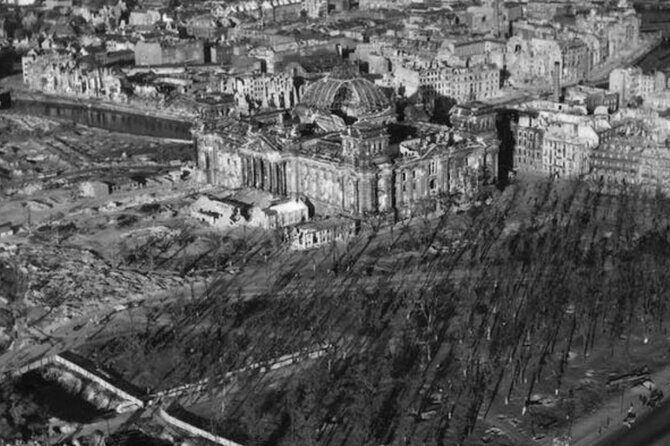
- Reichstag Area: Banner No.5 and Hitler’s Final Hours Nearby
- Weidendammer Brücke: The Bridge Where the Breakout Happened
- Pacing, Language, and How to Get Answers Without Stress
- Weather and Comfort: Small Things That Matter on an Outdoor Route
- Who This Tour Is For (and Who Might Want a Different Style)
- Should You Book the Berlin Battlefield Tour (Operation Berlin 1945)?
- FAQ
- FAQ
- How long is the Berlin Battlefield Tour (Operation Berlin 1945)?
- How many people are in the group?
- Is the tour offered in English?
- What’s included with the ticket?
- Are there admission fees at the stops?
- Where does the tour start and where does it end?
- What if the weather is bad?
- How does cancellation work?
- Is the meeting area near public transportation?
Key Things I’d Highlight Before You Go
- Small group of up to 15 means more time for questions and follow-ups
- Six real battlefield landmarks tied to the last days of 1945
- Bottled water and rain ponchos help you stay on your feet in bad weather
- English guide and a mobile ticket for an easy check-in
- Free admission at each stop keeps the focus on walking and storytelling
- Easy end point by Friedrichstraße lets you keep sightseeing afterward
Walking the Battle of Berlin: Why These Stops Feel Personal
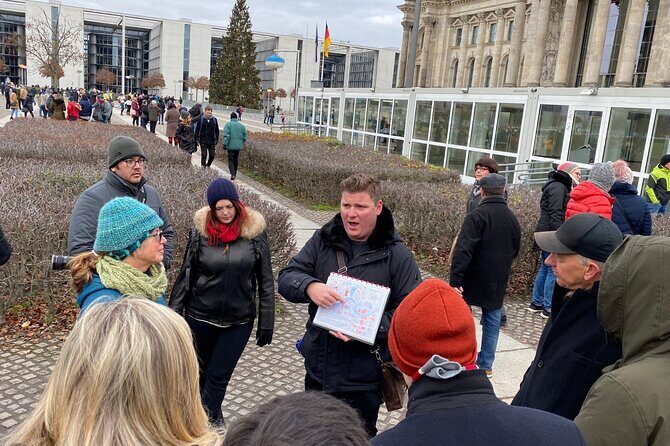
If you know the broad story of Berlin in 1945, this kind of tour gives you something better than dates. You start to see the conflict as geography—bridges, ministry buildings, open ground, and the last approach to the Reichstag. That matters because the battle wasn’t fought in one dramatic scene. It was fought in movement, missteps, and forced choices.
I also like that the route uses what’s still on the map. You’re not just hearing a lecture in a museum room. You’re looking at places like Moltke Bridge and the nearby government district and then getting the tactical context for why those spots turned into bottlenecks.
The tone stays balanced, too. The tour talks about what the Soviet 3rd Shock Army needed to do, and it also considers what the German defenders faced in trying to hold key positions.
You can also read our reviews of more tours and experiences in Berlin.


Price and Value: Getting a Lot of Ground for $54.01
At about $54.01 per person for roughly 2 hours 30 minutes, this is the kind of guided walk where you feel the value most in two places: time and concentration. A two-and-a-half-hour battlefield route is long enough to make the story cohere, but not so long that you’re exhausted before the big moments.
You also get small practical perks that don’t sound like much until you’re standing outside in changeable Berlin weather: bottled water and rain ponchos if needed. That means your money is not just paying for information; it’s paying for a smoother experience while you walk.
Finally, there’s the group size. A maximum of 15 people keeps this from turning into a line of bodies. It’s set up for dialogue, not just listening.
From Hauptbahnhof to Moltke Bridge: Getting Oriented Before the First Hard Moment
The tour starts at Ella-Trebe-Straße 9 (10557 Berlin) on the southern side of the modern Hauptbahnhof meeting point. Before you hit the bridge, you get about ten minutes of intro to set the scene. That intro matters. It gives your brain something to hang the story on before you start moving through the modern city.
Then you head toward Moltke Bridge, where the tour clocks about ten minutes at the stop. Even if Berlin looks calm today, the bridge area became part of the fight’s machinery. Your guide orients you to the Soviet advance, which helps you understand why bridges weren’t just crossings—they were strategic pressure points.
Tip: wear shoes you can walk in for a good chunk of time. This tour is built around movement between locations, not bus rides.
Moltkebrücke: The Red Sandstone Bridge as a Battlefield Choke Point
Moltke Bridge is described as an ornate red sandstone structure—and the key word here is location. This is one of the places where the battle becomes concrete. The tour explains how the bridge area factored into the Soviet axis of advance, and it discusses the challenges faced by both the Soviets and the German defenders.
Why that works for you: it prevents the story from becoming one-sided. You get the sense of what “advance” meant in real terms—timing, exposure, and the difficulty of pushing through defended spaces.
The stop itself is around ten minutes, which is enough to understand the idea without turning it into a long pause. You keep momentum, and the story keeps stacking up.
Bundeskanzleramt Area: The Himmler House and Point-Blank Destruction
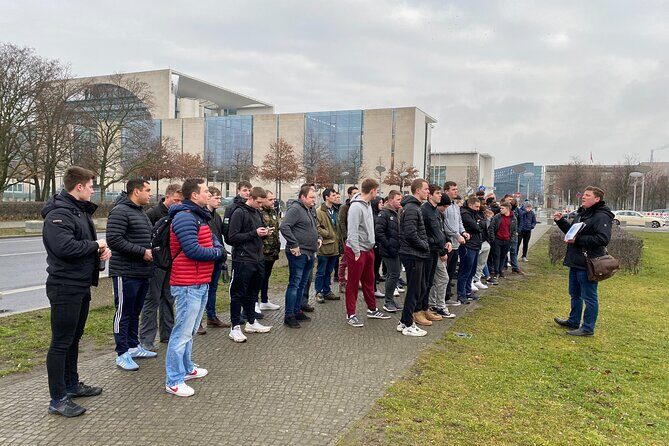
Next you cross Moltke Bridge and move to the Bundeskanzleramt, the former Interior Ministry area. This district was nicknamed the “Himmler House” in the old diplomatic quarter, and the tour leans into why that label matters for the story’s human scale.
Here, the focus is on what happened after a Soviet artillery barrage at point blank range. You hear about the horrific room-to-room fighting that took place following that opening.
This stop is only about ten minutes, so you won’t get lost in details—but you do get a clear takeaway: modern buildings can look orderly, yet in wartime they turn into traps and fighting zones. Watching the streets around the complex while your guide describes the scale of that destruction helps you picture the battle’s brutality in a way that museum captions can’t.


Platz der Republik and Königsplatz: Standing in No Man’s Land
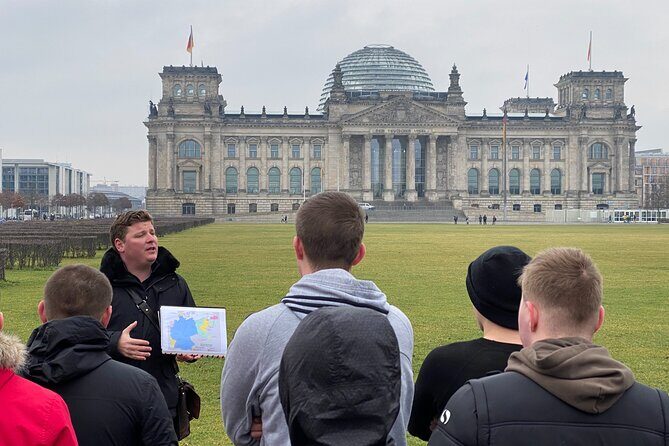
From the ministry area, the tour continues toward Platz der Republik, on the former Königsplatz. This is one of the most powerful parts of the walk because it’s about open ground and distance.
You’re told to take stock of a roughly 300-meter stretch that units like the 207th and 150th rifle divisions would have had to cross before reaching the Reichstag area. That number hits hard. It turns the vague idea of “fighting toward the Reichstag” into something measurable.
Also, this is where the tour does a good job of making you feel what “advance” costs. The open stretch becomes the obstacle, not just the destination. You’re not only learning where the Reichstag stood in the drama—you’re understanding the approach that got people there, and the problem of crossing that kind of exposed distance.
Expect about ten minutes here. Short, but meaningful.
Reichstag Area: Banner No.5 and Hitler’s Final Hours Nearby
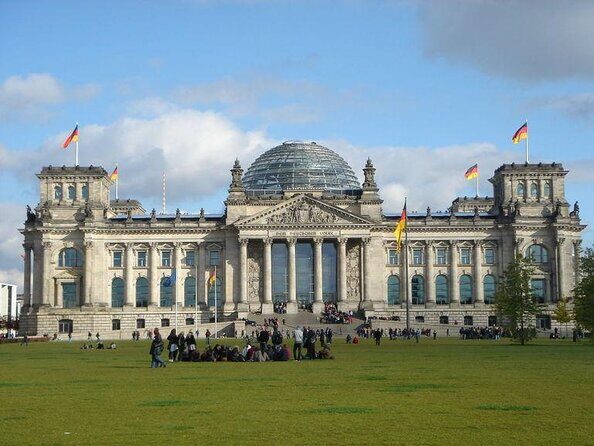
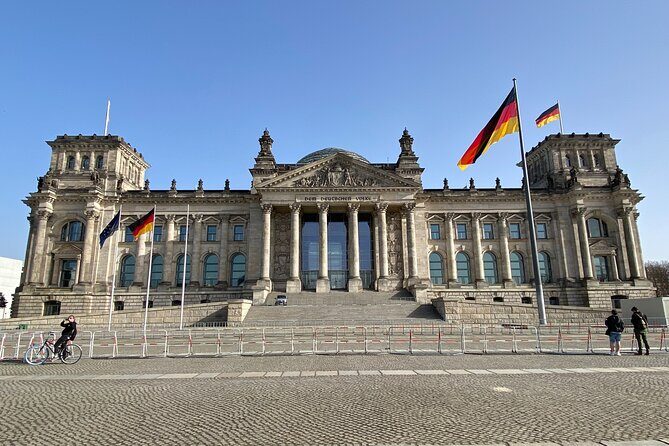
The route finally brings you toward the Reichstag building. The tour spends about 20 minutes at the foot of the Reichstag, and that’s where the storytelling pivots toward the final moments.
Before the banner story, your guide connects the area to Hitler’s final moments in the Führer bunker, which was only a few hundred meters away. That detail changes the way you look at the surrounding streets. It’s not abstract history; it’s proximity.
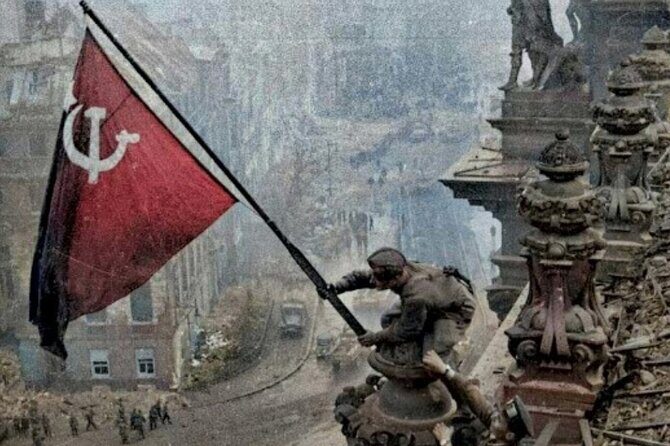
Then you hear the stories of Sergeant Yegorov and Sergeant Kantariya, who raised special banner No.5 on the roof—signifying the end. That’s the kind of specific human moment that makes the big ending feel earned, not sudden.
Important note for your expectations: this portion is about being at the Reichstag’s exterior area and hearing the story there. The tour description doesn’t promise an interior visit, so if you want museum-level deep access, you’ll likely need to plan that separately.
Weidendammer Brücke: The Bridge Where the Breakout Happened
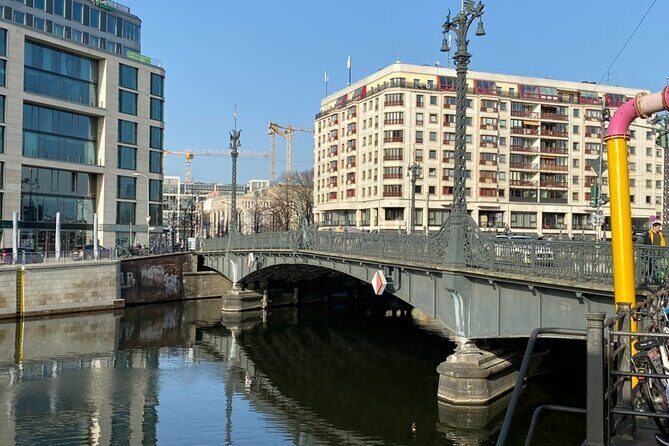
After the Reichstag area, you head to Weidendammer Brücke (about 15 minutes). This bridge was one of the few still intact over the Spree during the final days of the battle.
One of the most striking story beats here is the timing: the night of May 1st, 1945, when the bridge became the scene of terrible carnage after a breakout attempt from the Führerbunker.
Why this stop lands: it closes the loop on the last days with a different angle. Instead of the arrival and symbolism of banner-raising, you get the desperation and chaos of attempting an exit during the battle’s final squeeze.
Logistically, the tour ends at Weidendammer Bridge at 10117 Berlin, about 50 meters from the S+U Friedrichstraße train station. That’s a big help. You can slip right back into the city’s transit system for your next stop without fighting your way across town.
Pacing, Language, and How to Get Answers Without Stress
This is set up as a small-group walking tour with a cap of 15 people, and it’s offered in English. The short duration at each location—roughly ten minutes in most stops, then longer at the Reichstag—creates a rhythm. You won’t be stuck at one spot for too long, but you also won’t feel rushed through the big beats.
Bring questions. In the kind of tour this is, your best learning usually comes from asking why something mattered strategically, or how defenders and attackers experienced the same place differently. The format makes that kind of talk realistic.
One name that shows up in feedback is Jochen, praised for running serious, in-depth conversations that work well if you’re traveling with a history fan (or you are one). Even if your guide is someone else, the tour’s design clearly supports Q&A, not just one-way narration.
Also: confirmation is received at booking time, and you’ll have a mobile ticket. That’s practical in Berlin, where you’ll probably be switching between transit lines and different sights throughout the day.
Weather and Comfort: Small Things That Matter on an Outdoor Route
The tour requires good weather. That means you should dress like it might change. The good news is you get rain ponchos and bottled water if needed, which reduces the risk that a light rain turns into a miserable walk.
Because it’s an outdoor route, also think about sun and wind. Even when rain doesn’t happen, Berlin’s open spaces and bridge approaches can feel exposed.
The duration is about 2 hours 30 minutes, so plan a meal or snack before you go. You’ll have time after the tour ends near Friedrichstraße to grab something, but don’t start hungry.
Who This Tour Is For (and Who Might Want a Different Style)
This Battlefield Berlin walk fits best if you like history tied to real places—bridges you can point at, distances you can visualize, and buildings you can see while you’re learning what happened there.
You’ll probably enjoy it most if:
- You want a story that connects tactics to the ground you’re standing on
- You like guided discussion and don’t want a huge crowd
- You’re comfortable walking across central Berlin for a couple hours
It might not be the best choice if you want long museum-style time inside places. This is outdoors and narrative-driven, with stops built for interpretation at each location rather than extended indoor visits.
Should You Book the Berlin Battlefield Tour (Operation Berlin 1945)?
I’d book it if you want a focused, small-group way to understand the Battle of Berlin without getting lost in thick textbooks. For around $54.01, the payoff is strong: a clear route, specific landmark storytelling, and practical comfort items like ponchos and water—plus the group size that keeps questions possible.
I’d also book it sooner rather than later. The tour is often reserved about 27 days in advance on average, so if your timing is fixed, waiting can narrow your options.
If you’re traveling with limited patience for walking, or you absolutely need inside access to major sites, then you might pair this with separate plans rather than expecting one tour to do everything.
FAQ
FAQ
How long is the Berlin Battlefield Tour (Operation Berlin 1945)?
It runs for about 2 hours 30 minutes.
How many people are in the group?
The tour is limited to a maximum of 15 travelers.
Is the tour offered in English?
Yes, it’s offered in English.
What’s included with the ticket?
You get a mobile ticket, and the tour provides bottled water and rain ponchos if needed.
Are there admission fees at the stops?
The tour lists the stops as admission ticket free.
Where does the tour start and where does it end?
It starts at Ella-Trebe-Straße 9, 10557 Berlin, and ends at Weidendammer Brücke, 10117 Berlin.
What if the weather is bad?
The tour requires good weather. If it’s canceled due to poor weather, you’ll be offered a different date or a full refund.
How does cancellation work?
You can cancel for free up to 24 hours in advance for a full refund. If you cancel less than 24 hours before the start time, the amount paid is not refunded.
Is the meeting area near public transportation?
Yes. The end point is about 50 meters from the S+U Friedrichstraße station, and the tour is noted as near public transportation.