REVIEW · HANNOVER
Hanover Private Walking Tour With A Professional Guide
Book on Viator →Operated by Global Guide Services · Bookable on Viator
Seven stops, two hours, and you get Hanover.
This private walking tour is built for your group alone, so you actually get answers and direction instead of tuning out the loudest voice. I also like how it covers seven top landmarks in about two hours, then leaves the rest of your day open for wandering, lunch, and side streets. One thing to think about: the walk is packed into a tight time window, and admission tickets aren’t included for places where entry is required.
With guide Anna leading, the tone feels both friendly and practical—she can adjust the pace and focus to your interests, and she stayed flexible when timing was off. The itinerary also mixes major architecture with real-world reminders of WWII, including the Aegidien Church ruins and the Hiroshima Peace Bell, so you leave with a sharper sense of what shaped the city.
In This Review
- Key Highlights to Know Before You Go
- What This Tour Feels Like on the Ground
- Starting Point: Hanns-Lilje-Platz 2 and a Simple Walking Plan
- Market Church, Old Town Hall, and the Power Symbols in Brick Gothic
- Ballhof Building and Kreuz-Church: From Sports Hall to Church Rebuild
- Oskar-Winter-Fountain, the Wish-Ring Detail, and Leibniz House Nearby
- Aegidien Church Ruins and the Hiroshima Peace Bell at 08:15
- New Town Hall and the 98 m View from the Curved Lift
- Price, Group Size, and Whether It’s Worth $305.84
- Timing, Comfort, and How to Use the Rest of Your Day
- Who This Tour Suits Best
- Should You Book? My Take
- FAQ
- How long is the Hanover private walking tour?
- What does the tour cost?
- Is this tour private or shared?
- What languages is the tour offered in?
- Where do we meet the guide?
- Where does the tour end?
- Do we need transportation?
- Is admission included?
- Is there a mobile ticket?
- What if I need to cancel?
Key Highlights to Know Before You Go
- Private, group-only guide time for questions, pace control, and tailored explanations
- Seven major sights in ~2 hours, then you’re released back into the city
- North German brick Gothic landmarks like the Market Church and the Old Town Hall area
- Memorials that aren’t just pretty ruins, especially the Hiroshima-linked Peace Bell
- New Town Hall viewpoint options, including the 98 m climb via a curved lift
What This Tour Feels Like on the Ground
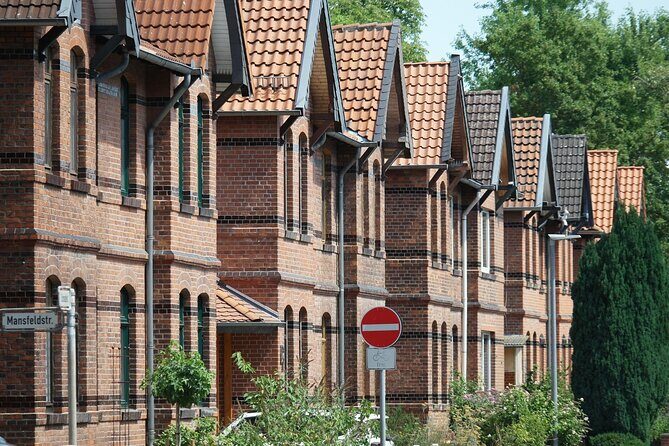
This is the kind of tour that helps you get your bearings fast without dragging on all day. You walk, you stop, and your guide turns landmarks into something you can actually picture in your head later—what you’re looking at, why it matters, and what to look for when you pass it again on your own.
Because it’s private, you don’t have to fight for attention at each stop. If you’re curious about details on a façade, you can ask. If you’d rather move quickly and save questions for later, you can do that too. And at the end, you’re not trapped on a schedule—you’ve got the rest of your day.
If you’re the type who likes to plan a loose route after a tour, this one sets you up well. You learn the big structures and the main “why” behind them, so your self-guided time feels less like random wandering and more like smart wandering.
You can also read our reviews of more walking tours in Hannover

Starting Point: Hanns-Lilje-Platz 2 and a Simple Walking Plan
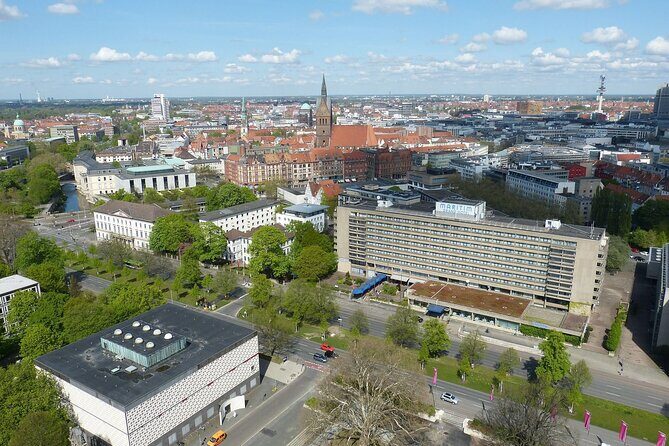
You meet at Hanns-Lilje-Platz 2, 30159 Hannover. The tour is designed as a true walking experience—no transportation is needed, and it’s near public transportation, which helps if your timing or arrival plan gets messy.
That “no transit” detail matters more than it sounds. Hanover’s Old Town streets can be easy to navigate, but having someone else handle the sequence means you spend less mental energy figuring out directions and more energy noticing what you’re seeing.
The total time is about two hours, which also helps. You’re not committing to half a day on foot. It’s a great way to spend the first afternoon (or the first part of your trip) and still feel like you did something meaningful.
Market Church, Old Town Hall, and the Power Symbols in Brick Gothic
The tour kicks off at the Market Church, the main Lutheran church in Hanover. Built in the 14th century, it’s considered one of the best-known examples of North German brick Gothic. That style is more than looks—it’s a reminder that this region built big, durable monuments using brick as a serious architectural language.
You’ll also see how the church carries scars of modern history. It was partially destroyed by an air raid in 1943, then restored later. The high western tower is a big deal here: it used to symbolize the power and wealth of the town’s citizens, and it still acts like a visual anchor when you’re walking around the center.
Next comes the Old Town Hall. It was built about 100 years ago, with Romanesque influences and Neo-Gothic design. What makes this stop feel more alive is the way your guide connects the building’s decoration to the people and institutions behind it—portraits of princes and coats-of-arms shown on murals.
Practical note: If you want to get the most out of this portion, look up while standing still. These buildings don’t tell their story only at eye level.
Ballhof Building and Kreuz-Church: From Sports Hall to Church Rebuild
Right nearby is the Ballhof Building, which you might not guess has had such different roles. It started as a sports hall designed so ball games could happen out of wind and rain. Then it shifted into an assembly hall, and later became a theatre.
This is one of those stops where your guide’s explanations make the place feel less like a random historic building and more like a living one that keeps adapting. It also adds variety to the walk—architecture history, yes, but not only “old churches and war monuments.”
Then you reach Kreuz-Church, the oldest church in Hanover, dating from 1333. It was mostly destroyed during WWII, then reconstructed afterward. That rebuilding piece matters: you’re not just seeing a relic, you’re seeing how the city decided what to preserve and how to carry forward its identity.
If you’re sensitive to war-linked sites, this part can feel heavy—but it stays grounded because you’re given context for what you’re looking at and why it was rebuilt the way it was.
Oskar-Winter-Fountain, the Wish-Ring Detail, and Leibniz House Nearby
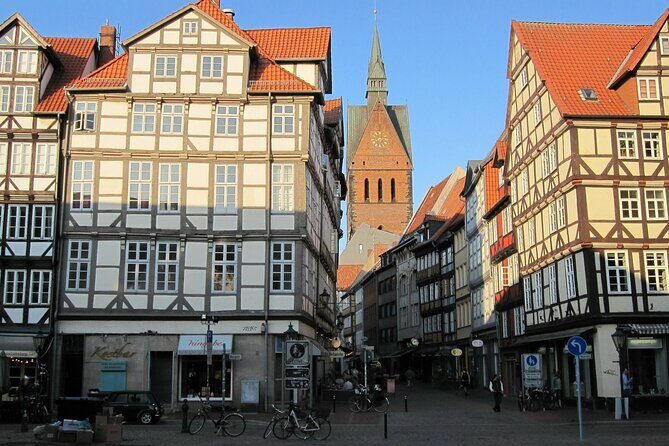
As you keep walking through the older streets, you’ll reach the Oskar-Winter-Fountain. The legend says that if you make a wish and turn the small brass ring embedded in the ironwork, that wish comes true.
Whether you treat the story as playful or meaningful, it’s a great pause. It gives you something tangible to do, and it keeps the tour from feeling like nonstop “read-only” history.
Behind it is the Leibniz House, associated with mathematician and philosopher Gottfried Wilhelm Leibniz (1646–1716). This is a nice shift from pure architecture to the human ideas that shaped the region. It’s also a good reminder that historic cities aren’t only about buildings—they’re about thinkers, leaders, and the everyday life that surrounded these sites.
You can also read our reviews of more guided tours in Hannover


Aegidien Church Ruins and the Hiroshima Peace Bell at 08:15
The emotional core of the tour is the Aegidien Church ruins. It was destroyed during WWII and was never repaired or reconstructed. That means you don’t get a clean “restored to glory” story—you get a visible reminder of what was lost.
Inside the ruins, you’ll see the Peace Bell, donated by the city of Hiroshima. Every year on August 6 at 08:15, a delegation from Hiroshima rings the bell in memory of those killed during the air strike.
This stop is powerful because it connects Hanover to a much wider world. It’s also practical in how your guide frames it: you learn what the bell symbolizes and how the ritual timing adds weight. Even if you’re not a “bells and memorials” person, the story makes you understand why the ruins are kept as ruins.
Consideration: This is the kind of place where you might want a moment to read and stand quietly. If you’re rushing through the rest of the tour, slow down a bit here.
New Town Hall and the 98 m View from the Curved Lift
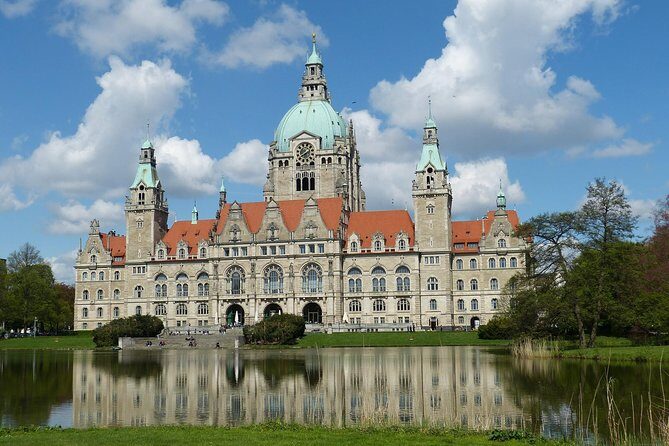
The final big landmark is the New Town Hall. It opened under Emperor Wilhelm II, and the city director announcement about the cost was famously blunt—ten million Marks, paid in cash. In other words: this was not a small civic project, and the building’s scale makes it obvious why it wasn’t.
Once you’re ready to go up (and this is where planning helps), you’ll learn the view is part of the point. You can climb 98 m to the top in a curved lift, described as the only one of its kind in Europe, inside the green dome.
If conditions allow, you might catch views toward the Harz Mountain range. That’s weather-dependent, so don’t bet the whole day on perfect visibility—but even without long-distance views, the experience of going up and seeing the city’s layout is worth it.
One more key detail: admission tickets aren’t included. If you’re budgeting, set aside money for any entry fees needed for town hall access or viewpoint areas.
Price, Group Size, and Whether It’s Worth $305.84
The price is $305.84 per group (up to 15 people). That can feel like a “splurge” number until you do the math for group cost-sharing—or until you compare it to the value of having a guide who can tailor the experience.
Here’s what you’re really paying for:
- Private attention for your whole group, not just a shared talk
- A focused two-hour route through seven key landmarks
- A guide who can adapt content, based on your interests and timing
In practical terms, this is good value if you have even a small group and want a guided “orientation package.” If you’re traveling solo, it can still be a smart buy if you enjoy deep Q&A and you’d rather have a human explain details than read a dozen plaques yourself.
Also, booking averages matter. This one is often reserved far in advance—about 80 days on average—so if your travel dates are fixed, don’t wait until the last minute.
Timing, Comfort, and How to Use the Rest of Your Day
This is a 2-hour walk, and after that you’re free. That structure is great for independent travelers because you can pivot into your own style immediately—coffee, shopping, museums, or just more wandering.
The tour claims to suit any age, and since it doesn’t require transportation, you’re mostly planning around walking comfort. There aren’t extra transit legs to slow you down, which helps keep the day predictable.
A good strategy: treat the tour as your “map lesson.” After you finish, pick one or two areas you felt connected to—like the war memorial sites for a reflective mood, or the civic center for architecture and viewpoints. You already know where things are now, which makes the rest of your day feel easier.
Who This Tour Suits Best
You’ll likely love this tour if:
- You want a private guide who can answer questions and keep things paced for your group
- You like seeing how architecture, war, and civic life connect in a single walking route
- You want a short guided hit of Hanover without losing your whole afternoon
It’s also a smart choice if someone in your group enjoys stories with specific details—things like the wish-ring at Oskar-Winter-Fountain or the Hiroshima Peace Bell ritual at 08:15.
Should You Book? My Take
If your goal is to understand Hanover quickly and meaningfully, I’d book this. The best part is the balance: you get major landmarks, but the route doesn’t just stack monuments. It links symbols of civic power, the rebuild after destruction, and a global memorial thread that reaches far beyond Germany.
Just go in knowing it’s a tight, guided walking experience. If you want long museum-style time at each stop, you may feel the schedule is quick. And since admission isn’t included, confirm what you want to enter at the end so you can budget without surprises.
For most people, though, this is exactly the right size of tour—guided enough to make your self-guided time smarter, short enough to keep your day yours.
FAQ
How long is the Hanover private walking tour?
It lasts about 2 hours.
What does the tour cost?
It’s $305.84 per group, for groups of up to 15 people.
Is this tour private or shared?
It’s a private tour/activity, meaning only your group participates.
What languages is the tour offered in?
The tour is offered in English.
Where do we meet the guide?
The meeting point is Hanns-Lilje-Platz 2, 30159 Hannover, Germany.
Where does the tour end?
The tour ends at 30 Hanover, Germany.
Do we need transportation?
No. No transportation is needed for this walking tour.
Is admission included?
Admission ticket is not included.
Is there a mobile ticket?
Yes. The tour uses a mobile ticket.
What if I need to cancel?
You can cancel for a full refund up to 24 hours in advance.