REVIEW · RHINE RIVER
e-Scavenger hunt Paderborn: Explore the city at your own pace
Book on Viator →Operated by Qula · Bookable on Viator
A phone game turns Paderborn into a walk. This e-scavenger hunt is self-paced, so you can pause for a drink on the main square and still keep moving. I also like how the English mobile format gives you just enough context at each old-town stop without turning the experience into a wall of text.
One thing to plan for: the walk lives on your phone. If the in-app directions feel tricky, have Google Maps ready as a backup so you can keep your rhythm.
In This Review
- Key reasons to pick this Paderborn e-walk
- Self-paced e-scavenger hunt: what the experience feels like
- Price and time: does $36.69 per group feel fair?
- Getting started at Parkplatz Liboriberg (and ending right where you began)
- Stop-by-stop route: square to half-timbered carvings in the city center
- A nice central square for a drink and reset
- The half-timbered gable house (built around 1560)
- Abdinghof Monastery Petrus and Paulus: a Benedictine foundation from 1015
- Bartholomäuskapelle: hall church acoustics you can notice
- Paderborn’s big church cluster: cathedral, Marktkerk, and the education story
- Paderborn Cathedral and its three patron dedications
- Marktkerk: when Jesuits and a university church shaped the town
- A quick note on language
- Market square art and architecture: Neptune Fountain, von Spee, and the town hall
- Neptune Fountain in the market square (Josef Rikus, 1977–1979)
- Friedrich von Spee statue: a bronze reader
- Paderborn town hall with three gables and Weser Renaissance style
- Following the Pader headwaters plus a shopping street break
- The city’s Pader headwaters: follow the path along the small river
- A modern shopping street with the city’s newest energy
- Tips to make the phone game and navigation behave
- Who this e-scavenger hunt is best for
- Should you book this Paderborn e-hunt?
- FAQ
- How long does the e-scavenger hunt in Paderborn take?
- What’s the price for this experience?
- What language is it offered in?
- Do I get a mobile ticket?
- Is smartphone use included?
- Where do I start, and where does it end?
- Is it a private activity?
- What are the hours available?
- Can I cancel for a full refund?
Key reasons to pick this Paderborn e-walk
- Up to 6 people per group for $36.69, so your cost per person can drop fast.
- English mobile ticket plus an online game, meaning you’re not stuck waiting on a live guide.
- Historic highlights are built into the route, from a 1560 half-timbered gable to major churches.
- Short, satisfying pauses are part of the plan, including a main square you can treat like a breather.
- You finish back at the start near Parkplatz Liboriberg, which keeps logistics simple.
Self-paced e-scavenger hunt: what the experience feels like
This is a city walk paired with an online game you run on your phone. The idea is simple: you explore Paderborn at your own pace, and the game nudges you to notice specific sights instead of just wandering.
For me, the big win is control. You decide when to slow down for a church doorway, when to stop for a photo, and when to move on. With a 2 to 4 hour window, you can also stretch or tighten the walk depending on your energy.
It’s offered in English, and you get a mobile ticket. That combination is practical if you don’t want to download a pile of complicated apps or translate on the fly.
One more detail worth factoring in: you’ll need your own smartphone and data. Nothing is included for the device itself, so plan to use your phone normally.
You can also read our reviews of more city tours in Rhine River


Price and time: does $36.69 per group feel fair?
The price is $36.69 per group, up to 6 people, for about 2 to 4 hours. That’s the kind of pricing that can work very well if you’re traveling with friends or family.
Quick math: if you fill all 6 spots, you’re at roughly $6.11 per person for the game-and-walk experience. Even if you’re only 2 or 3 people, the group price can still be competitive compared with paying per person for a guided tour that lasts a similar amount of time.
Also, this isn’t just “stand here and listen.” You’re actively moving through the city center and solving prompts along the way, which makes the time feel more productive. If you’re the kind of traveler who likes structure but hates tight schedules, this is a good match.
Getting started at Parkplatz Liboriberg (and ending right where you began)

You meet at Parkplatz Liboriberg, Liboriberg 1004, 33098 Paderborn, Germany. The activity ends back at the same meeting point, so you don’t have the stress of figuring out a one-way route back to your car or transit.
The walk is designed for easy access: it’s near public transportation, and it’s marked as usable by most travelers. There’s also service animal allowance and it’s described as user-friendly for the hearing impaired, which is a nice practical touch.
The hours listed are basically all day (12:00 AM to 11:59 PM). In real life, that means you can usually choose a time that fits your day—shopping time, church-sight time, or a slower afternoon with a long coffee.
Stop-by-stop route: square to half-timbered carvings in the city center
The route begins with a relaxed intro before it starts stacking up the big historic stops.
A nice central square for a drink and reset
You start with a nice square in the middle of the city. This isn’t just a random starting place. It’s built in as a breather: a place to pause, get your phone ready, and settle into the pace.
Practical tip: use this moment to charge your phone if needed, and check you’ve got mobile data. Once you’re past this stop, you’ll want to keep the game flow going.

The half-timbered gable house (built around 1560)
Next comes a three-storey half-timbered gable house, built around 1560. What you’re looking for isn’t general charm—it’s specific carving detail.
The gable front has rich carvings on the friezes. The most impressive frieze is the lower one, which gives the house its name, and it tells a story: Adam and Eve’s fall into sin. The key detail is that the narration runs in a classic reading direction, so you can actually follow the story rather than just admire the patterns.
How to enjoy it: don’t rush. If you only glance, you’ll miss the narrative element that makes this stand out.
Abdinghof Monastery Petrus and Paulus: a Benedictine foundation from 1015
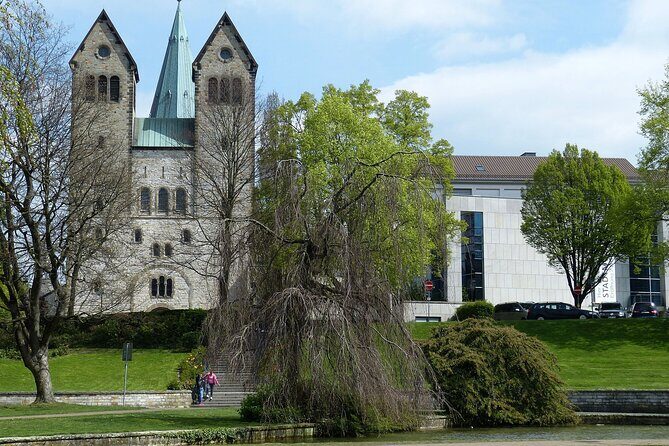
Then you reach Abdinghof Monastery Petrus and Paulus, a former Benedictine abbey founded in 1015. This stop shifts the mood from “street energy” to something more reflective.
Even if you’re not a church architecture expert, a site like this helps you understand that Paderborn’s center wasn’t built overnight. It’s layered, with older foundations feeding the city’s identity for centuries.
The drawback here is simple: if you’re in a hurry, you might wish you had more time to read and look closely. But if you’re doing this at a human pace, it works well.
Bartholomäuskapelle: hall church acoustics you can notice
After the monastery, you visit Bartholomäuskapelle, described as the oldest known hall church on German soil. That alone sets expectations.
It also has a special angle: acoustics. Even if you don’t plan a performance, you’ll likely find the space encourages you to be mindful of sound and scale.
If you’re sensitive to loud groups, choose a quieter moment if possible. This kind of small historic church can feel echoey when there’s foot traffic.
Paderborn’s big church cluster: cathedral, Marktkerk, and the education story

At this point, the route turns into a “main event” section: two major church buildings plus the context that links faith to education.
Paderborn Cathedral and its three patron dedications
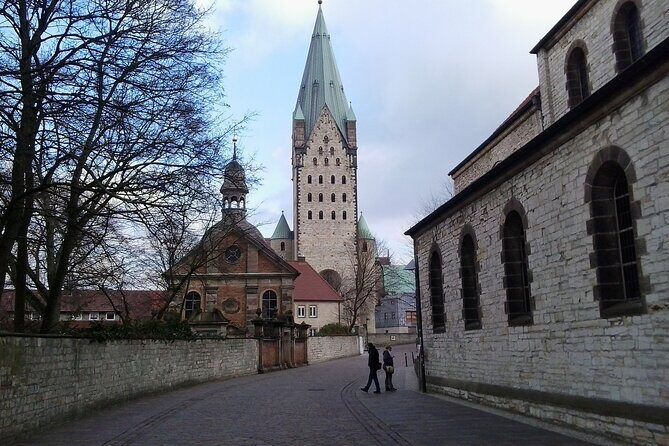
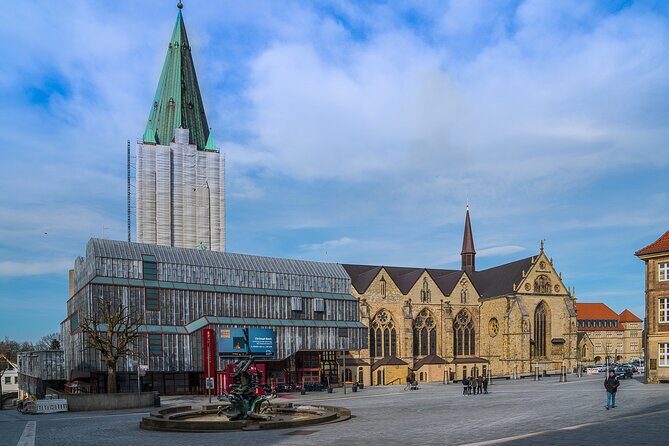
You then arrive at Paderborn Cathedral, one of the most important church buildings in Germany from an art-historical point of view. It’s the archiepiscopal church of Paderborn and is dedicated to three saints:
- Mary
- Saint Kilian
- Saint Liborius of Le Mans as the principal patron
This matters because it gives you a framework for what to pay attention to. Instead of wandering, you can look for how the space reflects those dedications. The stop feels less like a checkbox and more like a themed visit.
Marktkerk: when Jesuits and a university church shaped the town
Next is Marktkerk, a Roman Catholic church building in the center of town. Its key backstory is that it was originally a Jesuit and university church of the first University of Westphalia, dedicated to Saint Francis Xavier.
That “university church” detail is the kind of thing you might not guess just from looking at the building. It’s a reminder that religious institutions often doubled as education hubs, at least in the early days of universities.
If you like learning through place names and dedications, this is one of the stops that rewards your attention most.
A quick note on language
You may see the same church listed in English and Dutch forms (Marktkerk / De Marktkerk). In practice, it’s the same stop on your walk, so don’t overthink it if the wording shifts on your phone screen.
Market square art and architecture: Neptune Fountain, von Spee, and the town hall
Now you move into the civic heart of Paderborn: fountains, statues, and a town hall that shows off a specific architectural style.
Neptune Fountain in the market square (Josef Rikus, 1977–1979)
In the middle of the market square is the Neptune Fountain, created by Paderborn artist Josef Rikus between 1977 and 1979. The nice part about this stop is that it’s modern enough to feel familiar, but still tied to the historic center.
It’s also a natural “pause point.” Market squares are where people decompress, and this one gives you an easy reason to stop without feeling like you’re abandoning the route.
Friedrich von Spee statue: a bronze reader
Next is a bronze statue of Friedrich von Spee reading a book. It’s not a church or museum stop; it’s an open-air reminder that the town honors scholarship and ideas in a very literal way.
If you’ve got a habit of photographing street art and monuments, this is one you’ll likely enjoy because it’s human and focused.
Paderborn town hall with three gables and Weser Renaissance style
You finish this core cluster at Paderborn town hall, known for its three gables and identified as a prime example of Weser Renaissance architecture. The upper floor with its many windows is a particularly typical detail.
This is where you’ll feel the difference between “historic-looking” and “historic with a style label.” When an architecture style is part of the description, you can spot patterns instead of just saying, nice building.
Following the Pader headwaters plus a shopping street break

The final stretches balance “old” and “everyday.”
The city’s Pader headwaters: follow the path along the small river
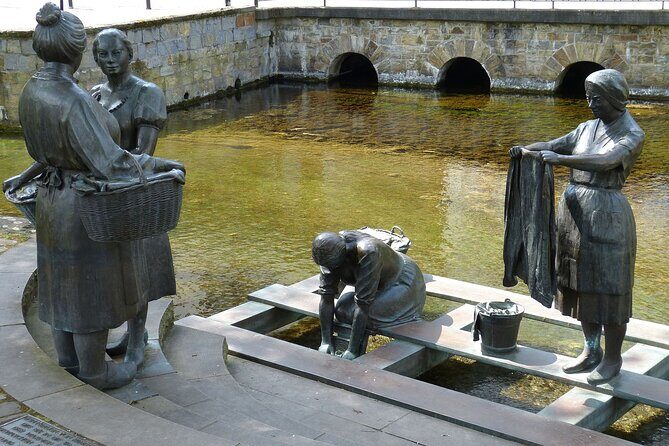
The city is described as built in the headwaters of the Pader, and the walk asks you to follow this path along the small river. This is a practical ending because rivers naturally guide your sense of direction and pace.
It also gives your legs a softer landing after the denser church-and-square area. If you’re tempted to speed-run everything, this final segment is the section where you’ll feel your mistake fastest.
A modern shopping street with the city’s newest energy
After the river path, you also get a nice modern shopping street with the nicest, hippest shops in the city. That’s your chance to turn the walk into a bigger outing: pop into a store, pick up a snack, or just watch city life move at a normal speed.
If you prefer quiet sightseeing over shopping, you can still use it as a decompression zone. If you like browsing, this is where you can turn your walk into something slightly more personal.
Tips to make the phone game and navigation behave
Because this is a phone-based experience, small choices matter.
- Use your phone brightness at a readable level before you start. You’ll be checking prompts as you move.
- If you get stuck, use Google Maps alongside the game. Some routes can be confusing at street level.
- Bring a portable charger if your battery is weak. A 2 to 4 hour walk is enough to drain phones with heavy GPS use.
- Since it’s English, stick to the language setting you’re given. If your phone auto-switches languages, double-check before you begin.
Also, pace it like you’re exploring with friends, not like you’re on a checklist run. The value here comes from noticing details you’d otherwise pass by.
Who this e-scavenger hunt is best for
This experience fits best if you want structure without a live guide. It’s great for:
- Couples or small groups who enjoy walking and light puzzle-solving on a phone
- People who like religious architecture but don’t want a lecture
- Travelers who want to control timing so they can spend longer where they care most
If you need a fully guided, turn-by-turn narration with deep explanations, you might find this style too independent. But if you’re happy to explore and let the route prompt you, it’s a strong match.
Should you book this Paderborn e-hunt?
I’d book it if you want a flexible 2 to 4 hour walk through Paderborn’s center that mixes churches, a half-timbered house with a clear carved story, major market-square landmarks, and an ending along the Pader. The group price is also unusually friendly for shared travel, especially up to 6 people.
Skip it if you dislike phone-based navigation or you know you’ll struggle without step-by-step human guidance. Otherwise, this is a smart way to see a lot of Paderborn without feeling trapped on someone else’s schedule.
FAQ
How long does the e-scavenger hunt in Paderborn take?
It’s listed as about 2 to 4 hours.
What’s the price for this experience?
It costs $36.69 per group, up to 6 people.
What language is it offered in?
The experience is offered in English.
Do I get a mobile ticket?
Yes, it includes a mobile ticket.
Is smartphone use included?
No. Use of a smartphone and data is not included, so you’ll need your own phone and mobile data.
Where do I start, and where does it end?
You start at Parkplatz Liboriberg, Liboriberg 1004, 33098 Paderborn, Germany, and the activity ends back at the same meeting point.
Is it a private activity?
Yes. It’s private, and only your group participates.
What are the hours available?
It’s listed as open daily from 12:00 AM to 11:59 PM.
Can I cancel for a full refund?
Yes, you can cancel up to 24 hours in advance for a full refund. If you cancel less than 24 hours before the start time, no refund is offered.