REVIEW · COLOGNE
e-Scavenger hunt Aachen: Explore the city at your own pace
Book on Viator →Operated by Qula · Bookable on Viator
Aachen gets fun when you chase clues. This e-Scavenger hunt turns the old center into a smartphone-led city game while still hitting top sights like Aachen Cathedral. I like the easy mobile ticket setup and the way it blends a walking tour with short interactive challenges; one possible drawback is that if your phone struggles with the game’s videos, the pace can feel slower.
You control the timing. There’s no fixed schedule, and the game window runs all day, so you can start whenever your feet and plans allow. It’s offered in English, runs about 2 to 4 hours, and it’s private for your group (up to 6), starting and ending at Friedrich-Wilhelm-Platz.
In This Review
- Key things to know before you play
- How the e-Scavenger hunt works on your phone
- Price and time: what $37.33 per group really buys you
- Starting at Friedrich-Wilhelm-Platz and walking the old center loop
- Stop by Aachen Cathedral: Charlemagne’s architectural statement
- The market and town hall: Carolingian-era hints in plain sight
- Doll fountain and Elisenbrunnen: spa culture in the city center
- Ponttor and the outer walls: reading Aachen’s medieval defenses
- Klenkes and Saint Nicholas Church: local identity plus deep roots
- Granusturm and Katschhof square: the “Aachen twins” viewpoint
- Regenschirmdamen sculpture and Grashaus: art and civic self-confidence
- Archaeological finds on 60 m²: when the ground tells stories
- Practical tips so your hunt goes smoothly
- Should you book the e-Scavenger hunt in Aachen?
- FAQ
- How much does the e-Scavenger hunt Aachen cost?
- How long does the experience take?
- What language is it offered in?
- Where do we start and end the hunt?
- Can we start the game at any time?
- Do I need a smartphone?
- Is this a private experience and is it accessible?
Key things to know before you play
- Start anytime in Aachen’s center: no rigid tour schedule, just a self-paced route.
- Smartphone access with a mobile ticket: the city game lives on your phone.
- A walk that feels like sightseeing, not homework: major landmarks show up naturally.
- A mix of big sights and smaller details: from the Dom to fountains and sculptures.
- Built around major Aachen themes: Charlemagne, spa culture, medieval walls.
- Private group format: better for families, friends, and small travel pods.
How the e-Scavenger hunt works on your phone
Think of this as a choose-your-pace stroll where clues guide you between Aachen highlights. You’ll use an online app on your phone, with a mobile ticket that gets you into the game. The experience is designed to work as both a city game and a walking tour, so you’re not just reading plaques—you’re actively moving from one point to the next.
Practically, you’ll want to plan like you’re doing a low-stress walk in the old center. Bring a charged phone (and a backup battery if you have one), because the activity doesn’t include phone use costs or data. Also, if you’re relying on video or sound for parts of the game, it’s worth checking that your settings and connection are ready before you start. One review note specifically flagged trouble with playing the videos, so this is a real-life “watch your tech” consideration.
The good part: since there’s no set start time, you can sync it to your day. If you want to do it after lunch, after coffee, or right at golden hour, you can.
You can also read our reviews of more city tours in Cologne



Price and time: what $37.33 per group really buys you
The price is $37.33 per group, up to 6 people. That’s the key value here: when you fill the group size, you’re paying roughly $6 to $7 per person—often cheaper than a typical guided tour per head.
Duration is listed as 2 to 4 hours (approx.). That range matters because you’re not locked into a strict itinerary timetable. If you move quickly between stops, you can stay closer to the 2-hour end. If you pause longer at the Cathedral area, town hall sights, and square viewpoints, you’ll likely drift toward the 3–4 hour side. Either way, you’re buying flexibility.
And you’re not stuck with just one landmark. The route spans Cathedral, market and civic buildings, spa culture, medieval walls, churches, towers, sculptures, and even archaeological finds. For $37.33, you’re paying for a guided-feeling experience without the guided-tour pressure.
Starting at Friedrich-Wilhelm-Platz and walking the old center loop
Your start point is Friedrich-Wilhelm-Platz in Aachen, and the activity ends back there. That loop format is convenient. You can park your day’s logistics around that area—then return when you’re ready for coffee, dinner, or a transit connection.
You’ll also notice the route keeps you in the historic core rather than sending you far out. That’s helpful if you’re short on time, traveling with mixed ages, or just don’t want to spend half your trip on transit.
The activity is also described as near public transportation, which makes it easier to pair with other plans. And since it’s private for your group only, you won’t have to manage a large crowd. That tends to make clue-based walking more comfortable—especially if you’re chatting, taking photos, or moving at a slower pace.
Stop by Aachen Cathedral: Charlemagne’s architectural statement
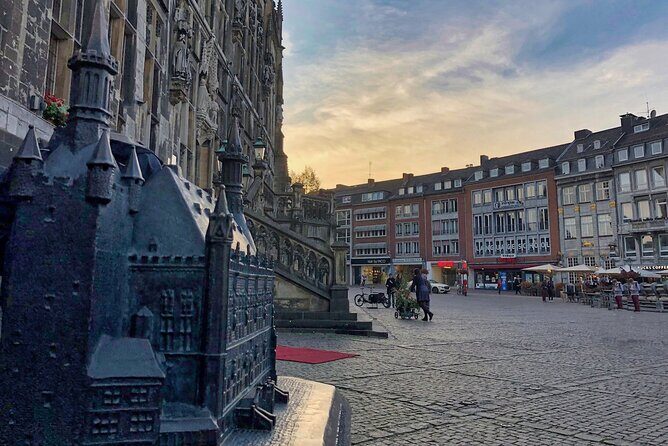
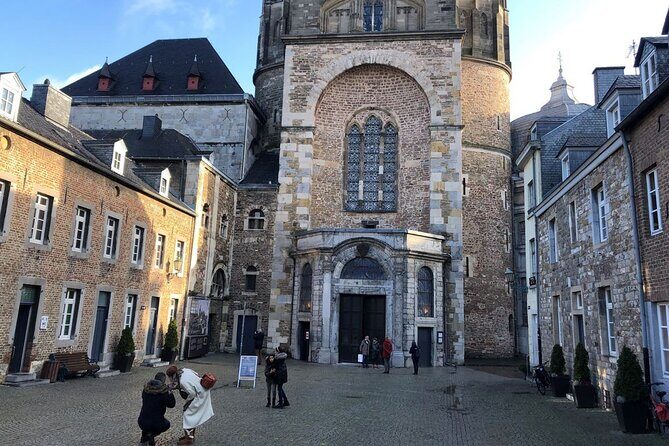
Aachen Cathedral is the anchor of the experience. It’s highlighted as one of Aachen’s main attractions, with its roots tied to Emperor Charlemagne. The Cathedral was completed at the end of the 8th century at his request, which gives you instant context for why this building feels so central—architecturally and historically.
When you arrive, don’t rush past it. The value of this stop isn’t only that it’s famous; it’s that it helps you understand Aachen’s identity. Charlemagne’s link is more than a name-drop. It explains why later civic buildings and public squares sit in a gravity field around this kind of power.
Potential drawback: the Cathedral area can feel like a lot at once—big landmark, crowds, and the start of your clue flow. If you’re sensitive to busy spaces, plan to take a breath at the edge of the main views before you jump into the game steps.
The market and town hall: Carolingian-era hints in plain sight
From the Cathedral zone, you’ll reach the market in Aachen, described as the central point of the city. This is where the game naturally shifts from imperial scale to civic life—where people gathered, traded, and made the city feel like a living organism.
The standout here is the town hall on the market. Portions are from the Carolingian period, which is a nice detail because it connects the Cathedral era to everyday public space. In other words, Aachen isn’t just grand buildings from one ruler; it’s layers of eras sitting next to each other.
One of my favorite ways to experience markets is to treat them like open-air museums. Even if you don’t shop, you’re reading the city’s shape. Use this stop to orient yourself: look for sight lines between the market, the Cathedral area, and nearby structures. That makes the rest of your clue walk feel more logical.





Doll fountain and Elisenbrunnen: spa culture in the city center
Aachen has a spa reputation, and the game points you straight to the evidence. First you’ll come to a beautiful fountain, including mention of the doll fountain near the Dom. This is one of those charming details that makes a self-paced hunt feel personal—little landmarks that you’d otherwise miss.
Then you’ll move to the Elisenbrunnen, described as the symbol of Aachen as a spa and bathing city. Here, hot springs rise to the earth’s surface in the middle of the city center. The details get even better: it’s noted that not only Charlemagne, but also the ancient Romans already appreciated these sources.
That combination—imperial era plus Roman continuity—helps you understand why Aachen felt important long before modern tourism. This is a good stop to slow down, because the setting is urban but the story is ancient.
Practical tip: since you’ll be walking in a core area, wear shoes you can trust. You’ll likely move between sights more than you expect for a 2–4 hour experience.
Ponttor and the outer walls: reading Aachen’s medieval defenses
Not every city game stops at a city gate, but yours does. The route includes the Ponttor, also known as Brückenpforte or Brückenthor in earlier centuries. It’s a city gate built in the 14th century, part of Aachen’s outer city walls.
What I like about this stop is how it adds depth. After seeing imperial and civic buildings, a defensive structure gives you a different lens. You start asking: how did people move in and out? Where were the chokepoints? Which roads mattered?
Even if you only catch the gate from certain angles, it’s enough to shift your brain from sightseeing mode to city-planning mode. That’s the big win of clue walks: they nudge you into noticing more than you would on a casual stroll.
Klenkes and Saint Nicholas Church: local identity plus deep roots
Two stops add personality and time depth.
The Klenkes is described as a typical greeting of Aachen’s inhabitants and also a landmark recognized worldwide by residents. This is a fun cultural insert, because it’s not just architecture—it’s identity. If you like learning small local words or phrases tied to place, this is exactly the kind of detail that turns a walk into an actual understanding of the city.
Then comes Saint Nicholas Church, described as a former Franciscan monastery church. Its history goes back to 1005. That’s far enough back to make the city timeline feel real, not theoretical.
One consideration: church areas can involve quiet zones or changing conditions depending on when you’re there. The game is running all day, but the space itself might still have its own rhythm. Keep your phone use respectful and ready to pause if signs or rules ask you to.
Granusturm and Katschhof square: the “Aachen twins” viewpoint
The clue route also touches the Granusturm, described as a monumental tower. It originally belonged to the Aachen royal palace and is part of the town hall. That’s a powerful detail for a single building: palace → royal power → integrated civic structure.
After that, the experience brings you to Katschhof square, framed by striking contrasts. The Catedral stands on one side and the town hall on the other, both towering over the square. The square is also noted as a place brought to life by numerous events.
If you want one mental snapshot of Aachen, this is it. This is where you feel the city’s defining tension: sacred and civic power side by side, in a shared public space.
Because the game includes the square as a landmark, you’ll likely be looking up, turning slowly, and checking angles for clue steps. That makes it a great place for photos, but also for just standing still and letting the geometry sink in.
Regenschirmdamen sculpture and Grashaus: art and civic self-confidence
Aachen isn’t only big buildings and stones. Your route includes a bronze sculpture called Regenschirmdamen, also referred to as Weather of Aachen. That adds a human, slightly playful streak to the walk. Even if you don’t know the artist or the story, the presence of public art helps break up the heavier historical stops.
Then you’ll reach the Grashaus, described as built around 1260 and noted as Aachen’s first town hall. The description also points to it as an open symbol of citizens’ self-consciousness. That’s a strong concept for a tour stop. It reminds you that city government was not just bureaucracy—it was a public statement.
To get more from these stops, do this: after you spot the building, take a second to imagine the square as a working civic space. Markets, announcements, meetings. The clue walk format helps, because you’re moving through locations that would have shaped daily life.
Archaeological finds on 60 m²: when the ground tells stories
One of the more interesting elements on your route is the chance to see archaeological finds from Aachen on 60 m². Finds can range from the Neolithic to the late Middle Ages.
This is valuable because it shifts the story from buildings to what’s underneath the city. Even without deep technical explanation (since none is provided here), the concept helps you think: people have been living, trading, and leaving traces here for a very long time. That makes the Cathedral and medieval civic buildings feel less like isolated monuments and more like chapters in an ongoing city.
If you’re short on time, you can spend less time with this stop and still keep the overall flow. But if you enjoy layers—old, older, oldest—this is the one to slow down for.
Practical tips so your hunt goes smoothly
This is a smartphone-driven experience, so a little prep goes a long way.
- Bring a charged phone and consider a power bank. You’re using your device for the app and mobile ticket.
- Expect you’ll need data because smartphone and data aren’t included.
- Wear walking shoes. The experience is designed as a walk-through city highlights.
- Plan for tech hiccups. One review specifically mentioned trouble playing videos, so test audio/video settings early if you can.
- Use the flexible timing. Start when you have the energy to follow clues.
- Know it’s private. It’s for your group only (up to 6), so there’s no blending into a larger crowd.
On accessibility: the activity allows service animals and is described as user-friendly for the hearing impaired. If you’re traveling with accessibility needs, this is a promising sign—especially for a city-center route.
Should you book the e-Scavenger hunt in Aachen?
I’d book it if you like city exploring that feels structured without feeling rigid. It’s a good match for travelers who want a highlights route—Cathedral, market/town hall, spa culture, medieval walls—while keeping control of pacing and timing. The value is strong because it’s priced per group up to 6.
Skip it (or go in with eyes open) if your phone can’t handle app content well, or if you hate clue-based walking. The experience depends on your device and may include video elements, which can be a weak point if tech is slow or connectivity is spotty.
If you want Aachen in a smarter, more active way than a normal self-guided stroll, this is a solid choice.
FAQ
How much does the e-Scavenger hunt Aachen cost?
It costs $37.33 per group, up to 6 people.
How long does the experience take?
Plan for about 2 to 4 hours, depending on how long you spend at each stop.
What language is it offered in?
The game is offered in English.
Where do we start and end the hunt?
You start at Friedrich-Wilhelm-Platz, 52062 Aachen, Germany, and it ends back at the same meeting point.
Can we start the game at any time?
Yes. There’s no fixed schedule, and the listed opening hours run daily from 12:00 AM to 11:59 PM.
Do I need a smartphone?
Yes. The activity uses an online app on your phone, and smartphone use/data are not included.
Is this a private experience and is it accessible?
Yes, it’s private for only your group. Service animals are allowed, and it’s described as user-friendly for the hearing impaired.