REVIEW · DRESDEN
Dresden Small Group Walking Tour
Book on Viator →Operated by Walkative! TOUR · Bookable on Viator
Dresden reads like a story on foot. This 2h15 small-group walk connects the city’s Protestant roots, Baroque masterpieces, and the scars of WW2 without making you buy museum tickets at every corner. I love the tightly organized route (only a few minutes between major sights), and I really like the way the guide ties buildings to real events. One thing to weigh: this is tied to a pay-what-you-wish style setup, so you may feel extra pressure around tipping if you prefer strict, fixed pricing.
Expect an easy, street-level pace with a maximum group size of 35 and an English-speaking guide. You get a mobile ticket, the tour runs in all weather, and you should have moderate mobility (it’s a walking tour, not a ride-and-drop). Since the route ends near the Zwinger, it’s a great spine for the rest of your day in Dresden—just plan on skipping paid entry tickets during the walk.
In This Review
- Key highlights you’ll feel right away
- Starting at the Martin Luther Statue: your quick orientation in Dresden
- Frauenkirche and Neumarkt: watching Dresden rebuild in plain sight
- Fürstenzug and Dresden Castle: Saxony’s power told through art and architecture
- Altmarkt to Brühlsche Terrasse: markets, the Elbe, and the city’s best vantage lines
- Katholische Hofkirche (Hofkirche) and Semperoper: when Baroque turns theatrical
- The Zwinger: why the final stretch works so well
- Price and value: is $35.89 a good deal for what you get?
- What the guide actually does that makes the walk better
- Who should book this Dresden walking tour?
- Quick practical tips before you go
- Should you book this Dresden small group walking tour?
- FAQ
- How long is the Dresden Small Group Walking Tour?
- What does the tour cost, and what’s included?
- Where does the tour start and end?
- Is the tour in English?
- Will we enter paid attractions during the tour?
- How big is the group?
- What’s the cancellation window?
Key highlights you’ll feel right away
- A focused route that hits major Dresden icons in about two hours
- No paid attractions entered, so you stay on the street and keep momentum
- Baroque meets Reformation, explained with clear context
- WW2 and rebuilding themes handled with care and specificity
- Easy meeting and guide visibility, with some guides using a yellow umbrella for spotting
- Small-group feel with a cap of 35 people
Starting at the Martin Luther Statue: your quick orientation in Dresden
The tour begins at the Martin Luther Statue near Neumarkt (11:00 am). Even before you move far, you get a useful “frame” for the whole walk: Dresden’s identity isn’t only about art and palaces—it also ties into the Protestant Reformation and how religion reshaped power in German-speaking Europe.
From a practical standpoint, I like this start because it’s public, obvious, and central. You don’t need to hunt for a meet-up point in a side street. And if you’ve ever arrived early to a walking tour and stared at a crowd feeling invisible, you’ll be glad some guides have used a bright yellow umbrella to make identification easy at the start.
Your guide will set expectations fast: you’ll be seeing exteriors and major landmarks, with history woven in as you walk. The route is designed so you’re not stuck in one place too long, which matters when you’re learning a lot in a short time.
You can also read our reviews of more walking tours in Dresden
Frauenkirche and Neumarkt: watching Dresden rebuild in plain sight
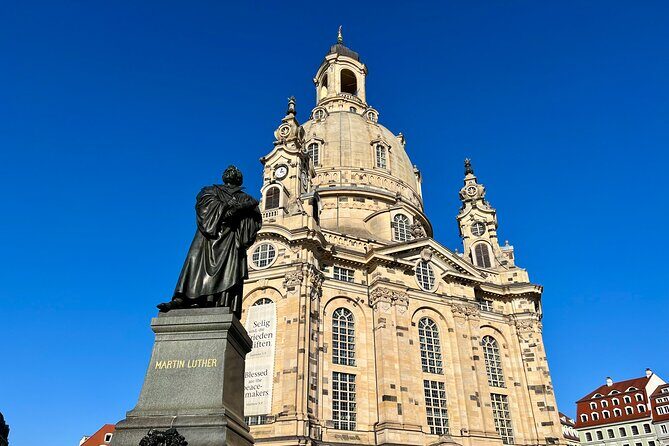
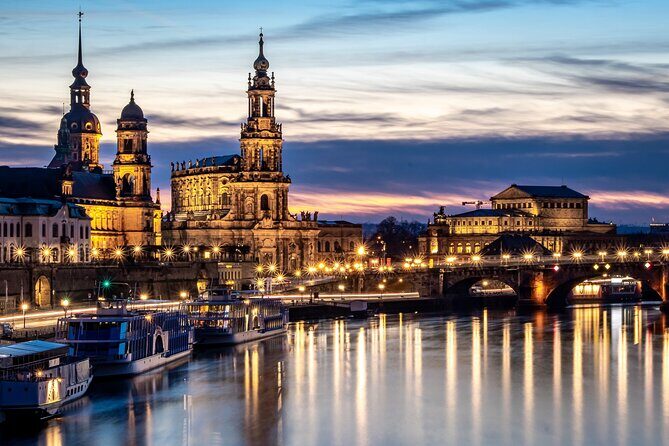
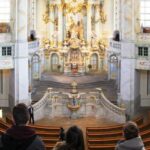
Next comes the Frauenkirche Dresden area, a top stop for anyone who wants to understand modern Dresden. This is a Baroque church with the kind of dome that visually anchors the city. What makes it more than just a beautiful building is its post-WW2 story: it was destroyed, then rebuilt—now functioning as a symbol of reconciliation and resilience.
Right after that, you’ll shift to Neumarkt, a historic square that also carries the scars and the return of Dresden. After heavy wartime damage, the area was reconstructed with restored buildings, and today it works as a lively meeting point for shopping and cafés.
What I like about this sequence is how it teaches you to read the city. You’re not just looking at “pretty stuff.” You’re learning how the city chose to rebuild—what it restored faithfully, and what it shaped back into an everyday urban space.
Small drawback: if you’re the type who hates emotional or heavy historical topics, this portion may feel intense because the guide often addresses WWII and rebuilding as core context. The pacing stays respectful, but it’s still real history.
Fürstenzug and Dresden Castle: Saxony’s power told through art and architecture
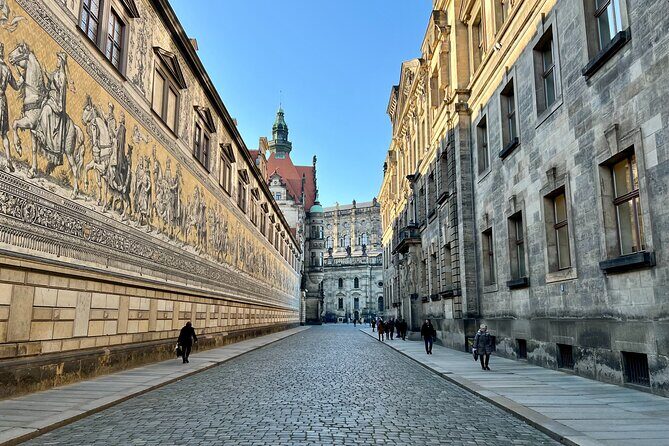
Then you get the Fürstenzug, the huge porcelain mural that depicts a procession of rulers from the House of Wettin. It stretches more than 100 meters, which means you’ll be able to take in the scale quickly, then let the guide break down what you’re seeing—why it was made, what it communicates, and how ruling families used public art to project authority.
I love stops like this because a mural like Fürstenzug is visual learning. Even if you only remember a few details, you’ll remember the feeling: Dresden wasn’t just a backdrop; it was a stage for political storytelling.
After that, the walk moves toward Dresden Castle (the Royal Palace). This is where the city’s “royal” side comes in. You’ll see the imposing façade and hear how the palace served as the residence of Electors and Kings of Saxony for centuries. Even from outside, the size and design signal status—this isn’t a place built for ordinary life.
What you’ll learn here is the link between power and place. Dresden’s architecture wasn’t random. It was deliberate messaging—religious, political, and cultural—built into stone and ornament.
Altmarkt to Brühlsche Terrasse: markets, the Elbe, and the city’s best vantage lines
As you continue, you reach Old Market Square, or Altmarkt—one of Dresden’s older squares. It’s the kind of place that helps you understand daily Dresden, because it isn’t only about monuments. It’s also about how people actually move, meet, and shop around history.
This is a good stop to reset your brain. After heavier context and palace symbolism, Altmarkt gives you a feel for the city as a working urban center.
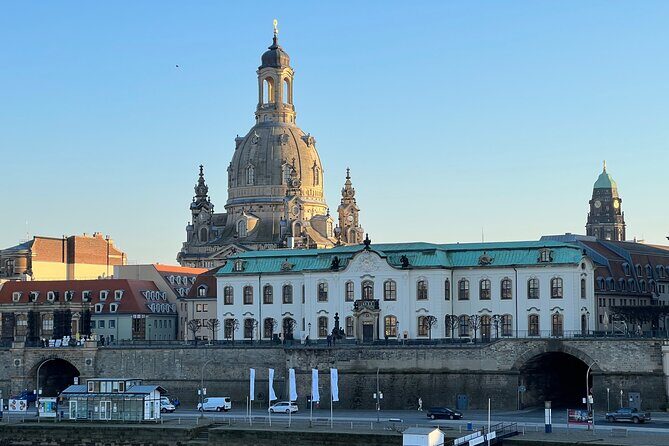
Then the tour heads to Brühlsche Terrasse, often called the Balcony of Europe. This is your view break: panoramic looks over the Elbe River and Dresden’s skyline. The guide typically points out what you can notice from there—how the riverfront area connects to the city’s layout and why this promenade became a classic spot.
I’d strongly suggest you take a few minutes here to just look. Even a short stop can help you “map” Dresden in your head. Once you can place the river, you’ll find it easier to understand how the earlier stops fit into the larger picture.
Katholische Hofkirche (Hofkirche) and Semperoper: when Baroque turns theatrical
From there, the route reaches Katholische Hofkirche, also known as the Hofkirche or Dresden Cathedral. This Baroque church is a prominent landmark, with an interior that’s famous for details like the Silbermann organ. Even without entering paid attractions during this tour, the exterior and the skyline presence give you something meaningful: a sense of scale and showmanship.
The guide’s job here is to make you see beyond the façade. If you’re learning Dresden for the first time, this is a moment that can click your understanding of why the city’s religious buildings are so dramatic. They weren’t built to be quiet. They were built to impress.
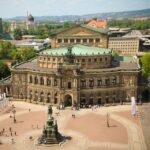
Finally, you’ll get the Semper Opera House (Semperoper). It’s another major “architectural statement” in Dresden—named after Gottfried Semper—and it continues to be known worldwide for opera performances and elegant design.
What I like about finishing this segment with the opera house is contrast. You go from church grandeur to cultural performance grandeur. Together, they show how Dresden invested in both faith and the arts.
In some past tours, guides described these places with a mix of humor and serious context, which helps a lot when you’re walking past the same kind of monumental architecture all day. You’ll come away remembering the story, not only the shapes.




The Zwinger: why the final stretch works so well
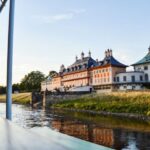
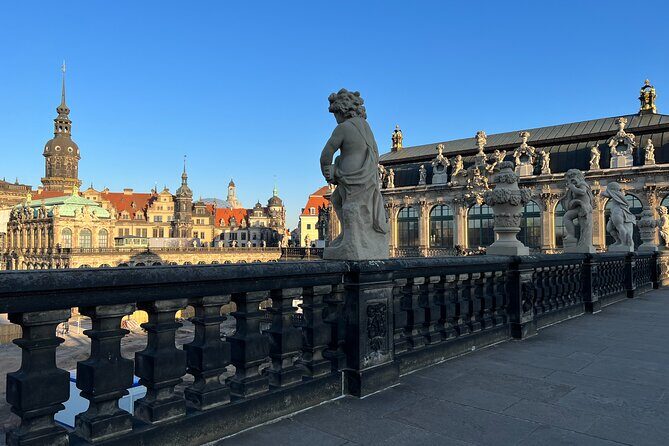
The tour ends near the Dresden Zwinger (Sophienstraße, 01067 Dresden). The Zwinger Palace is a Baroque masterpiece known for its impressive gardens and art and historical collections. On this tour, you won’t be entering paid attractions, so think of the stop as a powerful overview—an exteriors-and-setting kind of finish.
This ending makes practical sense. The Zwinger area is a natural anchor for continuing your day. Once the tour drops you nearby, you’re positioned to decide what you want next: linger around the gardens, walk the surrounding palace complex areas, or build a museum plan later depending on your interests.
And because the tour timing is about 2 hours 15 minutes, you’re not stuck being “toured” until late afternoon. You still have energy to explore on your own afterward.
Price and value: is $35.89 a good deal for what you get?
At $35.89 per person for about 2h15, the value is mostly about the guide and the organization. This tour includes a local expert guide and a well-built narrative, and it stays street-level without paid attraction entry. That can be a money-saver if you’d rather spend on one bigger museum later than pay small fees repeatedly.
Now, here’s the detail worth putting on your radar: the tour is noted as joining a general pay-what-you-wish style setup. The amount you pay covers a reservation fee and the guide’s payment, and the guide may still expect that you reward them at the end. If you’re comfortable with that, it’s fine. If you dislike the feeling of being nudged, you might find the pay-what-you-wish framing slightly awkward—especially since some people feel they paid what should have been lower if the experience is partly “free-style.”
So I’d treat this tour like a guided introduction where your ticket covers the booked place and the guiding work, and your tipping is a moral choice, not a surprise expense.
What the guide actually does that makes the walk better
One of the most praised parts of this experience is the guide’s delivery. Across the guides’ styles, the pattern is clear: you get history that’s placed next to what you’re seeing.
You may meet guides with names like Nicola, Nicolas, Nicholas, Nicolo, Dominique, or James. The specific guide changes the vibe, but the common strengths show up repeatedly:
- Clear, organized context rather than random facts
- Attention to architecture and why it looks the way it does
- Thoughtful handling of sensitive WWII material
Some guides also keep things light with humor, which helps when you’re standing in the same part of town taking in multiple monuments. And a more visual start (like a yellow umbrella) can seriously reduce stress if you’re meeting 10 minutes before start and everyone looks the same.
Who should book this Dresden walking tour?
This one fits best if you want:
- A high-impact overview of Dresden’s main sights without buying multiple entry tickets
- A guide to connect Reformation themes, Baroque landmarks, and WWII rebuilding into one understandable story
- A manageable walking pace with a moderate fitness level
- An English tour in a small group (up to 35)
It’s not ideal if you want deep museum time inside lots of paid sites. The walk is designed to keep you outside and moving, not to turn into a ticketed attractions day.
If you’re visiting Dresden for the first time and want to set your mental map fast, this is a strong first-choice tour. If you already know the basics and want a slow, in-depth gallery-by-gallery day, you might want something more focused and ticket-heavy.
Quick practical tips before you go
- Wear shoes you can stand in—this is a walking tour with multiple major stops.
- Dress for weather: it runs in all conditions.
- Bring a phone for the mobile ticket and to navigate if you get separated at the start.
- If you’re sensitive to politics or you prefer strictly historical framing, pay attention to your guide’s tone; the topic range can go beyond art history depending on the day and the guide’s style.
Should you book this Dresden small group walking tour?
I’d book it if you want a guided “spine” through central Dresden with major landmarks, clear context, and a pace that leaves you time afterward. The price is reasonable for a guided narrative and for a route that doesn’t force you into repeated ticket lines during the walk.
I’d think twice only if the pay-what-you-wish framing (and the end-of-tour tipping expectation) makes you uncomfortable. If that’s you, look at your own style: some people love the flexibility, while others prefer a straight fixed-price tour with no extra emotional freight.
If your goal is to get your bearings quickly, understand why Frauenkirche and the rebuilt city matter, and connect Saxony’s royal story to what you can actually see, this tour does the job—cleanly, in a short window, and in English.
FAQ
How long is the Dresden Small Group Walking Tour?
The tour is listed at about 2 hours 15 minutes.
What does the tour cost, and what’s included?
It costs $35.89 per person and includes a local expert guide and a thoroughly constructed narrative. Food and drinks are not included.
Where does the tour start and end?
It starts at the Martin Luther Statue area near Neumarkt, 01067 Dresden, Germany, and ends near the Zwinger on Sophienstraße, 01067 Dresden, Germany.
Is the tour in English?
Yes, it’s offered in English.
Will we enter paid attractions during the tour?
No. During the tour, the group will not enter any paid attractions.
How big is the group?
The tour has a maximum of 35 travelers.
What’s the cancellation window?
You can cancel for a full refund if you cancel at least 24 hours before the experience’s start time. If you cancel less than 24 hours before, the amount you paid won’t be refunded.